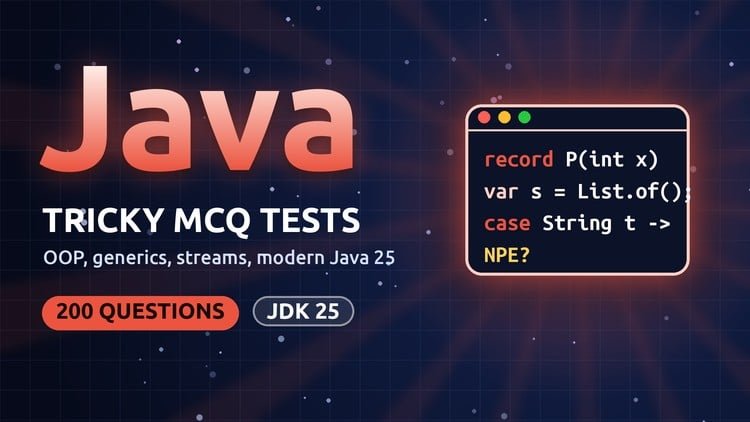
200 tricky Java questions on OOP, generics, streams, exceptions and modern Java, each verified with JDK 25
What You Will Learn:
- Predict the result of tricky expressions involving numeric promotion, overflow, strings and boxing.
- Trace object creation, initialization order, overriding, hiding and overload resolution.
- Model data with records, enums, sealed types and interfaces, and use generics and collections without surprises.
- Predict control flow through try, catch, finally and try-with-resources, including suppressed exceptions.
- Write correct stream pipelines with lambdas, collectors and Optional.
- Use Java 21 to 25 features and reason about threads, virtual threads and the memory model.
Java Programming Mastery: Tricky MCQ Practice Tests – An Experienced Developer’s Take
So, you’re looking to level up your Java game, specifically targeting those little nuances that can trip you up in an interview or, worse, in production code. I recently dove into the ‘Java Programming Mastery: Tricky MCQ Practice Tests’ course, and let me tell you, it’s not for the faint of heart. This isn’t your typical “hello world” tutorial; it’s a deep dive designed to expose those under-the-hood behaviors of Java that even seasoned developers can overlook.
Overview
Forget the straightforward syntax drills. This course throws you into the deep end of Java’s complexities, focusing on the kind of questions that often appear in certification prep or are used by hiring managers to separate the pretenders from the contenders. The emphasis is on predicting the *exact* output of meticulously crafted code snippets. We’re talking about scenarios involving the subtle interplay of numeric promotion, the perils of integer overflow, the often-misunderstood string immutability, and the boxing/unboxing dance. They’ve also included a significant chunk on modern Java features, right up to JDK 25, which is frankly impressive given how quickly things evolve. The coverage of object lifecycle – from creation and initialization order to the intricacies of overriding, hiding, and overload resolution – is particularly sharp. They also tackle the more abstract concepts like records, enums, sealed types, and interfaces, ensuring you can model data effectively without those dreaded “surprise” behaviors from generics and collections.
Prerequisites
This course is absolutely NOT for beginners. You should have a solid grasp of core Java programming concepts, including:
- Basic syntax and data types
- Object-Oriented Programming principles (inheritance, polymorphism, encapsulation, abstraction)
- Familiarity with common Java collections framework classes
- A foundational understanding of exception handling
If you’re still fumbling with `public static void main(String[] args)`, you’ll want to gain more practical experience with real-world projects and perhaps some hands-on labs before tackling this.
Skills & Tools
The primary skill honed here is your ability to meticulously analyze Java code and predict its behavior under complex conditions. You’ll become more adept at:
- Deconstructing intricate expressions
- Understanding object instantiation and lifecycle
- Navigating the nuances of control flow, especially within try-catch-finally blocks and try-with-resources (including suppressed exceptions!)
- Writing efficient and correct stream pipelines
- Leveraging modern Java features (JDK 21-25) for concurrent programming and memory management
The course implicitly relies on your existing development environment (an IDE like IntelliJ IDEA or Eclipse) and the Java Development Kit (JDK) to verify the answers. No specific new industry-standard tools are introduced, but the knowledge gained will make you a more proficient user of them.
Career Benefits & Job Roles
This course is a goldmine for anyone serious about advancing their Java career. The skills you’ll acquire are directly applicable to roles requiring deep Java expertise, such as:
- Senior Java Developer
- Java Architect
- Performance Engineer
- Backend Developer
Mastering these tricky concepts will significantly boost your confidence during technical interviews, making you a more attractive candidate for high-paying positions. It’s about acquiring those sought-after job-ready skills that employers are willing to pay a premium for. This can be a significant catalyst for career growth.
Pros
- Unparalleled Depth: The questions are genuinely tricky and cover a breadth of advanced Java topics that go far beyond superficial knowledge. This is the kind of material that separates average developers from exceptional ones.
- Modern Java Focus: The inclusion of JDK 21-25 features, especially around virtual threads and the memory model, is incredibly valuable. Staying current with these advancements is crucial for anyone working with modern Java architectures.
- Interview & Certification Ready: If you’re aiming for Oracle certifications or targeting roles with rigorous technical assessments, this course provides targeted practice that directly addresses common challenging questions.
- Builds Critical Thinking: This isn’t about rote memorization; it’s about developing a deep, analytical understanding of how Java *really* works, which is an invaluable skill for debugging and writing robust code.
Cons
- Steep Learning Curve: As mentioned, this is not for beginners. If you’re not already comfortable with advanced Java concepts, you might find the material overwhelming and demotivating rather than enlightening. It requires a significant existing foundation to get the most out of it.
In conclusion, if you’re an intermediate to advanced Java developer looking to solidify your understanding of complex Java behaviors and prepare for challenging technical scenarios, this course is an excellent investment. Just be prepared to put in the mental effort; this is where the real mastery happens.