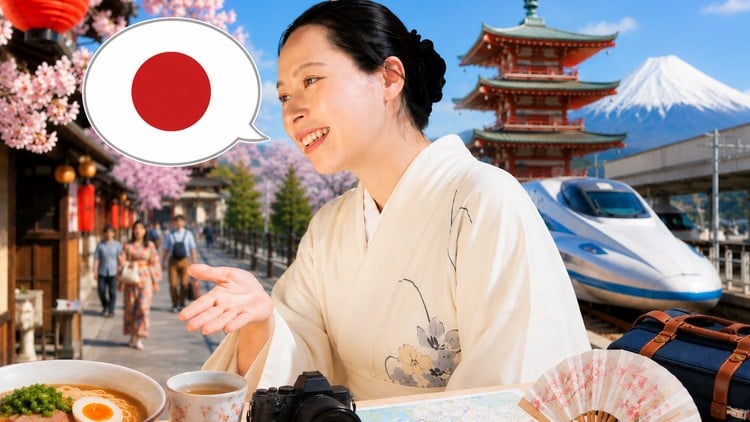
Learn essential Japanese for Japan travel. Ask directions, order food, take photos, and travel with confidence.
What You Will Learn:
- Use essential Japanese phrases to ask for directions and travel around Japan with confidence.
- Take better travel photos by asking people to take your picture naturally in Japanese.
- Order food, ask for recommendations, and customize meals at Japanese restaurants.
- Start conversations with simple Japanese and use AI translation apps when needed.
- Understand Japanese travel etiquette and cultural customs to avoid common mistakes.
- Enjoy Japan more by turning everyday travel situations into memorable experiences.
The Review: Why Every Tech Pro Needs a “Cultural API” Before Landing in Tokyo
Let’s be honest: as tech professionals, we’re used to optimizing everything. We want the most efficient code, the fastest CI/CD pipelines, and the most streamlined workflows. But when I booked my first trip to Japan, I realized my “operating system” for social interaction was completely incompatible with the local environment. I didn’t need a 50-hour deep dive into Kanji; I needed a functional script to navigate the streets of Akihabara and the boardrooms of Minato. That’s where Japanese for Japan Travel: First Phrases for Beginners comes in. Think of this course as the essential “ReadMe” file for your first physical deployment to Japan.
Most language apps feel like a mindless grind, but this course approaches learning like a series of real-world projects. It’s not about rote memorization of obscure grammar that you’ll never use. Instead, it focuses on high-impact, job-ready skills for the traveler—how to interface with locals without sounding like a broken legacy system. Whether you’re a developer attending a tech conference or a PM scouting new hardware partners, the ability to “patch” your cultural gaps is what separates a tourist from a professional. This course takes you from beginner to advanced social awareness in a surprisingly short sprint.
Prerequisites
The barrier to entry here is lower than a Python “Hello World” script. You don’t need any prior knowledge of Japanese alphabets (Hiragana or Katakana), though a basic curiosity about non-Western social structures helps. If you have the patience to sit through a 30-minute stand-up meeting, you have more than enough bandwidth for this. It’s designed for the absolute novice who needs immediate, functional output rather than a long-term certification prep path.
Skills & Tools
What I appreciated most was the focus on industry-standard tools—specifically, how to leverage AI translation apps alongside your own voice. We often think of tech and human language as separate entities, but this course treats them as a dual-stack solution. You’ll learn the “human interface” of essential phrases while using hands-on labs (practice scenarios) to master the etiquette of ordering at a high-end sushi bar or navigating the complex Shinkansen system. You aren’t just learning words; you’re learning the “protocols” of Japanese society—knowing when to bow, how to handle business cards (meishi), and how to ask for help without being a “system hog” in public spaces.
Career Benefits & Job Roles
You might wonder why a travel course belongs in a professional development conversation. In the modern tech landscape, career growth is increasingly tied to global mobility. Being “culturally bilingual” is a massive asset for Solutions Architects, Technical Sales Engineers, and Global Product Managers. If your company is eyeing an expansion into the Asian market, showing that you’ve invested in local etiquette and basic communication can be a significant differentiator during performance reviews. It shows you have the “soft skills” to handle international stakeholders. It’s not just a vacation prep; it’s an investment in your personal brand as a globally-minded professional who can operate in diverse environments without constant supervision.
Pros
- Efficiency-First Curriculum: It cuts the bloat. You won’t waste time on academic theory. It’s all about high-utility phrases that provide immediate ROI from the moment you touch down at Narita.
- Cultural Debugging: The sections on etiquette act like a linter for your behavior, catching common “bugs” (social faux pas) before they happen. This is crucial for maintaining professional dignity in a country that values protocol.
- Practical Tech Integration: I loved the honest take on AI apps. Instead of pretending you’ll be fluent, it teaches you how to use translation tech as a “copilot” to enhance your real-world projects on the ground.
- Networking Ready: The course gives you the “social hooks” needed to start conversations. In the tech world, the best deals often happen over a beer in an Izakaya, not just in a Zoom room.
Cons
- Limited Depth for Long-term Learners: If your goal is a certification prep for the JLPT or you’re looking for a beginner to advanced fluency path, this isn’t it. This is a targeted tactical strike for travelers and short-term professionals, not a four-year linguistics degree. It lacks the “back-end” grammar logic that serious students might crave.