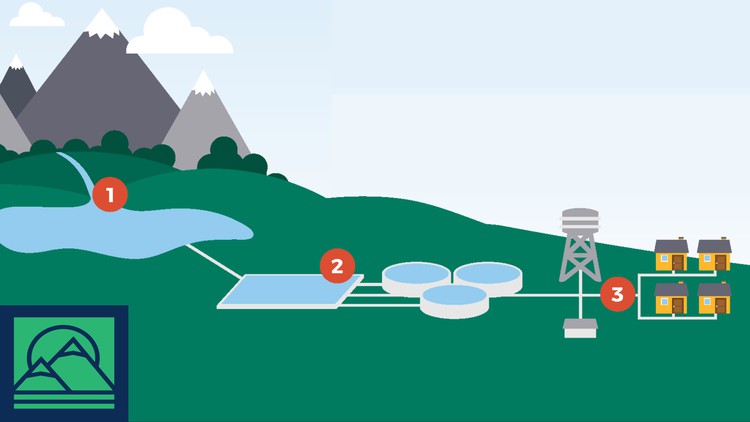
What you need to know about how drinking water gets to your faucet
What you will learn
Dicuss the importance of providing safe water to consumers and the risks of untreated water
Learn water cycles in urban and natural areas
Learn how the process of water treatment works
Learn how to help save water in our homes and act responsibly
Description
You drink water every day and use it for hygiene, gardening, cleaning, and other applications,
But how much do you really know about tap water?
In this course, we will discuss drinking water treatment from many angles according to the following plan :
· First, we will address data about access to safe drinking water around the world,
· After that, we will talk about the importance of providing safe water to consumers and the risks of untreated water,
· Then, we will discuss water cycles in urban and natural areas,
· Next, we will explain how the process of water treatment works,
· And in the following chapter, we will address the challenges related to ensuring access to drinking water around the world,
· Finally, we will see how we can help save water in our homes and act responsibly.
By the end of this course, you will have more knowledge about how raw water is treated and turned into safe drinking water. You will also learn why it is important to ensure safe water in order to avoid the dangerous consequences of unsafe water. You will also become more aware of the challenges that threaten safe water supply around the world and how you can help save water at your home and act responsibly.
Content
Introduction
Access to safe drinking water around the world
Risks of drinking unsafe water
Narutal and urban water cycles
Drinking water treatment process
Challenges of providing safe water
Saving our and acting responsibly
Conclusion
The Invisible Grid: Why This Course Matters More Than You Think
I’ve spent the better part of a decade working in and around industrial tech, and if there is one thing I’ve learned, it’s that we are dangerously disconnected from the systems that keep us alive. We obsess over 5G speeds and cloud latency, but we barely give a second thought to the liquid flowing out of our faucets. I jumped into the Introduction to Drinking Water Supply & Treatment course expecting a dry, academic lecture. What I found instead was a sobering, high-level breakdown of the world’s most critical infrastructure.
Most people think water treatment is just “adding some chlorine and calling it a day.” This course destroys that myth. It treats the water supply as a complex, end-to-end real-world project that requires absolute precision. If a server goes down, you lose data; if a treatment plant fails, people get sick. The course manages to bridge the gap between environmental science and hardcore engineering, making it a surprisingly gripping watch for anyone who values job-ready skills in the utility or environmental sectors. It’s an eye-opener on the sheer scale of the engineering required to keep the “Urban Water Cycle” from collapsing under the weight of human demand.
Prerequisites
You don’t need a PhD in chemistry to get started here, but you shouldn’t come in totally cold either. This is a beginner to advanced trajectory, so it’s accessible, but a few things will help you digest the material faster:
- Basic Science Literacy: Understanding the fundamentals of pH levels and basic chemical reactions will make the filtration sections much easier to follow.
- Systems Thinking: If you’ve worked in IT or logistics, you’ll find the logic of water flow very familiar.
- Curiosity about Infrastructure: You have to actually care about how cities function; otherwise, the detailed breakdown of sedimentation tanks might feel like a slog.
Skills & Tools
The course goes beyond theory and gets into the industry-standard tools and methodologies used by municipal engineers and operators. By the end, you’re not just a passive observer; you’re thinking like a technician. Key takeaways include:
- Water Quality Analysis: Learning the metrics for turbidity, pathogen load, and chemical contaminants.
- Unit Process Management: Mastering the “train” of treatment, from coagulation and flocculation to advanced disinfection techniques.
- Hydraulic Modeling Concepts: Understanding how pressure and flow are maintained across an urban grid.
- Conservation Strategy: Practical frameworks for residential water auditing and demand management.
- Compliance & Safety: Navigating the regulatory landscape that governs safe human consumption.
Career Benefits & Job Roles
Let’s talk career growth. The “silver tsunami” is real—veteran water operators are retiring in droves, and there is a massive demand for fresh talent who actually understand the tech. Taking this course is a solid move for certification prep if you’re looking to enter the field. It’s not just for people who want to wear a hard hat, though. It’s for:
- Environmental Consultants: Who need to understand the lifecycle of water to advise on sustainability.
- Water Treatment Operators: Entry-level folks looking for a foundational boost before taking state exams.
- Urban Planners: Who need to integrate water supply logic into city designs.
- Public Health Officials: Who need to understand the risks of untreated water to manage community safety.
Pros
- No Fluff Delivery: The course gets straight to the point. It treats your time with respect, focusing on high-impact information rather than filler.
- Deep Dive into Mechanics: I loved the hands-on labs style of explanation when it came to the physical treatment stages. Seeing how gravity and chemistry work in tandem was a highlight.
- Career Versatility: The knowledge is universal. Whether you’re in London, New York, or a rural village, the physics of clean water don’t change.
- Actionable Sustainability: It doesn’t just preach about saving water; it gives you the “why” and “how” that makes you actually want to change your habits.
Cons
- Visual Polish: While the content is top-tier, some of the diagrams feel a bit dated. In a field that is increasingly using digital twins and 3D modeling, I would have loved to see some more modern, high-fidelity visualizations of the treatment plants.