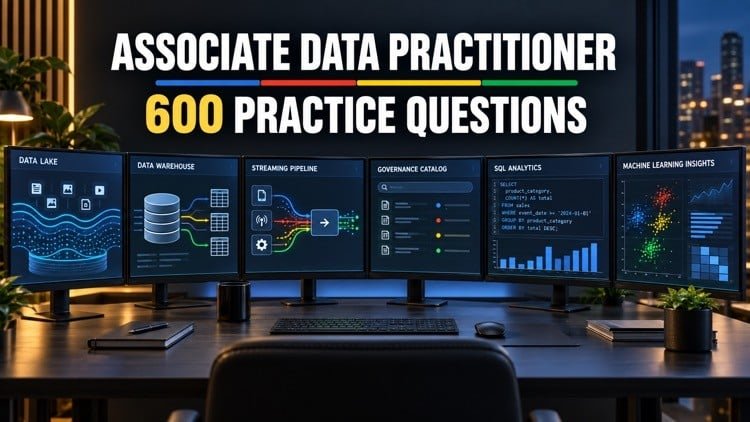
Four timed mock exams on ingestion, storage, processing, SQL analytics, governance, security, quality, and ML
What You Will Learn:
- Assess readiness across the current Google Cloud Associate Data Practitioner exam domains.
- Apply data ingestion, storage, transformation, analysis, governance, security, and machine learning basics to realistic scenarios.
- Explain why the best data service or practice fits each requirement and why plausible alternatives do not.
- Build a focused revision plan from four timed tests, domain feedback, and detailed answer explanations.
Alright, let’s talk about the ‘Google Associate Data Practitioner: 600 Questions’ offering. If you’re eyeing that Google Cloud Associate Data Practitioner certification, you’ve probably scoured a few resources. This one, however, isn’t your typical lecture-based learning path. Think of it less as a course and more as your ultimate training montage before the big fight. It’s a laser-focused, high-intensity workout designed purely for exam readiness. This isn’t about teaching you from scratch; it’s about sharpening your existing knowledge into a razor-sharp edge, ready to tackle Google’s notoriously tricky certification questions.
Overview
Forget the fluffy introductions and theoretical deep dives you might find elsewhere. This package is an unadulterated, no-holds-barred assault of 600 meticulously crafted questions, split into four timed mock exams. What truly sets it apart isn’t just the sheer volume, but the quality and the strategic intent behind each question. This isn’t just rote memorization; it’s designed to make you think like a Google Cloud solution architect, pushing you to understand the “why” behind every service choice. You’ll quickly discover your blind spots, not just in terms of what services do, but in the subtle nuances that differentiate them – which is absolutely critical for real-world application and, of course, passing the exam. It’s the diagnostic tool you need to build a truly effective focused revision plan, turning abstract concepts into concrete, job-ready skills.
Prerequisites
Let’s be brutally honest: this is not for the faint of heart or the absolute beginner to Google Cloud. If you’re just starting your journey with data engineering or cloud platforms, this will feel like being thrown into the deep end without a lifejacket. You need a solid foundational understanding of Google Cloud’s core data services – think BigQuery, Cloud Storage, Pub/Sub, Dataflow, Dataproc, and at least a conceptual grasp of Vertex AI capabilities. Familiarity with SQL is non-negotiable, and a basic understanding of data governance, security principles, and the overall data lifecycle on a cloud platform is expected. This resource is for those who have already completed substantial self-study or formal training and are now looking to transition their knowledge from intermediate to advanced exam readiness.
Skills & Tools
While this isn’t a course with explicit hands-on labs, the skills you hone here are directly applicable to actual real-world projects. You’ll develop a critical eye for scenario-based questions, learning to quickly identify the optimal GCP service for specific data ingestion, storage, transformation, and analysis requirements. You’ll master the art of explaining *why* a particular service is the best fit and, crucially, *why* plausible alternatives fall short. This deepens your understanding of industry-standard tools within the Google Cloud ecosystem, such as BigQuery for analytics, Dataflow for stream/batch processing, Cloud Storage for various data types, and the basics of machine learning operationalization with Vertex AI. Furthermore, you’ll gain crucial exam-taking strategies, including time management and deciphering tricky question structures.
Career Benefits & Job Roles
Passing the Google Associate Data Practitioner certification is a significant milestone for anyone looking to accelerate their career growth in the data domain. This practice set provides the ultimate certification prep, validating your expertise and significantly enhancing your marketability. It directly supports roles such as:
- Associate Data Engineer: Demonstrates your ability to design, build, and manage data pipelines on Google Cloud.
- Cloud Data Analyst: Equips you with the knowledge to leverage GCP services for complex data analysis.
- Business Intelligence Engineer: Strengthens your capability to build robust reporting and analytical solutions.
- Entry-level Solutions Architect (Data Focus): Provides a solid foundation for architecting data solutions using Google Cloud services.
It’s a clear signal to employers that you possess the practical, actionable knowledge to contribute effectively to data-driven initiatives on Google Cloud, moving you beyond just theoretical understanding.
Pros
- Unparalleled Exam Simulation: The 600 questions are incredibly realistic in terms of difficulty, format, and the subtle nuances Google uses to differentiate options. The timed mock exams perfectly simulate the pressure of the actual certification exam, making it invaluable for certification prep.
- Exceptional Explanations: This isn’t just a pass/fail quiz. Every single question comes with a detailed explanation not just for the correct answer, but also for why the incorrect options are wrong. This level of insight is crucial for truly understanding the material and developing job-ready skills.
- Comprehensive Domain Coverage: It meticulously covers every single domain listed in the Associate Data Practitioner exam blueprint – from ingestion and storage to SQL analytics, governance, security, and even the basics of ML. No stone is left unturned, ensuring you have a holistic understanding.
- Diagnostic Power: The structured tests and detailed feedback allow you to pinpoint your exact weaknesses. This isn’t just about getting a score; it’s about identifying where your focused revision plan needs to concentrate, making your study time incredibly efficient.
Cons
- Not a Learning Resource: This is purely a practice and assessment tool. There are no lectures, no foundational explanations of services, and certainly no hands-on labs. If you’re coming in as a true beginner or even an intermediate looking to learn new concepts, you’ll need to pair this with other educational resources. It assumes prior knowledge, making it unsuitable as a standalone learning platform.