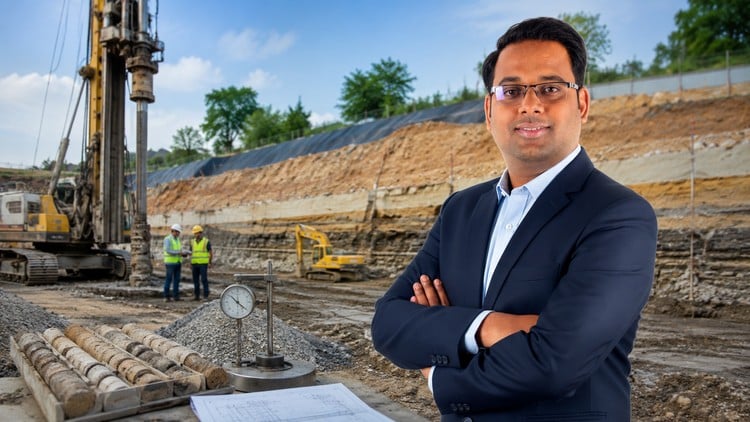
Learn to solve questions of Geotechnical Engineering while understanding the concepts with IIT Roorkee alumni
What You Will Learn:
- Deconstruct complex geotechnical problems and identify the exact formulas needed instantly.
- Master core soil mechanics concepts including phase relationships, permeability, effective stress, compaction, and consolidation.
- Apply advanced theories like shear strength, earth pressure, and bearing capacity to practical, multi-step numerical questions.
- Avoid common examiner “traps” and mathematical pitfalls that cost students critical marks.
- Solve numerical problems faster using optimized shortcuts developed over 15 years of exam-preparation coaching.
- Show more
Overview
Alright, let’s talk about ‘Geotechnical Engineering Practice Sessions in Hinglish’. As someone who’s navigated the engineering landscape for a while, I’ve seen countless courses promise the moon. This one, however, offers something refreshingly direct and incredibly practical: a no-nonsense approach to mastering geotechnical problem-solving. My take is, this isn’t your average theoretical deep dive into soil mechanics; it’s a laser-focused program designed to equip you with job-ready skills in tackling the numerical challenges that plague civil engineering students and professionals alike.
The core value here isn’t just about understanding concepts, but about *applying* them effectively under pressure. The IIT Roorkee alumni pedigree immediately signals credibility, and their 15 years of coaching experience isn’t just a marketing blurb – it translates into invaluable insights on how to approach problems efficiently. What you’re really getting is a masterclass in problem deconstruction, learning to strip down complex scenarios to their fundamental components, identify the exact formulas needed instantly, and execute solutions with precision. The Hinglish delivery is a strategic move, making intricate topics incredibly accessible and intuitive for a vast audience, bridging the gap between academic English and practical, everyday understanding that resonates deeply with learners from the Indian subcontinent.
Prerequisites
While the course aims to deconstruct problems, you’re not starting from absolute zero. To get the most out of these practice sessions, you should ideally have:
- A foundational understanding of basic engineering mathematics (calculus, linear algebra).
- Exposure to introductory civil engineering concepts, particularly related to materials and structural behavior.
- Familiarity with physics principles relevant to mechanics.
- Most importantly, a strong desire to master numerical problems and improve your certification prep for competitive exams like GATE, ESE, or other public service commission exams. This isn’t a course for passive learning; it demands active engagement.
Skills & Tools
This course isn’t about teaching you how to use specific industry-standard tools like Plaxis or GeoStudio directly, but it’s about building the fundamental intellectual toolkit that underpins their effective use. You’ll gain:
- Rapid problem identification and formula retrieval skills.
- An optimized methodology for solving multi-step numerical questions, including those pesky “examiner traps” that cost critical marks.
- Deep conceptual mastery from beginner to advanced topics in soil mechanics – phase relationships, effective stress, compaction, consolidation, shear strength, earth pressure, and bearing capacity.
- The ability to apply advanced theories to practical scenarios, transforming theoretical knowledge into actionable solutions.
- Efficient problem-solving frameworks through the ‘optimized shortcuts’ honed over years of coaching. Think of these as mental algorithms to cut through the noise and get to the solution faster.
Career Benefits & Job Roles
For individuals looking at tangible career growth, this course offers significant advantages. It directly enhances your capabilities for:
- Competitive Exam Excellence: If you’re targeting GATE, ESE, or state-level engineering exams, the focus on problem-solving speed and accuracy is invaluable.
- Higher Studies Foundation: A rock-solid understanding of geotechnical principles is crucial for postgraduate studies in civil or geotechnical engineering.
- Site Engineers & Project Managers: Better grasp of soil behavior directly translates to improved decision-making on real-world projects involving foundations, excavations, and retaining structures.
- Consulting Roles: Developing a strong analytical approach is key for geotechnical consultants who need to assess ground conditions and recommend appropriate solutions.
- Design Engineers: Applying advanced theories to practical design challenges for various civil infrastructure projects.
Pros
- Unmatched Accessibility (Hinglish): For learners comfortable with Hinglish, this breaks down language barriers, making complex geotechnical concepts far more intuitive and easier to grasp than pure academic English. This greatly improves engagement and retention.
- IIT Roorkee Alumni Credibility & Expertise: Learning from experienced professionals from a top-tier institution provides immense confidence. Their 15 years in exam preparation means they understand exactly where students struggle and how to guide them effectively.
- Laser Focus on Practical Problem-Solving: This isn’t just theory; it’s an intensive workout in applying concepts to numerical problems. The emphasis on deconstructing problems and using optimized shortcuts directly translates to improved performance in exams and real-world application.
- Comprehensive Topic Coverage: From core soil mechanics to advanced theories, the course covers a wide spectrum, ensuring a holistic understanding of geotechnical engineering. It really helps solidify your foundation and build on it.
Cons
- Limited Direct Hands-on Application: While it’s excellent for numerical problem-solving and conceptual understanding, the course description focuses solely on ‘practice sessions’ and ‘solving questions’. It doesn’t appear to incorporate hands-on labs with physical soil samples or simulations using advanced geotechnical software. For some professionals, the lack of direct interaction with field data or software tools might be a drawback, as modern geotechnical practice often involves digital modeling and analysis alongside theoretical calculations.