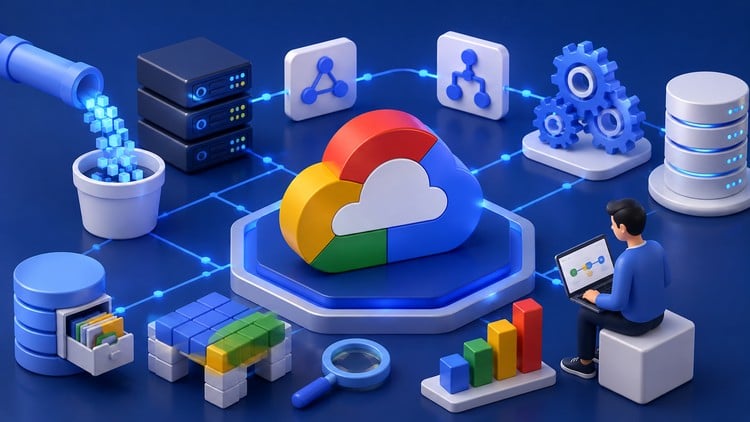
Prepare with 6 practice exams covering BigQuery, Dataflow, Pub/Sub, Dataproc, storage, streaming, security.
What You Will Learn:
- Assess readiness for the Google Cloud Professional Data Engineer exam through realistic data engineering and architecture scenarios.
- Design and build scalable data processing solutions using BigQuery, Dataflow, Pub/Sub, Dataproc, Cloud Storage, and related services.
- Implement reliable data pipelines, storage strategies, governance, security, quality, orchestration, and batch or streaming workflows.
- Monitor, troubleshoot, optimize, and manage production data platforms for performance, reliability, cost, and operational efficiency.
Overview: Cutting Through the Noise of Google Cloud Certification
If you have been in the data engineering space for more than a minute, you know that Google Cloud’s Professional Data Engineer (PDE) exam is widely considered one of the toughest “professional” level certifications out there. It’s not just a memory test; it’s a grueling evaluation of your ability to think like a cloud architect under pressure. I recently sat through the ‘GCP Professional Data Engineer Practice Tests’ course, and let’s be honest—most practice exams are either lazily recycled or way too easy. This set, however, feels like it was designed by someone who has actually spent nights troubleshooting a failing Dataflow pipeline at 3 AM.
What sets this specific set of 6 practice exams apart is the focus on “the gray areas.” In the real world, you aren’t usually choosing between a “right” and “wrong” tool; you’re choosing between two “right” tools where one is 10% more cost-effective or 20% more scalable. These tests hammer home those nuances. They force you to differentiate between when to use Bigtable for high-throughput writes versus when Cloud Spanner is necessary for global consistency. It’s an grueling but necessary certification prep experience that moves you away from theoretical knowledge and toward job-ready skills.
Prerequisites: Who Should Actually Buy This?
Don’t jump into these tests if you’ve never touched the Google Cloud Console. You will get frustrated and likely quit. To get the most out of this course, you should already have a solid grasp of SQL and at least a functional understanding of Python or Java for data processing. This is a beginner to advanced bridge, but the starting line is definitely not “zero knowledge.” Ideally, you should have completed some hands-on labs or worked on real-world projects involving distributed systems. If you don’t know the difference between a PCollection and a BigQuery partition, go back to the documentation first, then come back here to sharpen the blade.
The Toolkit: Skills & Industry-Standard Tools
The course covers the full spectrum of the modern GCP data stack. You aren’t just learning how to click buttons; you’re learning the industry-standard tools used by top-tier tech companies. The curriculum dives deep into:
- BigQuery: Advanced optimization, slot management, and federated queries.
- Dataflow & Apache Beam: Handling late-arriving data, windowing strategies, and side inputs.
- Pub/Sub: Designing decoupled, asynchronous messaging architectures for streaming workflows.
- Dataproc: Migrating legacy Hadoop/Spark workloads to the cloud without breaking the bank.
- Security & Governance: Using IAM roles, Cloud KMS for encryption, and Data Loss Prevention (DLP) API to keep the auditors happy.
- Orchestration: Managing complex dependencies with Cloud Composer (Airflow).
Career Benefits & Job Roles
Let’s talk about the ROI. In the current market, “Data Engineer” is one of the most in-demand titles, often commanding higher salaries than generalist Software Engineers. Completing these practice tests and subsequently earning your certification is a massive signal to recruiters. It proves you understand career growth isn’t just about learning a new language, but mastering an ecosystem. This course prepares you for roles such as Senior Data Engineer, Cloud Solutions Architect, and Data Platform Engineer. Being GCP certified often puts you at the top of the pile for high-paying consultancy roles and big tech positions where operational efficiency and cost optimization are the names of the game.
Pros: Why This Is Worth Your Time
- Detailed Explanations: This is the gold standard. Every question comes with a “why.” Even if you guess correctly, reading the breakdown of why the other three options were sub-optimal is where the real learning happens.
- High-Fidelity Scenarios: The questions mimic the actual exam’s case-study approach. They present complex business problems—like a retail giant needing real-time inventory updates—and ask you to architect the solution.
- Focus on Cost and Performance: Google loves to test you on the “cheapest” or “fastest” way to do something. These tests emphasize cost-effective strategies, which is a vital skill for any real-world production data platform.
- Up-to-Date Content: GCP evolves fast. These tests include recent updates to services like BigLake and Vertex AI integration, ensuring you aren’t studying outdated 2021 tech.
Cons: The Honest Truth
The only real downside is the lack of an integrated sandbox. While the questions are brilliant, they are still just questions. If you are someone who learns strictly by doing, you might find the “reading and clicking” format a bit dry. I would have loved to see a few “lab-style” challenges where you have to verify your answer in a live environment. It can also be quite a blow to the ego—the difficulty spike between Test 1 and Test 4 is significant, and it might discourage learners who aren’t prepared for the “Professional” level rigor.