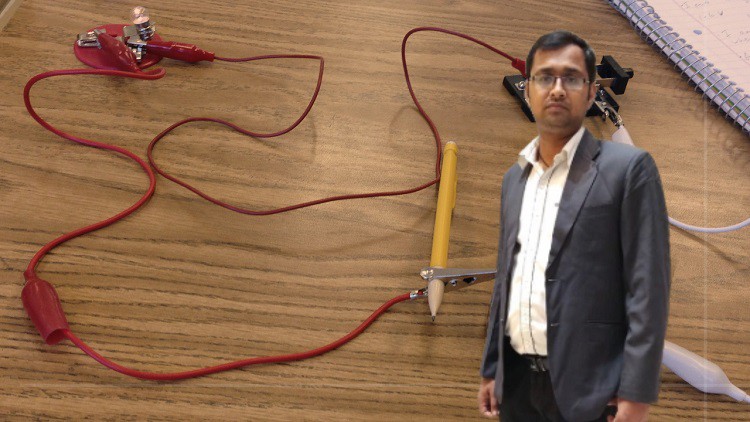
|| Numerical based Multiple Choice Questions || Three Practice Test ||
What you will learn
Understand the Basic Concept of Ohm’s Law
Student get the Confidence in the Ohm’s Law
Easily Clear the Exam in the Electrical Stream
Able to Solve Ohm’s Law Based Question
Description
Dear Learners,
Are you preparing for an interview at an Electrical Company? Don’t be stressed; take our Ohm’s Law-based practice test and prepare yourself for your Interview.
In the Ohm’s Law-based Multiple Choice Questions quiz, there will be a series of practice tests where you can test your basic Knowledge.
What will you get from these practice tests?
- These questions will help you with Self-Study and Self-Assessment.
- These practice tests help you check your Practical Knowledge.
- Here, you can track your progress and understand which areas need improvement.
- These practice tests are mobile-compatible, so you can easily access them anytime with your Smartphone.
- Here, the active Q&A board gives you the opportunity to directly Interact with the instructor.
Generally, you need to refer to a variety of books and websites in order to cover the ocean of topics in Ohm’s Law. To make it easy for you guys, I have collected a few Ohm’s Law-based Numerical questions. When you solve these questions, your confidence will definitely increase.
100% MONEY-BACK GUARANTEE
This Course has a 30-Day Money-Back Guarantee. Without any delay, the applicants participate in the Ohm’s Law-based practice test and understand the various questions and answers.
Best of Luck for the exam!
Alright folks, let’s talk about a cornerstone of electrical engineering: Ohm’s Law. If you’re just starting out, or even if you’ve been around the block a few times and want to shore up your fundamentals, this course, ‘Fundamental Questions on Ohm’s Law’, is definitely worth a look. I’ve been in the trenches of this field for a while, and I can tell you, a solid grasp of Ohm’s Law isn’t just for passing exams; it’s your bread and butter for pretty much any hands-on work or certification prep you’ll do.
Overview
This isn’t some dusty textbook recap. The course dives straight into the practical application of Ohm’s Law, which, let’s be honest, is where the rubber meets the road. They’ve framed it around tackling numerical problems, which is a smart move. You’re not just memorizing V=IR; you’re learning to wield it. The inclusion of three dedicated practice tests is a big win here. This isn’t about theoretical understanding alone; it’s about building the muscle memory to solve Ohm’s Law-based questions quickly and accurately. For anyone aiming to clear exams in the electrical stream, from introductory certifications to more advanced modules, this course aims to instill that crucial confidence. It’s about moving beyond the formula and truly internalizing how voltage, current, and resistance interact in real-world circuits. Think of it as building the foundation for more complex circuit analysis and troubleshooting – skills that are absolutely essential for job-ready applications.
Prerequisites
Honestly, the bar is set pretty low here, which is a good thing for beginners. If you can do basic arithmetic – multiplication, division, maybe a bit of algebra – you’re good to go. No need to be a calculus wizard or have a deep understanding of semiconductor physics. This course is squarely aimed at those who need to build their foundational knowledge. If you’ve got a high school level understanding of basic math, you’re already ahead of the curve.
Skills & Tools
The primary skill you’ll hone is problem-solving related to Ohm’s Law. This means developing analytical thinking to break down circuit problems, identify the knowns and unknowns, and apply the correct formula. While the course itself is theoretical and numerical, the skills it imparts are directly applicable to practical scenarios. You’ll indirectly be preparing yourself for tasks that might involve using industry-standard tools like multimeters or oscilloscopes, as you’ll understand the principles behind the readings you’re getting. Think of it as learning the language before you start speaking it with actual equipment.
Career Benefits & Job Roles
Let’s be blunt: mastering Ohm’s Law is a direct pathway to career growth in the electrical field. Whether you’re looking at entry-level technician roles, aspiring to be a certified electrician, or aiming for engineering support positions, this knowledge is non-negotiable. It’s a foundational requirement for understanding electrical systems, troubleshooting faults, and even designing simple circuits. For those pursuing certification prep, this course will significantly boost your chances of passing exams that cover basic electrical principles. It’s about becoming a more effective and employable professional. Think of roles like:
- Electrical Technician
- Apprentice Electrician
- Field Service Technician
- Electrical Engineering Assistant
- Instrumentation Technician
Pros
- Direct Application Focus: The emphasis on numerical questions and practice tests means you’re not just learning theory, but actively applying it, which builds real confidence.
- Accessibility for Beginners: The low prerequisite makes it an excellent starting point for anyone new to electrical concepts.
- Exam-Oriented Approach: The structure is clearly designed to help students perform well in assessments and gain job-ready skills.
- Builds Foundational Confidence: Getting a strong handle on Ohm’s Law is a huge confidence booster for tackling more advanced electrical topics and real-world projects.
Cons
My only honest critique is that this course stays strictly within the numerical and conceptual realm of Ohm’s Law. While this is its strength, it means there’s no direct exposure to hands-on labs or real-world projects where you’d physically manipulate circuits or use industry-standard tools. The learning is primarily theoretical, albeit highly practical in its problem-solving approach. To bridge that gap, you’ll definitely want to supplement this with some practical experience once you’ve got the theory down pat.