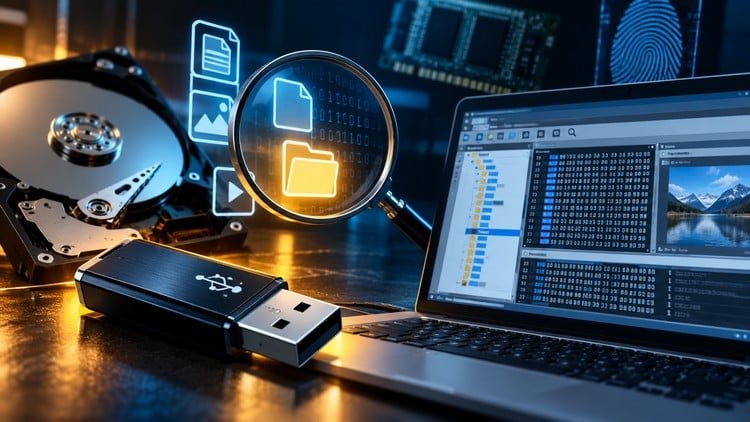
Learn FTK Imager for Digital Forensics: Imaging, Deleted File Investigation, Memory Acquisition & Evidence Analysis
What You Will Learn:
- Install FTK Imager and understand its interface and essential features.
- Add and examine physical drives and explore their contents using FTK Imager.
- Create forensic disk images and verify their integrity using hash values.
- Identify and investigate deleted file entries in forensic images.
- Capture RAM and understand the basics of memory acquisition using FTK Imager.
- Mount forensic images and access their contents for examination.
Alright, let’s dive into the FTK Imager for Digital Forensics: Practical Investigation course. As someone who’s spent a good chunk of time in the trenches of digital investigations, I’m always on the lookout for solid training that actually translates into job-ready skills, especially with industry-standard tools like FTK Imager. This course promises a hands-on approach, and I was curious to see if it delivered.
Overview
This course isn’t just about clicking buttons; it’s about building a foundational understanding of forensic imaging and initial evidence acquisition using a widely-used tool. It hits the ground running, focusing on the core functionalities that are critical for any digital forensics practitioner. Think of it as your essential toolkit for capturing a “snapshot” of digital evidence without altering the original source – a non-negotiable first step in any investigation. The emphasis on creating verifiable forensic images and then digging into the nuances of deleted file recovery and even basic memory acquisition is a smart move. It covers the spectrum from initial acquisition to early-stage analysis, which is precisely what you need to be effective from day one.
Prerequisites
Frankly, the prerequisites are pretty reasonable. You don’t need to be a seasoned forensic examiner to jump in. A solid understanding of general computer operations and how file systems generally work is a good starting point. If you’ve got some basic IT knowledge or have tinkered with computer hardware, you’ll be in a good spot. The course is designed to take you from zero to functional with FTK Imager, so don’t let any perceived lack of deep technical expertise hold you back.
Skills & Tools
The star of the show here is, of course, FTK Imager. You’ll become proficient in its interface, mastering tasks like:
- Navigating the FTK Imager environment efficiently.
- Creating forensic images (both physical and logical) with proper verification using hash values (MD5, SHA1, SHA256 – they cover the essentials).
- Performing deleted file recovery within these forensic images, which is a huge part of any investigation.
- Getting a handle on memory acquisition – understanding why it’s important and how FTK Imager can assist.
- Mounting forensic images for live examination without modifying the original evidence.
Beyond FTK Imager itself, you’ll implicitly build skills in data integrity verification and logical reasoning for evidence handling. This is all about building those job-ready skills.
Career Benefits & Job Roles
Mastering FTK Imager is a significant step for anyone aiming for a career in digital forensics. This tool is practically a standard in many organizations, from law enforcement to corporate security. This course can be a fantastic stepping stone for roles like:
- Digital Forensics Technician
- Incident Responder
- eDiscovery Analyst
- Information Security Analyst
The hands-on experience with a real-world tool like FTK Imager is invaluable for resume building and can definitely help with certification prep. It’s about gaining practical knowledge that directly contributes to career growth.
Pros
- Practical, Hands-On Approach: This course really shines in its practical application. The focus is on learning by doing, which is exactly what you need to truly understand forensic tools. The hands-on labs are where the learning solidifies.
- Industry-Standard Tool: FTK Imager is ubiquitous. Learning it means you’re learning a tool that’s in active use across the industry, making the skills directly transferable to the workplace.
- Covers Essential Foundations: It doesn’t try to be everything to everyone. It hones in on the critical initial phases of digital forensics – imaging, verification, and basic examination – providing a robust foundation for further learning.
- Accessible for Beginners: While it uses industry terms, the course is structured in a way that doesn’t alienate those new to digital forensics, making it a great entry point.
Cons
If I had to pick one honest critique, it would be that this course, by necessity, stays focused on FTK Imager’s core functionalities. For deep, advanced analysis or complex artifact recovery, you’ll absolutely need to supplement this with other tools and more specialized training. It’s a fantastic starting point for acquisition and initial examination, but it’s not the be-all and end-all of digital forensics analysis.