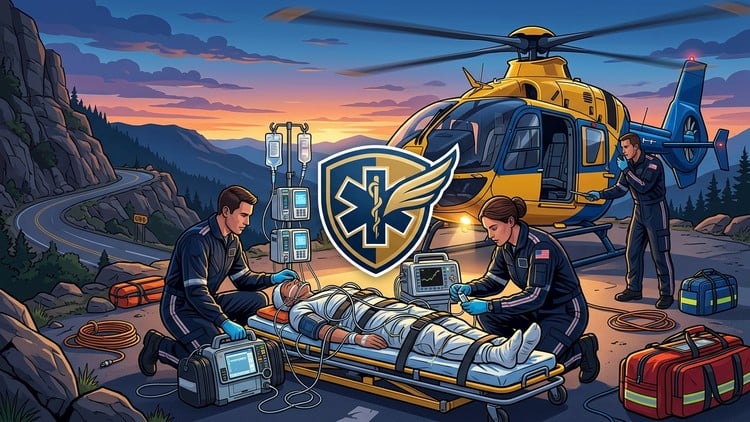
Pass your FP-C, CCP-C, or Paramedic exam. Questions on Ventilators, 12-Leads, Trauma, and OB/Peds with clear explanation
What You Will Learn:
- Master ventilator management, specifically troubleshooting alarms, fixing blood gases, and understanding modes like SIMV and AC.
- Interpret complex 12-lead ECGs to identify STEMIs, axis deviation, blocks, and dangerous electrolyte imbalances like hyperkalemia.
- Calculate accurate burn fluid resuscitation using the Parkland formula and manage trauma shock states like neurogenic and hypovolemic shock.
- Confidently manage high-risk OB emergencies like preeclampsia, shoulder dystocia, breech birth, and neonatal resuscitation (NRP).
Overview: Beyond the Standard Rig Mentality
If you’ve spent any time in the back of an ambulance, you know there’s a massive gulf between a “routine” transport and the high-stakes environment of a critical care intercept or a rotor-wing flight. This course, the FP-C, CCP-C Critical Care Paramedic & Flight Test Prep 2026, isn’t just another checkbox for continuing education. It’s a specialized certification prep powerhouse designed to bridge that gap. Having looked at a lot of medical hands-on labs and digital simulations over the years, I can tell you that most prep courses fail because they focus on memorization rather than clinical logic. This one is different.
What struck me immediately is the “no-fluff” approach to the 2026 guidelines. Instead of just throwing theory at you, the course treats you like a professional who is already job-ready but needs to refine their “street smarts” into “flight smarts.” It tackles the heavy mental load of managing a patient in a pressurized cabin or a mobile ICU where you don’t have a doctor standing over your shoulder. The instruction feels less like a lecture and more like a high-level briefing from a veteran flight medic who’s seen it all and wants you to survive your first solo shift. It’s dense, opinionated, and exactly what’s needed for career growth in the emergency services sector.
Prerequisites: Who Should Be Sitting in This Seat?
Let’s be real: this isn’t for the hobbyist. This is a beginner to advanced journey, but the “beginner” here refers to someone who is already a licensed Paramedic or RN. You need a solid foundation in basic anatomy, physiology, and pharmacology before you even think about hitting “play.” If you don’t know your basic ACLS rhythms, you’re going to get steamrolled by the complex 12-lead ECG analysis. The course assumes you have a baseline of field experience and are now looking to pivot into industry-standard critical care roles. It’s specifically tailored for those aiming for their Board for Critical Care Transport Paramedic Certification (BCCTPC) exams.
Skills & Tools: The Critical Care Toolkit
The curriculum leans heavily into industry-standard tools that separate the street medic from the flight professional. You aren’t just learning how to push buttons; you’re learning the “why” behind the machine. The focus on ventilator management is a standout—moving beyond basic settings into the nuances of SIMV and AC modes. You’ll also dive deep into real-world projects involving hemodynamic monitoring and advanced pharmacopoeia.
- Mechanical Ventilation: Mastering everything from troubleshooting high-pressure alarms to interpreting ABGs to make life-saving adjustments on the fly.
- Advanced Diagnostics: Using 12-lead interpretation to identify subtle STEMIs and electrolyte-driven arrhythmias that most people miss.
- Trauma Dynamics: Mastering the Parkland formula for fluid resuscitation and managing the delicate balance of neurogenic versus hypovolemic shock.
- High-Risk OB/Neonatal: Moving past “delivery in the field” to complex NRP (Neonatal Resuscitation Program) protocols and managing preeclampsia with magnesium sulfate.
Career Benefits & Job Roles
Earning an FP-C (Flight Paramedic-Certified) or CCP-C (Critical Care Paramedic-Certified) is the gold standard for anyone looking to escape the “box” and get into the air. This course provides the job-ready skills needed to transition into roles such as Flight Paramedic, Critical Care Transport (CCT) Medic, or even roles within specialized offshore or tactical medical teams. From a career growth perspective, these certifications often come with significant pay bumps and the kind of professional autonomy that standard EMS roles simply can’t offer. You’re essentially future-proofing your career by mastering the hardest aspects of pre-hospital medicine.
Pros
- Clinical Logic over Rote Memorization: The course explains the *pathophysiology* behind the treatment, which makes the answers obvious during the actual certification prep exams.
- Up-to-Date for 2026: It incorporates the latest evidence-based practices in trauma shock management and neonatal resuscitation, ensuring you aren’t learning outdated protocols.
- High-Yield Visuals: The breakdowns of 12-lead ECGs and ventilator waveforms are crystal clear, making complex data sets easy to digest for visual learners.
Cons
- Intense Cognitive Load: This is not a “casual” watch. The volume of information—especially regarding acid-base balance and ventilator modes—can be overwhelming if you aren’t prepared to put in serious study hours outside of the videos.