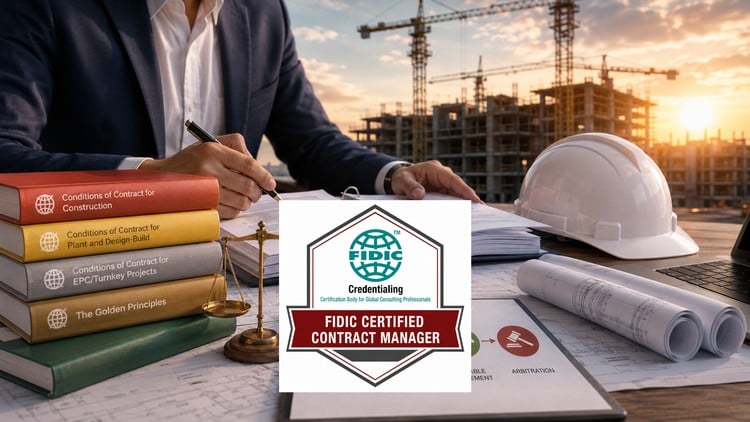
Scenario-based FCCM exam preparation: Red, Yellow & Silver Books (1999 & 2017), Claims, EOT, DAB/DAAB & Golden Principle
What You Will Learn:
- Pass the FCCM exam: format, eligibility, high-yield themes and a 10-week study plan
- Apply the Red, Yellow & Silver Books (1999 AND 2017 editions) to real project scenarios
- Master Claims under Clause 20: the 28-day Notice, time bars and contemporary records
- Navigate the full dispute path: Engineer’s determination, DAB/DAAB, NOD and arbitration
- Manage EOT, delay damages, Variations, payment machinery and Performance Security
- Compare risk allocation across the suite and judge Particular Conditions with the Golden Principles
- Command of the claims discipline: the 28-day Notice, the fully detailed claim, contemporary records, time bars
- Cross-book risk allocation: site data, fitness for purpose, Exceptional Events vs Force Majeure
Overview: Cutting Through the Contractual Noise
Let’s be real—most certification prep courses are a snooze-fest of dry slides and legal jargon that feels light-years away from the actual grit of a construction site. But the ‘(FCCM) FIDIC Certified Contract Manager Exam Prep Course’ hits differently. Having spent years navigating the technical side of infrastructure, I’ve seen how a poorly handled claim can sink a project faster than bad engineering. This course doesn’t just ask you to memorize the Red Book; it forces you to live inside it.
What I appreciated most was the focus on the “why” behind the industry-standard tools. We aren’t just looking at the 1999 vs. 2017 editions as a history lesson; we’re dissecting how the 2017 update transformed the Engineer’s role from a quasi-judge into a proactive manager. The course treats the Golden Principles as a moral compass for contract drafting, ensuring you don’t just pass an exam, but you actually learn how to keep a project out of arbitration. It’s a hands-on lab in contractual strategy, using real-world projects as the backdrop for every Scenario-based lesson.
The 10-week study plan is the secret sauce here. It’s designed for those of us juggling 50-hour work weeks. It moves you from beginner to advanced levels of understanding by layering complexity—starting with simple risk allocation and ending with the high-stakes world of DAAB hearings and Exceptional Events. It’s opinionated, rigorous, and frankly, exactly what you need to survive the FCCM exam’s tricky format.
Prerequisites: Who Should Step Into the Ring?
This isn’t an “Introduction to Construction 101” class. To get the most out of this, you need some skin in the game. While the course covers beginner to advanced concepts, you’ll struggle if you’ve never seen a Payment Certificate or a Variation order in the wild. I’d recommend this for:
- Engineers or Project Managers with at least 3-5 years of site experience.
- Quantity Surveyors looking to pivot into dedicated Contract Management roles.
- Legal professionals who need to understand the technical “mechanics” of the FIDIC suite.
- Anyone who has read a 28-day Notice and felt their blood pressure rise.
Skills & Tools: Your Professional Utility Belt
The course arms you with job-ready skills that go way beyond the exam. You’ll walk away with a mastery of:
- The FIDIC Suite: Deep-dive proficiency in the Red (Construction), Yellow (Plant & D&B), and Silver (EPC/Turnkey) books.
- Claim Mechanics: Managing the 28-day Notice, maintaining contemporary records, and drafting the fully detailed claim.
- Dispute Resolution: Navigating the path from Engineer’s determination to DAB/DAAB and Notice of Dissatisfaction (NOD).
- Time & Money: Calculating EOT (Extension of Time), managing delay damages, and understanding the payment machinery.
- Risk Assessment: Distinguishing between fitness for purpose and “reasonable skill and care,” and handling Exceptional Events.
Career Benefits & Job Roles: Leveling Up
The career growth potential here is massive. As global infrastructure projects become more complex, the demand for certified FCCM professionals is skyrocketing. This isn’t just a line on your LinkedIn; it’s a signal to recruiters that you can handle multi-million dollar risk profiles. Post-certification, you’re looking at high-yield roles such as:
- Senior Contract Manager: Leading the contractual strategy for Tier-1 contractors or international consultants.
- Claims Consultant: Specializing in forensic delay analysis and claim substantiation.
- Commercial Lead: Managing the financial and legal health of major EPC projects.
- Arbitration Support: Providing expert technical-contractual input during dispute proceedings.
Pros: Why This Course Wins
- The 10-Week Roadmap: Most certification prep fails because it lacks structure. This course provides a disciplined, high-yield path that respects your time while ensuring you cover every “must-know” theme.
- Dual-Edition Mastery: The industry is currently in a “hybrid” state where many projects still use 1999 forms while new ones use 2017. Learning both simultaneously is a huge advantage for career growth.
- Scenario-Based Logic: The focus on real-world projects means you aren’t just learning Clause 20 in a vacuum; you’re learning how to apply it when the site is flooded and the Employer is breathing down your neck.
- Focus on the Golden Principles: It teaches you not just what the contract says, but what makes a contract “fair,” which is essential for any professional acting in a DAAB capacity.
Cons: The Honest Reality
If I’m being critical, the sheer volume of information can be overwhelming. This is a “high-yield” course, which means it moves fast. If you aren’t prepared to put in the study hours outside of the modules, the 10-week study plan will feel like a sprint you can’t keep up with. It requires a significant mental commitment—don’t expect to “wing it” and pass the FCCM exam.