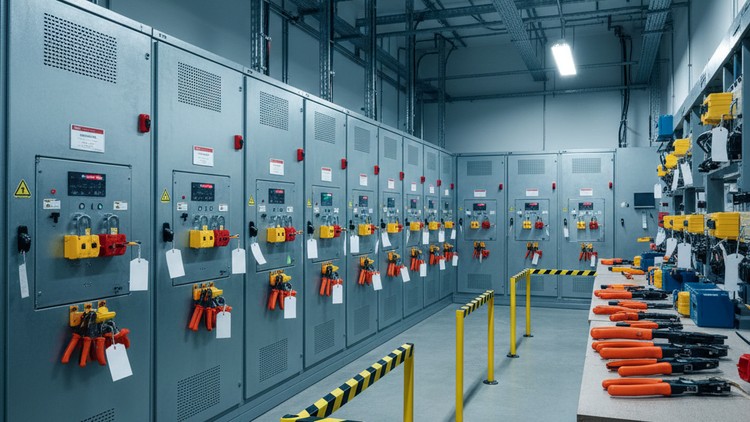
Interactive MCQ Practice for Certified Electrical Safety Awareness with Realistic Exam Scenarios
⭐ 4.50/5 rating
👥 114 students
🔄 December 2025 update
Add-On Information:
Note➛ Make sure your 𝐔𝐝𝐞𝐦𝐲 cart has only this course you're going to enroll it now, Remove all other courses from the 𝐔𝐝𝐞𝐦𝐲 cart before Enrolling!
- Course Overview
- Comprehensive Certification Simulation: This course offers an exhaustive and highly detailed simulation environment tailored specifically for professionals aiming to achieve the Certified Electrical Safety Compliance Professional (CESCP) status or other industry-recognized safety credentials.
- Latest Regulatory Alignment: The curriculum is meticulously structured around the December 2025 update, ensuring that all practice questions reflect the most current interpretations of the NFPA 70E standard and its relationship with OSHA 29 CFR 1910 Subpart S.
- Situational Cognitive Testing: Rather than focusing on simple rote memorization, the mock exams utilize complex case studies that require students to apply theoretical knowledge to multi-variable industrial scenarios involving high-voltage infrastructure.
- Advanced Theoretical Framework: Students will explore the interplay between NFPA 70 (National Electrical Code) and safety standards, learning how installation quality directly impacts the maintenance-related safety requirements of the facility.
- Adaptive Learning Feedback: Every question in the practice bank is accompanied by an in-depth technical rationale, providing immediate clarity on the underlying physics and legal mandates that dictate the correct safety response in any given situation.
- Audit-Ready Knowledge Base: The course prepares candidates to handle Authority Having Jurisdiction (AHJ) inspections by emphasizing the documentation and verification steps required to prove facility-wide safety compliance.
- Requirements / Prerequisites
- Foundational Electrical Proficiency: Prospective students should possess a strong working knowledge of AC and DC power systems, including an understanding of overcurrent protection, grounding, and bonding principles within industrial environments.
- Standard Documentation Access: It is highly recommended that participants have access to a personal copy of the NFPA 70E Handbook to facilitate deep-dive cross-referencing while working through the more challenging mock exam sections.
- Industrial Context Awareness: A basic familiarity with common electrical distribution equipment, such as switchgear, motor control centers (MCCs), and dry-type transformers, is necessary to visualize the scenarios presented in the practice exams.
- Prerequisite Safety Training: While not mandatory, having completed a basic OSHA 10 or OSHA 30 General Industry course provides an excellent contextual foundation for the high-level safety management concepts discussed here.
- Skills Covered / Tools Used
- Risk Assessment Matrix Interpretation: Master the ability to use qualitative and quantitative matrices to estimate the likelihood and potential severity of electrical incidents during both normal and abnormal operating conditions.
- Boundary Calculation and Implementation: Develop the technical skill to establish and enforce Limited and Restricted Approach Boundaries based on nominal system voltages and the specific configuration of the electrical equipment.
- Energized Electrical Work Permit (EEWP) Management: Learn the administrative intricacies of drafting, reviewing, and authorizing Work Permits, focusing on the legal necessity of proving why equipment cannot be de-energized before work begins.
- Human Error Precursor Identification: Gain insights into identifying behavioral and environmental factors—such as time pressure, fatigue, or poor lighting—that significantly increase the risk of a safety incident during troubleshooting.
- Incident Energy Analysis Reporting: Build the proficiency needed to read and interpret Power System Study labels, allowing for the accurate translation of calorie-per-centimeter-squared data into actionable safety protocols.
- Emergency Response and Victim Release: Understand the critical first-responder protocols specifically designed for electrical incidents, including the safe release of a victim from energized conductors and specific thermal burn first aid.
- Maintenance Condition Auditing: Learn how to evaluate the condition of maintenance for protective devices, understanding how a lack of testing can lead to catastrophic failures and increased incident energy levels.
- Benefits / Outcomes
- Institutional Risk Mitigation: By mastering these advanced safety concepts, you can lead your organization in reducing workers’ compensation claims and avoiding the heavy financial penalties associated with OSHA non-compliance.
- Professional Leadership Advancement: Earning a high score on this mock exam builds the confidence necessary to act as a Safety Lead or Qualified Person, making you an indispensable asset to any facility management team.
- Enhanced Technical Communication: Acquire the standardized vocabulary and technical jargon required to communicate effectively with electrical engineers, safety directors, and plant managers regarding complex electrical risks.
- Personal Safety Mastery: Beyond certification, the primary outcome is a profound shift in safety culture, moving from a “rules-based” approach to a “risk-based” mindset that prioritizes human life above all else.
- Gap Analysis Accuracy: Use the detailed performance analytics provided by the mock exam to identify your specific knowledge deficiencies, allowing for targeted study sessions that maximize your preparation efficiency.
- PROS
- Realistic Exam Environment: The timing and difficulty levels perfectly mirror the actual NFPA 70E certification exams, providing a low-stakes environment to perfect your test-taking strategy.
- Mobile-Accessible Learning: The interactive format allows for on-the-go study sessions, enabling busy professionals to prepare for their exams during commutes or on-site breaks.
- Peer-Reviewed Content: Every question is vetted by industry experts to ensure technical accuracy and relevance to modern industrial electrical applications.
- CONS
- Theoretical Constraints: This course focuses exclusively on cognitive and regulatory mastery; it cannot replace hands-on field training or the physical demonstration of safety equipment proficiency required for full qualification.
Learning Tracks: English,Personal Development,Career Development
Found It Free? Share It Fast!