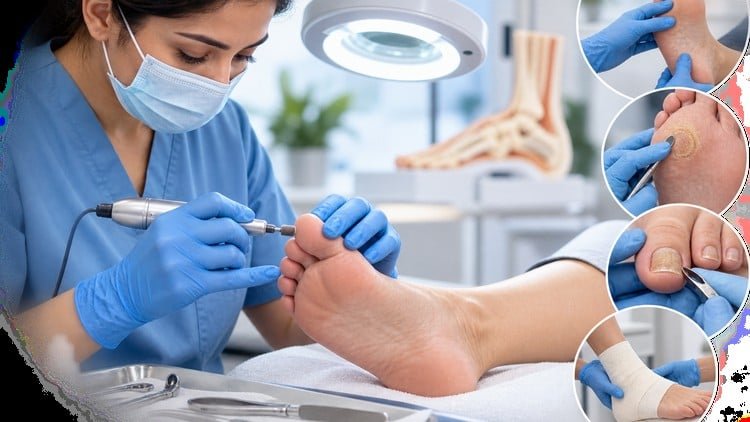
Complete Podiatries, Foot health : Anatomy, Common Conditions, Biomechanics & Clinical Treatment, Diabetic foot care
What You Will Learn:
- Understand the anatomy and biomechanics of the foot and ankle
- Identify and manage common podiatric conditions such as bunions, plantar fasciitis, and nail disorders
- Assess diabetic foot complications and understand appropriate wound care basics
- Evaluate footwear, gait, and orthotic principles to support patient care
Alright, so you’re looking at dipping your toes, pun absolutely intended, into the world of foot care with the ‘Diploma in Podiatry and Complete Foot Care (UK Accredited)’. As someone who values practical outcomes and solid professional development, my first thought always goes to: what’s the real-world utility here? Let’s break it down.
Overview
This isn’t just about trimming toenails, folks. That’s a common misconception. Podiatry, and by extension, comprehensive foot care, is a critical healthcare discipline often undervalued until you’ve got an issue that stops you in your tracks. This diploma appears designed to lay a seriously robust theoretical foundation for understanding the entire lower limb system – from intricate bone and muscle mechanics to the complex biomechanics keeping us upright. The “UK Accredited” badge is a significant signal of quality, implying a curriculum built to meet recognized industry standards. This is crucial if you’re serious about a legitimate career path; think of it as getting the blueprints before constructing a building.
Prerequisites
The course description doesn’t explicitly list prerequisites, suggesting accessibility for a broad audience, even those considering a complete career pivot. However, let’s be realistic. While it covers basics like anatomy, you’ll benefit immensely from a genuine interest in health sciences, an empathetic approach to patient care, and a keen eye for detail. Strong observational skills will serve you well, as will a willingness to dive into complex biological systems and medical terminology. If you’re without a prior science background, be prepared to dedicate extra time to foundational concepts, but it seems structured to guide you from beginner to advanced understanding within its scope.
Skills & Tools
This diploma is geared towards equipping you with truly valuable job-ready skills. You’ll delve into:
- Anatomical Interpretation & Biomechanical Analysis: Understanding foot and ankle structure and how they move (or don’t move correctly), fundamental for diagnosis.
- Diagnostic Acumen for Common Conditions: The ability to identify and understand conditions like bunions, plantar fasciitis, and various nail disorders, moving beyond surface-level observation.
- Diabetic Foot Assessment & Basic Wound Care: A critically important area. You’ll learn to assess complications and grasp principles of appropriate wound care, which can save limbs for diabetic patients.
- Footwear & Gait Analysis: Evaluating shoe impact on foot health and analyzing walking patterns to identify issues, leading to practical recommendations.
- Orthotic Principles: Understanding how custom inserts can support and correct foot mechanics.
While not involving physical instruments in a lab, the knowledge gained forms the basis for using various industry-standard tools and techniques in a clinical setting.
Career Benefits & Job Roles
Undertaking this diploma signals intent for career growth in a specialized healthcare sector. You’re building a foundation for tangible professional opportunities. This course can serve as excellent certification prep for further practical qualifications. Potential avenues include:
- Podiatry Assistant / Foot Health Practitioner: Working under supervision or in independent practice (depending on local regulations and additional practical training).
- Specialist in Diabetic Foot Care: A crucial and growing area of healthcare need.
- Footwear Consultant: Advising clients on appropriate footwear based on biomechanics and conditions.
- Stepping Stone to Advanced Qualifications: Provides a strong theoretical base for pursuing a full Bachelor’s degree in Podiatry or similar advanced clinical training.
- Entrepreneurial Opportunities: The knowledge empowers you to potentially build a specialized service, perhaps focusing on elderly care or sports-related foot issues, with subsequent practical experience.
The consistent demand for qualified foot care professionals means those with solid foundations can anticipate a stable and rewarding career trajectory.
Pros
- Comprehensive Curriculum: This isn’t superficial. It dives deep into anatomy, biomechanics, pathology, and practical management strategies, offering a holistic understanding crucial for effective patient care.
- UK Accreditation & Quality Assurance: The “UK Accredited” status lends significant credibility, assuring content meets recognized standards. This is vital for professional recognition and excellent certification prep.
- Focus on High-Impact Areas: Tackling common conditions, diabetes, and gait analysis means you’re learning to make a real difference in patient quality of life. These are high-value services in any healthcare setting.
- Solid Theoretical Foundation for Real-World Projects: While not hands-on in a physical lab, the theoretical depth means you’ll be well-prepared to understand and engage in real-world projects, like developing treatment plans or assessing patient cases, once you transition to practical settings.
Cons
Here’s the honest take, and it’s a big one for any clinical diploma: while this course provides an exceptional theoretical framework and is fantastic certification prep, it is inherently limited in providing direct, physical hands-on labs or clinical experience. Podiatry is a profoundly practical field, requiring dexterity, direct patient interaction, and skillful use of instruments. This diploma gives you the “what” and the “why,” but the “how to physically do it” will require significant additional practical training, potentially through supervised clinical placements or further education. You’ll finish with incredible knowledge, but you won’t be immediately performing treatments without that crucial practical component. It’s an excellent launchpad, but not the entire journey.
In conclusion, if you’re looking for a robust, accredited theoretical grounding in podiatry and complete foot care, this diploma looks like a strong contender. It’s an intelligent investment in specialized knowledge that builds foundational job-ready skills, particularly if you understand its role as a precursor to more practical training and truly unlocking significant career growth.