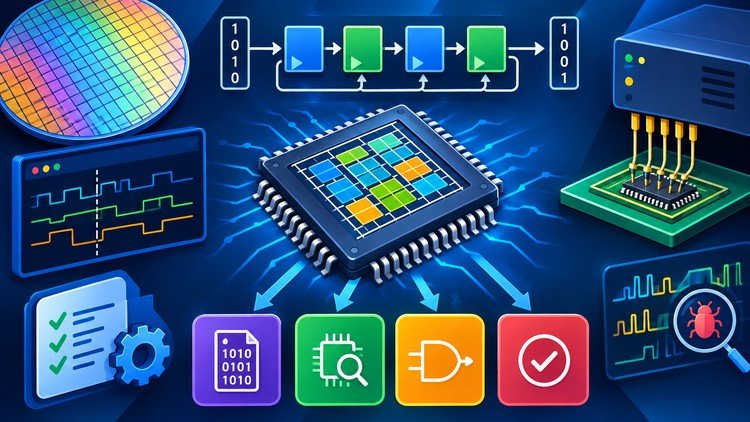
200+ DFT Practice Questions: Scan Design, ATPG, Memory & Logic BIST, Boundary Scan, and Test Coverage
What You Will Learn:
- Master core DFT concepts: fault models, controllability/observability, scan design, and ATPG fundamentals used in real chip design flows
- Understand Memory BIST, Logic BIST, and boundary scan (JTAG/IEEE 1149.1) architectures used to test embedded memories, logic, and I/O
- Apply test compression, fault coverage, and DPPM/defect-level concepts to evaluate and optimize real-world test strategies
- Build confidence with at-speed testing, IDDQ, core-based test (IEEE 1500), and DFT power considerations through practice questions
Alright, let’s be real for a moment. Navigating the semiconductor job market, especially for specialized roles like DFT, isn’t just about having the theoretical chops. It’s about pulling that knowledge out under pressure, dissecting complex scenarios, and articulating solutions on the fly. That’s precisely where ‘DFT Interview Preparation and Practice Tests’ carves out its niche. I’ve been around the block a few times in this industry, and I appreciate a resource that cuts to the chase and focuses on practical readiness over just re-hashing textbook definitions. This isn’t just another ‘learn DFT’ course; it’s a targeted assault on the interview process itself.
Overview
Let’s talk brass tacks. This course isn’t trying to be your first introduction to digital design, nor is it a deep dive into every single esoteric corner of test engineering. Instead, it serves as an incredibly effective bridge from theoretical understanding to interview-grade application. What it delivers is a rigorous workout for your DFT brain. With over 200 practice questions, it forces you to think like an interviewee, anticipating the curveballs and demonstrating true conceptual mastery across critical domains like scan design, ATPG, Memory & Logic BIST, and Boundary Scan (JTAG). It’s less about passive learning and more about active problem-solving, simulating the mental gymnastics required during a technical interview. If you’re looking to solidify your understanding and boost your confidence, ensuring you possess those crucial job-ready skills, this course feels like a focused bootcamp for the real deal.
Prerequisites
Here’s the deal: this isn’t a “DFT for Dummies” type of offering. You’ll definitely want to come in with a foundational understanding of:
- Basic Digital Logic & Circuits: Think flip-flops, gates, combinational vs. sequential logic.
- VLSI Design Fundamentals: An appreciation for the chip design flow, from RTL to GDSII, helps immensely.
- Computer Architecture Basics: Understanding how processors and memories generally operate provides valuable context for BIST.
- Hardware Description Languages (HDLs): While not strictly required for the questions, familiarity with Verilog or VHDL will help you contextualize many of the design-for-test structures.
While it covers topics from “beginner to advanced” within DFT, the starting point assumes you’re already familiar with the broader VLSI landscape.
Skills & Tools
By diligently working through these practice questions, you’ll sharpen a very specific set of skills vital for any DFT professional:
- Conceptual Fluency: Articulating complex topics like fault models, controllability/observability, and test compression with clarity and precision.
- Problem-Solving Under Pressure: Developing the ability to quickly analyze DFT-related scenarios and propose optimal test strategies.
- DFT Architecture Comprehension: Deepening your understanding of Memory BIST, Logic BIST, and JTAG (IEEE 1149.1) implementations.
- Test Metric Optimization: Applying concepts like fault coverage and DPPM/defect-level to evaluate and improve test plans.
- Advanced Test Knowledge: Building confidence around at-speed testing, IDDQ testing, core-based test (IEEE 1500), and DFT power considerations.
While the course itself is question-based, the concepts are directly applicable to industry-standard tools like Cadence Modus, Synopsys Tetramax, and Mentor Tessent, preparing you for real-world scenarios you’d face with these platforms.
Career Benefits & Job Roles
This course is a direct investment in your career growth. Excelling in DFT interviews opens doors to:
- DFT Engineer: The most direct path, focusing on implementing test structures within chip designs.
- Test Engineer: Developing and executing test plans on ATE, debugging test failures.
- ASIC Design/Verification Engineer: A solid DFT background makes you a much more valuable asset, understanding how your design choices impact testability.
- VLSI/Semiconductor Roles: Generally, strong DFT knowledge is highly sought after across the board in chip development.
The structured practice provided here is akin to certification prep for your professional career, directly preparing you for demanding technical discussions and ensuring you stand out in a competitive talent pool.
Pros
- Interview-Centric Focus: This isn’t just a conceptual review; it’s explicitly designed to prepare you for the kinds of questions and scenarios you’ll face in high-stakes interviews. The 200+ questions are gold.
- Comprehensive Topic Coverage: From foundational fault models to advanced BIST architectures and power considerations, it touches upon nearly every essential DFT topic required for a robust understanding and successful interview.
- Practical Application of Concepts: The questions compel you to apply theoretical knowledge to practical problems, solidifying your understanding beyond mere memorization. This bridges the gap to true real-world project thinking.
- Confidence Booster: Working through such a vast array of challenging questions under simulated interview conditions significantly builds confidence for the actual event.
Cons
- Lacks Direct Tool Exposure: While excellent for conceptual mastery and problem-solving, the course is solely practice questions. It doesn’t offer hands-on labs or simulations with actual industry-standard DFT tools, which is a crucial next step for truly becoming proficient in the field. This isn’t a flaw in its design, given its stated purpose, but it’s an important consideration for learners expecting a full tool-flow experience.