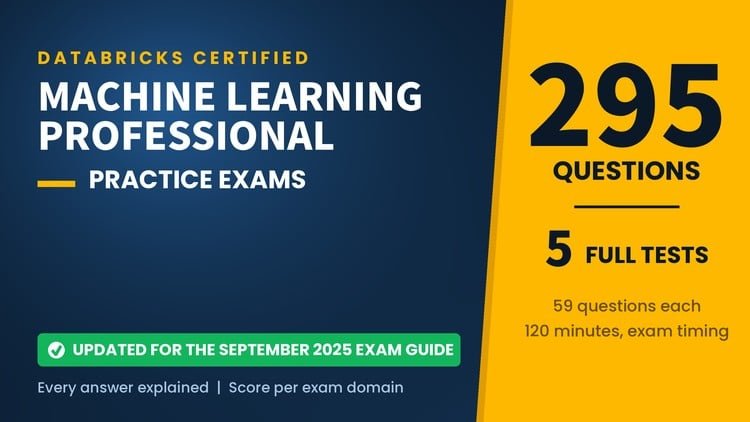
Model Development, MLOps and Model Deployment: 295 exam-weighted questions with explained answers and sources
What You Will Learn:
- Sit five full-length, exam-weighted practice tests for the Databricks ML Professional exam, updated to the September 2025 exam guide.
- Test yourself on Model Development, MLOps and Model Deployment at the official 44 / 44 / 12 weighting, with per-domain scoring per attempt.
- Tell apart the concepts the exam confuses: applyInPandas and mapInPandas, FeatureLookup and FeatureFunction, aliases and stages.
- Learn why every option is right or wrong from per-answer feedback and an overall explanation linking to the official documentation.
- Build up from single-concept questions to a timed 59-question simulation matching the real exam in length, weighting and difficulty.
- Show more
Alright, let’s talk about this Databricks ML Professional: 5 Practice Tests 2026. As someone who’s been in the trenches of data science and MLOps for a while, and has seen countless certification prep materials come and go, I was keen to put this one through its paces. The promise of 295 exam-weighted questions with explained answers and links back to official docs is a strong selling point, especially with the upcoming exam guide changes.
Overview
My initial impression is that this isn’t just a quick-and-dirty question bank. The focus on the specific weighting (44% Model Development, 44% MLOps, 12% Model Deployment) is a huge plus. This signals a deep understanding of what the actual Databricks ML Professional exam is trying to assess. What really stood out to me were the examples of concepts they explicitly mention differentiating, like `applyInPandas` vs. `mapInPandas` and `FeatureLookup` vs. `FeatureFunction`. These are precisely the kinds of subtle-but-critical distinctions that trip people up in high-stakes certification exams. It suggests the creators have really dug into common pitfalls and are addressing them head-on. The progression from single-concept questions to full-length, timed simulations is also a smart pedagogical approach, allowing for both granular learning and comprehensive assessment. It feels designed to build confidence and solidify understanding, not just rote memorization.
Prerequisites
This isn’t for the absolute beginner dipping their toes into data science. You’ll need a solid foundation in machine learning principles, Python programming, and a good working knowledge of the Databricks platform itself. Familiarity with core ML libraries like scikit-learn, TensorFlow, or PyTorch will be beneficial, as will some understanding of cloud concepts, especially if you’re aiming for job-ready skills. If you’re coming from a background where you’ve already worked on real-world projects or completed introductory Databricks courses, you’ll be in a much better position to leverage this material for career growth.
Skills & Tools
This practice test suite is laser-focused on validating your expertise with Databricks’ ML ecosystem. You’ll be tested on your ability to build, manage, and deploy machine learning models within the Databricks environment. This includes proficiency in:
- Model Development using Databricks features like MLflow tracking, feature stores, and distributed training.
- MLOps practices such as CI/CD for ML, model versioning, and monitoring.
- Model Deployment strategies including batch inference and real-time serving.
- Key Databricks libraries and APIs relevant to ML workflows.
The emphasis on industry-standard tools is implicit, as Databricks itself is a leading platform in the MLOps space. This material will help you transition from theoretical knowledge to practical application, which is crucial for developing job-ready skills.
Career Benefits & Job Roles
Successfully passing the Databricks ML Professional exam opens doors to a variety of roles. Think Machine Learning Engineer, MLOps Engineer, Data Scientist with an MLOps focus, and even roles in AI Platform Engineering. This certification demonstrates a verifiable competency that employers actively seek. It signals that you can not only build models but also integrate them into production systems reliably and efficiently. This is a significant differentiator in the competitive tech landscape and directly contributes to career growth.
Pros
- Targeted and Exam-Focused: The 5 full-length tests with precise weighting are invaluable for effective certification prep. It’s clear this material was built with the exam blueprint in mind.
- Deep Explanations: The per-answer feedback and explanations, linked to official documentation, are a massive step up from generic Q&A. This is where real learning happens, moving beyond just identifying correct answers to understanding the ‘why’.
- Concept Clarification: The explicit focus on differentiating confusing concepts is a brilliant touch. It shows an understanding of where candidates typically struggle and provides targeted reinforcement.
- Progressive Difficulty: The build-up from single-concept questions to full simulations allows for a structured learning path, catering to different stages of readiness from beginner to advanced.
Cons
My main critique is that while the practice tests are excellent for validating knowledge and preparing for the exam format, they are not a substitute for practical, hands-on experience. You’ll still need to engage with hands-on labs and build your own real-world projects on the Databricks platform to truly internalize the concepts. This practice test suite is a powerful tool for the final stages of your preparation, but it shouldn’t be your sole learning resource from scratch.