Bridging Science and Clinical Practice
What you will learn
Fundamentals of Embryology
Clinical Application
Reproductive Biology
Genetic Screening and Diagnosis
Why take this course?
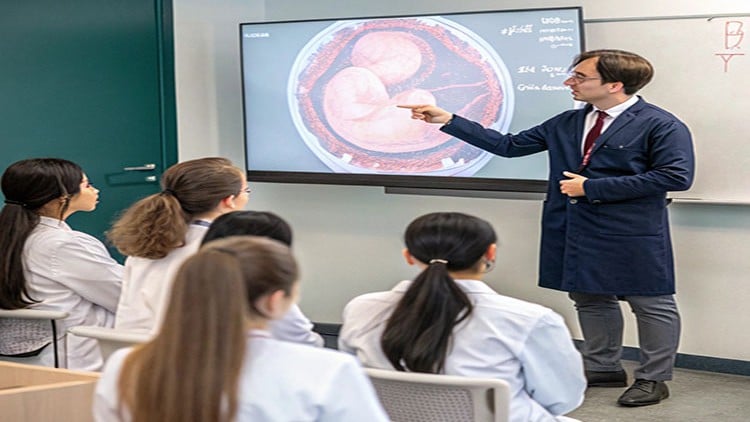
Embark on a fascinating journey through the wonders of human embryology! This course explores the remarkable process of how a single cell transforms into a complex human being. We will cover key developmental stages, cellular differentiation, organogenesis, and the impact of genetic and environmental factors on prenatal development. The course is ideal for students seeking a solid foundation in human embryology.
This comprehensive course delves into the intricate process of human development, from fertilization to birth. Through a blend of theoretical and practical approaches, students will gain a deep understanding of the key events, cellular and molecular mechanisms, and clinical implications of embryology. The course is designed for students in all health fields, including medical, nursing, and allied health professions, as well as healthcare professionals seeking to enhance their knowledge of human development.
potential Course Topics:
- Gametogenesis: Sperm and oocyte formation
- Fertilization and Early Embryonic Development: Cleavage, implantation, gastrulation
- Organogenesis: Development of major organ systems (e.g., cardiovascular, nervous, musculoskeletal)
- Fetal Development: Growth, maturation, and placental function
- Teratology: Congenital anomalies and their causes
- Clinical Embryology: Prenatal diagnosis, assisted reproductive technologies
- Molecular and Cellular Mechanisms of Development: Gene expression, signaling pathways, stem cells
- this course for students and professionals in the healthcare field who need to learn or review human embryology. It effectively combines scientific information with clinical applications, making it relevant and engaging for learners.
Overview: More Than Just Cells and Petri Dishes
Let’s be honest: most biology courses feel like a never-ending PowerPoint presentation on things we can’t see with the naked eye. But “Clinical Embryology: From Concept to Practice” isn’t your standard academic snooze-fest. Having spent years navigating the tech side of medical diagnostics, I’ve seen plenty of programs that claim to be “practical” but end up being purely theoretical. This course, however, actually manages to bridge the gap between heavy-duty science and the high-stakes environment of a modern fertility clinic. It’s essentially a comprehensive roadmap for anyone looking to get their hands dirty—metaphorically and literally—in the world of Assisted Reproductive Technology (ART).
What I found refreshing was the “under the hood” look at how a lab actually functions. We aren’t just talking about the miracle of life; we’re talking about standard operating procedures, the physics of micro-pipetting, and the logistics of cryopreservation. It’s an intensive dive into why a blastocyst succeeds or fails, viewed through the lens of a practitioner rather than just a researcher. If you’re tired of surface-level webinars, this is the deep dive you’ve been looking for. It takes you from beginner to advanced concepts without losing the thread of why this matters in a clinical setting.
Prerequisites: Who Should Sign Up?
Don’t expect to walk into this if you haven’t touched a microscope since high school. While the course is marketed as a beginner to advanced journey, you really need a solid foundation in biological sciences—think a degree in Biology, Biochemistry, or Medicine. If you’re coming from a tech background like I did, you’ll need to brush up on your molecular biology basics. That said, the course does a great job of leveling the playing field in the early modules before things get heavy. It’s perfect for medical graduates, lab technicians looking for career growth, or even biotech professionals who need to understand the clinical application of their products.
Skills & Tools: The Embryologist’s Tech Stack
The curriculum doesn’t shy away from industry-standard tools. You’ll get exposure to the software and hardware that define modern IVF labs. We’re talking about more than just microscopes; the course covers:
- Micromanipulation systems for ICSI (Intracytoplasmic Sperm Injection).
- Time-lapse imaging software for non-invasive embryo monitoring.
- Genetic screening protocols, specifically PGT-A and PGT-M workflows.
- Vitrogenation and cryopreservation equipment management.
- Real-world projects involving simulated lab data analysis to sharpen your diagnostic eye.
Career Benefits & Job Roles: The ROI
If you’re looking for job-ready skills, this is where the course pays for itself. The fertility industry is booming, and there is a massive shortage of skilled embryologists who actually understand the “why” behind the “how.” Completing this program puts you in a prime position for career growth in several high-demand roles:
- Clinical Embryologist: The most direct path, working in private or hospital-based IVF clinics.
- Lab Manager: Using the operational knowledge to oversee QA/QC (Quality Assurance/Quality Control) in reproductive labs.
- Genetic Counselor Support: Bridging the gap between the lab results and patient-facing clinicians.
- ART Consultant: Working for biotech firms that develop the next generation of industry-standard tools.
The focus on certification prep is also a major plus. Many of the modules align directly with what you’ll encounter on professional board exams, making the transition to a certified professional much smoother.
The Pros: What They Got Right
- Hands-on Labs: The integration of hands-on labs (even in hybrid formats) ensures you aren’t just a “book smart” embryologist but someone who can actually handle the hardware.
- Real-World Projects: You aren’t just memorizing stages of cleavage; you’re analyzing case studies and troubleshooting why a specific culture media might be underperforming.
- Networking Opportunities: The instructors aren’t just academics; they are industry veterans. The access to their insights on career growth and clinic politics is worth the price of admission alone.
- Future-Proofing: By including heavy sections on genetic screening and diagnosis, the course ensures you’re prepared for where the industry is heading, not just where it is now.
The Cons: A Reality Check
If I have one gripe, it’s the sheer intensity of the schedule. This isn’t a “do it in your spare time” kind of course. The volume of information—from reproductive biology to complex genetic screening—is massive. If you’re working a full-time 9-to-5, you might find yourself feeling overwhelmed by the mid-way point. They could probably benefit from breaking the advanced modules into a separate certification to let the basics breathe a bit more. It’s an “all-in” commitment, so make sure your calendar is clear before you sign up.