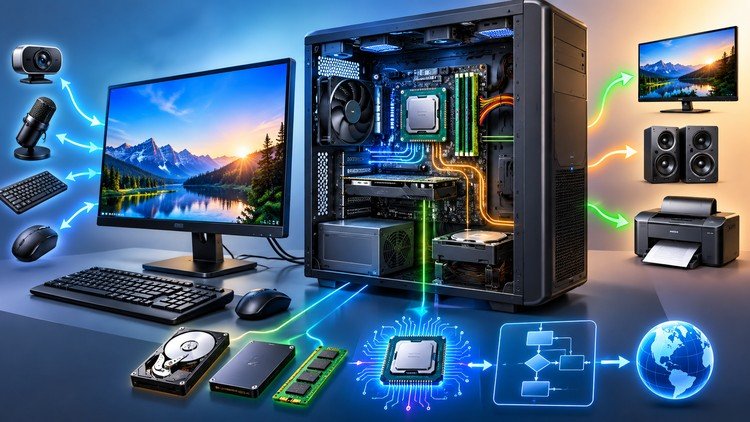
Learn binary, logic gates, CPU design, and assembly by building an 8-bit computer from scratch — no experience required.
What You Will Learn:
- Convert between decimal and binary, and understand two’s complement negative numbers
- Perform binary addition and subtraction by hand
- Build logic gates into functional circuits (selectors, adders)
- Design a half-adder and full-adder, then chain them into a multi-bit ALU
- Add subtraction capability to an ALU circuit
- Understand sequential logic: latches and flip-flops for data storage
- Show more
Alright, let’s talk about the ‘Build a Computer From Scratch: Binary to CPU to Assembly’ course. As someone who’s been in the tech trenches for a while, I’m always on the lookout for learning experiences that genuinely build a foundational understanding, not just surface-level familiarity. This course promised a deep dive from the ground up, and I have to say, it largely delivered. If you’ve ever looked at a server rack or a complex circuit board and wondered how it all *actually* works, this is your jumping-off point.
Overview
This isn’t your typical “drag and drop” coding bootcamp. The course takes a refreshingly academic, yet incredibly practical, approach. It starts by grounding you in the absolute bedrock: binary and its arithmetic. You’re not just told how it works; you’re doing it by hand. Then, it escalates to the fundamental building blocks of computation – logic gates. This is where things get really tangible. You’re not abstractly learning about AND/OR/NOT; you’re seeing how they’re combined to perform calculations. The real magic happens as you progress to designing an Arithmetic Logic Unit (ALU). This is the heart of any processor, and understanding how it’s constructed, even at an 8-bit level, provides an unparalleled insight into how modern CPUs operate. The transition to sequential logic, like latches and flip-flops, then lays the groundwork for understanding memory and state, which is crucial for grasping how programs are actually executed. It’s a systematic build, and by the end, you’ve pieced together a functional, albeit simple, 8-bit computer. This hands-on building aspect is a significant differentiator.
Prerequisites
The course proudly states “no experience required,” and for the most part, they’re right. However, I’d add a caveat. While you don’t need to be a seasoned programmer or electrical engineer, a certain level of comfort with problem-solving and a genuine curiosity for how things work under the hood are essential. If you get easily frustrated by abstract concepts or enjoy tackling intricate puzzles, you’re in for a treat. A basic familiarity with mathematical concepts (addition, subtraction) is assumed, but the binary conversion and arithmetic are taught from scratch.
Skills & Tools
The core of this course is about building job-ready skills that are often overlooked in more specialized training. You’ll gain a deep understanding of:
- Digital logic design: The ability to design and analyze combinatorial and sequential circuits.
- Computer architecture fundamentals: How CPUs are structured and how they execute instructions.
- Assembly language principles: Understanding the lowest level of programming and how it interacts with hardware.
- Troubleshooting: The iterative process of building and debugging complex systems.
The primary “tools” are conceptual: your brain, pen, and paper for manual exercises. As you progress, you’ll likely be using simulation software (though the course might guide you on specific choices, or leave it open for exploration) to test your circuit designs. This is where the real-world projects aspect really shines, even if it’s a simulated environment.
Career Benefits & Job Roles
While this course won’t get you a certification in the latest cloud framework overnight, the foundational knowledge it imparts is invaluable for a number of reasons. It’s excellent for anyone looking at roles in:
- Embedded systems development
- Hardware design and verification
- Low-level programming
- Computer architecture research
- Firmware engineering
Even for software engineers, a solid grasp of computer architecture can significantly improve performance tuning and debugging capabilities. It’s a path that could lead to career growth by providing a unique, differentiated skillset. This kind of deep understanding can be a real differentiator in interviews, especially for roles where a strong grasp of fundamentals is prioritized over just knowing specific industry-standard tools.
Pros
- Unparalleled Fundamental Understanding: You don’t just learn *about* computer architecture; you actively build it, fostering a retention that passive learning can’t match.
- Hands-On, Iterative Learning: The step-by-step construction, from logic gates to a functional CPU, makes complex concepts digestible and engaging.
- Bridging the Gap: It effectively bridges the gap between theoretical computer science and practical hardware implementation, a crucial area for many advanced tech roles.
Cons
The biggest hurdle, and it’s a significant one, is the steep learning curve if you have absolutely zero background in electronics or logic. While the course is designed for beginners, the sheer volume of new concepts being introduced rapidly, especially in the transition from binary to logic gates and then to complex ALU designs, can be overwhelming at times. It requires sustained effort and a willingness to re-read and re-watch sections if things don’t click immediately. It’s not a course you can passively coast through; you have to actively engage with the material.