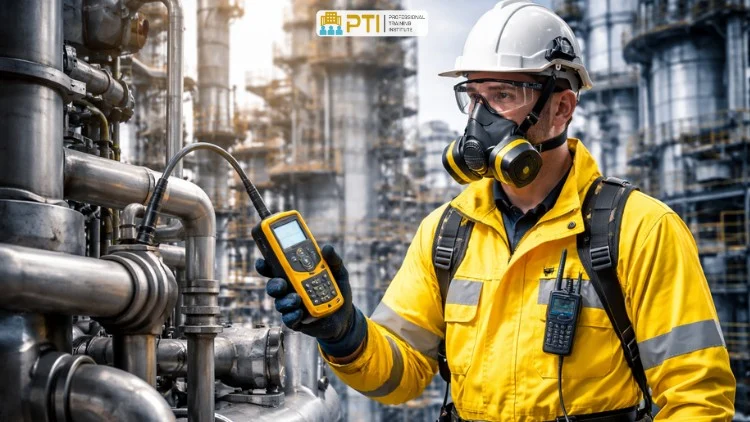
Become a competent AGT: gas detector calibration, atmospheric testing, permit-to-work, and oxygen/LEL/H₂S limits
⏱️ Length: 3.4 total hours
👥 128 students
🔄 April 2026 update
Add-On Information:
Note➛ Make sure your 𝐔𝐝𝐞𝐦𝐲 cart has only this course you're going to enroll it now, Remove all other courses from the 𝐔𝐝𝐞𝐦𝐲 cart before Enrolling!
- Course Overview
- Explore the global regulatory landscape including specific OSHA, HSE, and IMO mandates that dictate the legal necessity for certified atmospheric monitoring in high-risk industrial sectors.
- Analyze the physics of gas stratification within varied containment structures, moving beyond basic testing to understand how vapor density influences gas behavior in layered environments.
- Evaluate the Authorized Gas Tester’s role in the broader permit-to-work (PTW) ecosystem, focusing on how gas clearance certificates integrate with mechanical and electrical isolation procedures.
- Investigate the chemistry of inerting and purging, providing a deep dive into the use of nitrogen and carbon dioxide to displace hazardous atmospheres before human entry or hot work begins.
- Review the principles of industrial hygiene and how the AGT acts as the primary barrier against long-term chronic exposure to sub-lethal concentrations of volatile organic compounds (VOCs).
- Examine the human element of safety, focusing on how the AGT manages site pressure, communication with entry supervisors, and the authority to stop work in deteriorating conditions.
- Study the evolution of gas detection technology, comparing legacy catalytic bead sensors with modern infrared and photoionization technologies used in the 2026 industrial landscape.
- Requirements / Prerequisites
- A foundational understanding of workplace safety protocols, ideally having completed a basic site induction or a general health and safety awareness module prior to enrollment.
- Proficiency in basic mathematical calculations, necessary for converting parts per million (PPM) to percentages and calculating displacement volumes during ventilation exercises.
- Familiarity with Material Safety Data Sheets (MSDS) and the ability to interpret chemical properties such as flash points, vapor pressure, and specific gravity.
- Cognitive readiness to handle high-responsibility decision-making, as the AGT role requires a high level of integrity and the ability to remain calm under emergency scenarios.
- Physical capability to handle sensitive technical equipment and navigate industrial environments where testing might occur at heights or near restricted openings.
- Access to a stable digital learning environment to engage with the April 2026 updated software simulations and interactive hardware modules included in the curriculum.
- Skills Covered / Tools Used
- Mastery of Photoionization Detectors (PID) for the precise measurement of complex hydrocarbon chains and volatile toxins that standard multi-gas monitors may overlook.
- Application of Flame Ionization Detection (FID) techniques in specialized environments where high-sensitivity methane detection is a critical safety requirement.
- Utilization of remote sampling equipment, including aspirated pumps and extension probes, to conduct pre-entry checks without compromising the tester’s safety.
- Implementation of wireless telemetry and cloud-based monitoring, allowing for real-time data transmission from the work zone to a centralized safety command center.
- Proficiency in cross-sensitivity analysis, learning how to interpret “poisoned” sensors or false positives caused by the presence of non-target interfering gases.
- Advanced data logging and digital record-keeping, using specialized software to generate audit-ready gas clearance certificates that meet 2026 compliance standards.
- Execution of bump testing protocols using docking stations or manual regulators to verify sensor response times and alarm functionality before every work shift.
- Benefits / Outcomes
- Gain professional accreditation that is recognized across the oil, gas, maritime, and construction industries, significantly increasing your marketability for HSE leadership roles.
- Achieve the competency to reduce corporate liability by ensuring all gas testing is performed according to the most recent international safety benchmarks and legal standards.
- Develop the critical thinking skills required to troubleshoot failing detection equipment in the field, preventing unnecessary and costly work stoppages.
- Obtain enhanced career mobility, as this certification serves as a prerequisite for many high-paying offshore and specialized refinery positions worldwide.
- Cultivate a proactive safety culture within your organization by training others on the nuances of atmospheric hazards and the limitations of portable detection gear.
- Enhance emergency response coordination, as the AGT often serves as the primary technical advisor to rescue teams during atmospheric-related incidents.
- Pros
- Includes cutting-edge 2026 updates, ensuring learners are trained on the most current hardware and legal requirements rather than outdated 20th-century safety models.
- The condensed 3.4-hour format maximizes time efficiency, delivering high-impact technical knowledge without the filler content found in traditional multi-day seminars.
- Focuses on practical industrial application, bridging the gap between theoretical chemistry and the grit of real-world hot work and confined space operations.
- The course caters to a global audience, making it applicable for professionals working under various international jurisdictions and safety management systems.
- Cons
- While the course provides comprehensive theoretical and procedural mastery, it requires supplemental hands-on equipment familiarization to account for the specific hardware brands used at an individual’s specific job site.
Learning Tracks: English,Business,Operations
Found It Free? Share It Fast!