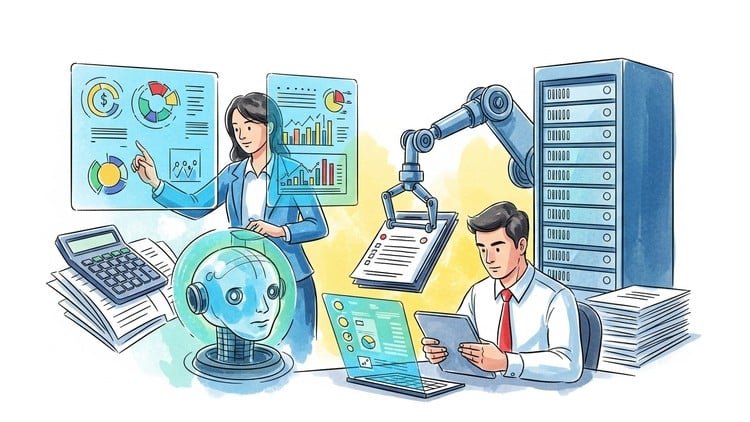
Master AI-driven Automation and Analytics to Revolutionize Accounting Practices
What You Will Learn:
- How to leverage AI technologies to automate key accounting processes such as revenue recognition, billing, collections, expense management, and period-end close
- Techniques for using AI-driven pattern recognition and predictive analytics to enhance accuracy, risk detection, and financial forecasting.
- Hands-on knowledge of popular AI tools and their integration within accounting systems and ERP platforms.
- Ethical considerations, data privacy protocols, and strategies for adapting accounting roles toward AI-enabled advisory and decision support.
Overview: Beyond the Spreadsheet Grind
Let’s be honest: the accounting world has been bracing for an “AI takeover” for years, but most of the advice out there is either too academic or just plain scary. When I dove into AI in Accounting Profession-The Guide To Practical Insights, I wasn’t looking for another lecture on why robots are coming for my job. I wanted to know how to make the robots do the grunt work so I could actually provide value. This course cuts through the fluff. It moves past the “what is AI” basics and gets straight into the plumbing of modern finance—showing you exactly how to rewire traditional workflows.
What struck me most was the focus on the “Black Box” problem. Most accountants are terrified of trusting a machine with revenue recognition or period-end closes because they don’t understand the logic. This course bridges that gap. It’s not just about clicking buttons; it’s about becoming a data architect. We’re talking about moving from a retrospective “what happened” mindset to a proactive predictive analytics approach. If you’ve been feeling like a glorified data entry clerk, this is the pivot point where you start acting like a strategic partner. It’s one of the few programs I’ve seen that treats hands-on labs as a core component rather than an afterthought, ensuring you walk away with job-ready skills that actually translate to a Monday morning at the office.
Prerequisites
You don’t need to be a Python wizard to get value here, but this isn’t exactly a “day one” course for someone who doesn’t know a debit from a credit. To really maximize the ROI on your time, you should have:
- A solid foundation in core accounting principles (GAAP or IFRS).
- Intermediate-to-advanced proficiency in Excel (if you’re comfortable with VLOOKUPs and Pivot Tables, you’re ready).
- A basic understanding of how ERP platforms (like NetSuite, SAP, or Oracle) function within a business ecosystem.
- A “tech-curious” mindset—you need to be willing to break old habits to embrace automation.
Skills & Tools Covered
The curriculum is packed with industry-standard tools and methodologies. You aren’t just learning theory; you’re seeing how AI-driven pattern recognition replaces manual sampling in audits and how machine learning models can flag anomalies in expense management before they become a compliance nightmare. Key focus areas include:
- Automated Revenue Recognition: Streamlining complex contract reviews using NLP.
- Predictive Financial Forecasting: Using historical data to build more accurate budget models.
- ERP Integration: How to hook AI modules into existing cloud accounting stacks.
- Risk Detection: Deploying AI to identify fraud patterns that human eyes usually miss.
- Data Privacy & Ethics: Navigating the messy world of data sovereignty and bias in algorithmic decision-making.
Career Benefits & Job Roles
The career growth potential here is massive because you’re positioning yourself at the intersection of finance and technology. This course acts as a certification prep powerhouse for those looking to pivot into high-compensation niches. By completing the real-world projects, you’re building a portfolio that proves you can handle the “Finance 2.0” landscape. Potential roles include:
- AI Implementation Specialist: Helping firms migrate from legacy systems to AI-enabled workflows.
- Financial Data Analyst: Moving beyond reporting to provide deep-dive predictive insights for the C-suite.
- Audit Innovation Manager: Leading the charge in tech-driven compliance and risk management.
- Strategic CFO Advisor: Shifting the role from “bookkeeper” to “strategic growth partner.”
Pros
- Practicality over Hype: The course focuses on practical insights you can use immediately, like automating the period-end close, rather than theoretical AI “pie-in-the-sky” concepts.
- Hands-on Experience: The hands-on labs are excellent. They force you to interact with industry-standard tools, which is vital for building confidence.
- Future-Proofing: It addresses the beginner to advanced spectrum, making it a great roadmap for long-term career growth in an increasingly automated field.
- Ethical Framework: I appreciated the deep dive into data privacy; it’s an often-ignored topic that is critical for any professional handling sensitive financial data.
Cons
If I have one gripe, it’s that the section on ERP integration can feel a bit overwhelming if you aren’t already familiar with the back-end of a major system like SAP. It’s a steep learning curve for those who have only used small-business software like QuickBooks, and you might find yourself needing to re-watch those modules a few times to truly grasp the technical architecture.