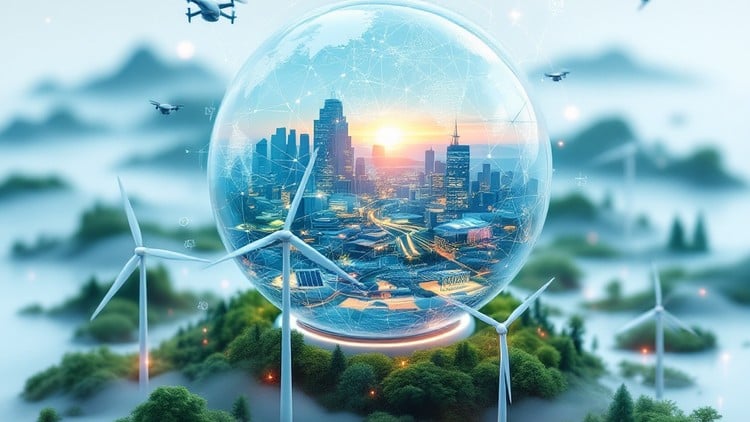
Master AI for climate, energy, and nature — plus the hidden footprint of AI itself and how to manage it responsibly
What You Will Learn:
- Map any AI-sustainability project onto a clear dual lens of impact and footprint
- Evaluate AI applications in monitoring, energy, climate, agriculture, and circular economy
- Quantify and interpret the energy, water, and hardware footprint of modern AI systems
- Apply efficient architectures, carbon-aware computing, and green procurement practices
- Embed AI emissions into corporate sustainability reporting and governance structures
- Spot greenwashing and weak baselines in AI sustainability claims with confidence
- Navigate the global policy landscape including the EU AI Act and CSRD requirements
- Decide when AI is the right tool and when simpler approaches deliver better outcomes
- Design AI use cases that are credibly net positive over realistic time horizons
In a world grappling with urgent environmental challenges, the conversation around Artificial Intelligence often oscillates between its potential as a savior and its undeniable, growing ecological footprint. The course, ‘AI & Environmental Sustainability: A Strategic Guide,’ doesn’t just enter this crucial dialogue; it provides a much-needed roadmap for navigating it with intelligence and integrity. As an experienced tech professional, I’ve seen countless courses promise the moon, but this one delivers a grounded, pragmatic, and incredibly timely perspective.
What struck me immediately is how this program courageously tackles the elephant in the room: AI’s own carbon, energy, and water demands. It’s not just about how AI can help monitor deforestation or optimize smart grids – which it covers brilliantly – but also about the hidden costs of training that mammoth LLM or deploying extensive edge computing. This course doesn’t just teach you to build; it teaches you to build *responsibly* and *strategically*. You’ll walk away with the critical thinking framework to assess whether AI is genuinely a net positive solution for a given environmental problem, or if a simpler, less resource-intensive approach would yield better results. It’s about becoming a leader who can design truly credibly net-positive AI initiatives, rather than just chasing hype or inadvertently contributing to the very problems you’re trying to solve.
Prerequisites
While the course description might imply a broad audience, to truly extract maximum value, I’d recommend a solid foundational understanding of both domains. You don’t need to be a senior ML engineer, but familiarity with core AI/ML concepts – data pipelines, model training basics, deployment considerations – will be immensely helpful. Similarly, a basic grasp of environmental sustainability principles like carbon accounting, energy efficiency, and lifecycle assessments will allow you to hit the ground running. This isn’t a “beginner to advanced” course in either AI *or* sustainability; it’s designed for intermediate to advanced tech professionals, data scientists, and strategists looking to specialize at their intersection. If you’re coming in cold on both fronts, be prepared for a steep, but rewarding, learning curve.
Skills & Tools
This course equips you with an impressive toolkit of both analytical and strategic skills. You’ll develop the ability to expertly evaluate AI applications across critical sectors like climate, energy, agriculture, and the circular economy. Crucially, you’ll learn to quantify and interpret the environmental footprint (energy, water, hardware) of modern AI systems, moving beyond vague estimates to concrete metrics. The curriculum delves into applying efficient architectures, carbon-aware computing principles, and green procurement practices, making you proficient in integrating sustainability at every stage of the AI lifecycle. Beyond the technical, you’ll gain crucial skills in embedding AI emissions into corporate sustainability reporting and governance, becoming adept at spotting greenwashing tactics and navigating the complex global policy landscape, including the impactful EU AI Act and CSRD requirements. While specific industry-standard tools aren’t the primary focus, the methodologies taught are universally applicable to platforms like AWS, Azure, and GCP, empowering you to implement these strategies regardless of your tech stack.
Career Benefits & Job Roles
The demand for professionals who can bridge the gap between AI innovation and environmental responsibility is skyrocketing. Completing this course significantly boosts your career growth potential, positioning you as a highly sought-after expert. You’ll gain genuinely job-ready skills applicable to a diverse range of roles, including: Sustainability Consultant specializing in AI, AI Ethicist, Environmental Data Scientist, ML Engineer with an ESG focus, Product Manager for Green AI Solutions, and even strategic roles within CTO/CIO offices tasked with sustainable technology adoption. The depth of understanding you’ll gain, particularly around policy and governance, provides a competitive edge, making this almost a form of certification prep for a niche that’s only going to grow in importance. You’ll be able to lead real-world projects, advise leadership, and build innovative solutions that genuinely make a difference.
Pros
- Unflinching Dual Perspective: The course stands out for its honest and comprehensive exploration of both AI’s immense potential for environmental good and its significant, often overlooked, ecological footprint. This balanced view is refreshing and essential for credible work in the field.
- Strategic & Policy Acumen: It goes beyond technical implementation, diving deep into strategic decision-making frameworks, corporate governance, and the vital global policy landscape (EU AI Act, CSRD). This equips learners with the high-level understanding needed to influence organizational direction.
- Practical Greenwashing Detection: The ability to “spot greenwashing and weak baselines” is an invaluable skill in today’s market. The course provides concrete methods and critical thinking tools to cut through marketing hype and assess genuine sustainability claims.
- Actionable Net-Positive Design: Rather than just identifying problems, the course empowers you to design AI use cases that are verifiably “net positive over realistic time horizons,” offering a crucial framework for responsible innovation and impactful real-world projects.
Cons
- Demanding Prerequisite Knowledge: While excellent for its target audience, the course assumes a fairly strong existing foundation in both AI/ML concepts and basic sustainability principles. Absolute beginners in either domain might find the pace challenging, potentially limiting accessibility for those eager to enter this interdisciplinary field without prior exposure.