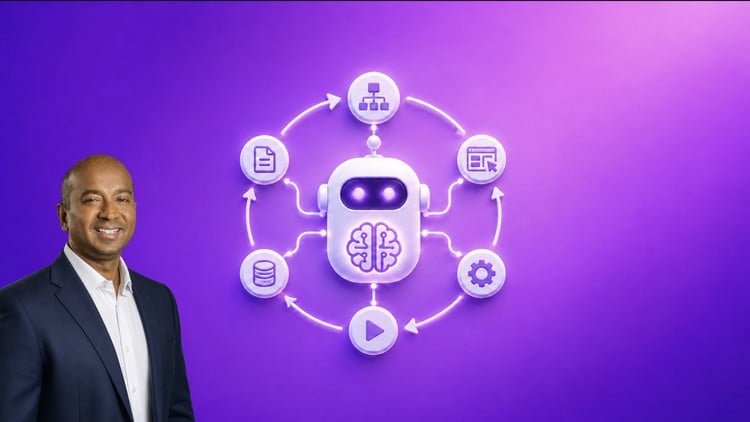
Build intelligent AI agents, automate workflows, connect tools, and design reliable agentic systems for real-world tasks
What You Will Learn:
- Explain what AI agents are and how they differ from traditional chatbots, scripts, and automation tools.
- Understand the core components of an AI agent, including goals, instructions, tools, actions, planning, and memory.
- Identify when to use single-agent, multi-agent, and orchestrated agent architectures.
- Design agent workflows that break complex goals into smaller, manageable tasks.
- Understand how AI agents select and call external tools, APIs, databases, and business applications.
- Create workflows for automating repetitive, rule-based, and knowledge-intensive tasks.
- Show more
Overview: Beyond the Chatbot Hype
Let’s be real—the market is currently flooded with generic “AI for Business” courses that do little more than teach you how to write a slightly better prompt. If you’ve been in the tech industry for more than a minute, you know that the real value isn’t in chatting with a bot; it’s in building systems that actually do the work. This is where the “AI Agents and Automation” course caught my attention. It moves past the surface-level fluff and dives straight into the “agentic” shift—the transition from static, rule-based automation to dynamic, autonomous systems that can reason, plan, and execute.
In my experience, the biggest hurdle for developers and architects today isn’t the LLM itself; it’s the orchestration. We’ve all seen scripts that break the moment a variable changes. This course tackles that fragility head-on. It reframes the AI as a reasoning engine rather than just a text generator. The original insights here focus on the “loops”—how an agent checks its own work, handles errors, and decides when to call a specific tool versus when to keep thinking. It’s an honest, deep dive into the plumbing of the next decade of software engineering. If you’re tired of “Hello World” tutorials and want to build production-grade AI systems, this is the shift you need to make.
Prerequisites
You don’t need a PhD in Machine Learning, but this isn’t a “no-code” miracle course either. To get the most out of the hands-on labs, you should have:
- A solid grasp of Python (specifically handling JSON, APIs, and asynchronous functions).
- Familiarity with the command line and basic environment management.
- A foundational understanding of how Large Language Models (LLMs) work (tokens, context windows, and basic prompting).
- A “builder” mindset—you need to be comfortable with the trial-and-error nature of non-deterministic software.
Skills & Tools Covered
This course acts as a comprehensive certification prep for anyone looking to claim the title of “AI Engineer.” You aren’t just learning theory; you’re getting your hands dirty with industry-standard tools. Key highlights include:
- Frameworks: Deep dives into LangChain and CrewAI for multi-agent orchestration.
- Memory Management: Implementing Vector Databases (like Pinecone or Weaviate) to give your agents long-term “knowledge.”
- Tool Integration: Connecting agents to external APIs, SQL databases, and web search tools using Function Calling.
- Architectural Patterns: Mastering the difference between a simple ReAct loop and complex multi-agent collaboration strategies.
- Reliability Engineering: Learning how to build guardrails to prevent your agents from hallucinating or going into infinite loops.
Career Benefits & Job Roles
We are currently seeing a massive shift in the job market. Companies are no longer just looking for “Data Scientists”; they want AI Automation Specialists who can deliver job-ready skills from day one. Completing this course positions you for career growth in several high-paying roles:
- AI Solutions Architect: Designing the high-level flow of how AI interacts with existing enterprise legacy systems.
- Automation Engineer: Moving beyond Zapier and into intelligent process automation (IPA).
- Machine Learning Operations (MLOps): Ensuring that agentic workflows are scalable, observable, and cost-effective.
- Technical Product Manager: Having the technical depth to lead teams building real-world projects involving autonomous agents.
This is a high-value investment. The ability to demonstrate a portfolio of agentic systems is a major differentiator in an increasingly competitive landscape.
The Pros
- Focus on Logic over Syntax: While you do code, the real value is in learning the design patterns. It teaches you how to think like an orchestrator, which is a skill that will outlast any specific software library.
- Real-World Projects: The hands-on labs aren’t just toy examples. You’re building systems that actually interact with the web and databases, giving you a tangible output to show potential employers or clients.
- No More Silos: The course does an excellent job of showing how to bridge the gap between “AI” and “Traditional Software.” It treats AI as a component of a larger system, which is exactly how it works in a corporate environment.
- Beginner to Advanced Pathing: It handles the beginner to advanced transition smoothly. It starts with the “Why” and ends with complex, orchestrated agent architectures without feeling like you’ve skipped a chapter.
The Cons
- The “Bleeding Edge” Tax: Because this field moves at 100mph, some of the specific library syntax in the videos might feel slightly dated within a few months. You’ll need to be proactive about checking documentation, as industry-standard tools in the AI space update their schemas almost weekly. It requires a bit of extra legwork to stay perfectly synced.