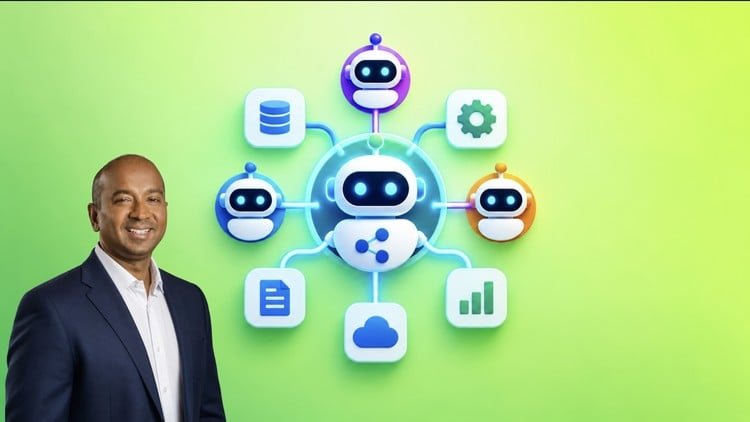
Build MCP tools and servers, orchestrate multi-agent workflows, and implement permissions, testing, and monitoring.
What You Will Learn:
- Build MCP servers to connect AI agents with external tools, APIs, and data.
- Design and orchestrate multi-agent workflows using LangGraph and Python.
- Develop MCP tools with structured schemas, validation, and error handling.
- Connect AI agents to databases, REST APIs, and enterprise applications.
- Implement supervisor agents, task delegation, routing, and agent handoffs.
- Secure AI agents with authentication, permissions, and human approval workflows.
- Monitor, test, and troubleshoot multi-agent systems using logs and tracing.
- Build and deploy a complete MCP-powered multi-agent application.
The Shift from Chatbots to Agentic Ecosystems
If you’ve been following the AI space for more than a week, you know the “chatbot” era is already starting to feel a bit primitive. We’re moving rapidly toward autonomous agents—systems that don’t just talk, but actually do work. But here’s the problem: getting different AI agents to talk to each other and safely access internal data is usually a nightmare of custom glue code. This is where Agent Orchestration and MCP: Build Multi-Agent AI Systems steps in, and honestly, it’s about time someone tackled the Model Context Protocol (MCP) in a structured way.
Most tutorials out there show you how to build a basic wrapper around an LLM. This course is different because it focuses on the “plumbing” and “governance” of AI. It’s one thing to have a model write a poem; it’s another thing entirely to have a multi-agent system browse your database, cross-reference it with a REST API, and then ping a human for approval before executing a transaction. This course cuts through the hype and focuses on how we, as developers, can build industry-standard tools that actually survive a production environment.
What I appreciated most was the deep dive into LangGraph. If you’ve used LangChain and felt it was too “magic” or hard to debug, LangGraph is the logical evolution, offering the control needed for complex, cyclical workflows. The course doesn’t just give you a “hello world” example; it pushes you into the deep end of agent orchestration, showing you how to manage state and memory across multiple specialized agents.
Prerequisites
This isn’t a “learn to code” class. To get the most out of these hands-on labs, you should come prepared with:
- Intermediate Python: You need to be comfortable with async/await, decorators, and basic data structures.
- API Fundamentals: Understanding how REST APIs work and how to handle JSON payloads is non-negotiable.
- Basic LLM Knowledge: You should know what a prompt is and have at least a passing familiarity with how tokens and temperature work.
- Environment Management: Familiarity with Docker or virtual environments will save you a lot of headaches during the deployment phase.
Skills & Tools You’ll Master
The curriculum is packed with job-ready skills that are currently in high demand across the tech sector. You aren’t just learning theory; you’re building real-world projects using a professional stack:
- LangGraph & LangChain: For designing stateful, multi-agent graphs and complex logic flows.
- Model Context Protocol (MCP): Learning to build servers that act as a universal interface between AI and data.
- Pydantic: For rigorous data validation and ensuring your agents don’t hallucinate invalid inputs.
- PostgreSQL & Vector DBs: Connecting agents to persistent storage for long-term memory and retrieval.
- Monitoring Tools: Using traces and logs to see exactly where an agentic loop failed (essential for career growth in AI engineering).
Career Benefits & Job Roles
We are currently seeing a massive shift in hiring. Companies are no longer just looking for “AI enthusiasts”; they want AI Engineers and System Architects who can build reliable, scalable automation. Completing this course serves as excellent certification prep for anyone looking to pivot into specialized AI roles.
By mastering MCP and orchestration, you position yourself for high-paying roles such as AI Solutions Architect, LLM Engineer, or Automation Consultant. The ability to implement human-in-the-loop workflows and strict permissioning makes you an asset to enterprise companies that are terrified of letting an AI run wild on their servers. It’s the difference between being a hobbyist and being a professional who understands industry-standard tools.
Pros
- Cutting-Edge Content: MCP is a relatively new standard from Anthropic, and finding high-quality instruction on it is rare. This course puts you ahead of the curve.
- Focus on Security: I loved the emphasis on permissions and human approval. In the real world, you can’t just give an agent your API keys and hope for the best.
- Architecture-First Approach: It teaches you how to think about agent handoffs and supervisor roles, which is critical for scaling from beginner to advanced systems.
- Practical Orchestration: The move from linear chains to complex graphs (LangGraph) is the “lightbulb moment” every AI dev needs.
Cons
- Rapidly Evolving Ecosystem: Because the Model Context Protocol and LangGraph are updating so frequently, you might occasionally find a minor syntax change in the documentation that differs from the video. It requires you to be proactive and check the latest docs, which—to be fair—is just part of being a dev in 2024.
Final verdict? If you’re tired of building “toy” apps and want to understand how the next generation of multi-agent systems is actually built, this is a must-watch. It’s dense, it’s technical, and it’s exactly what’s needed to stay relevant in the current market.