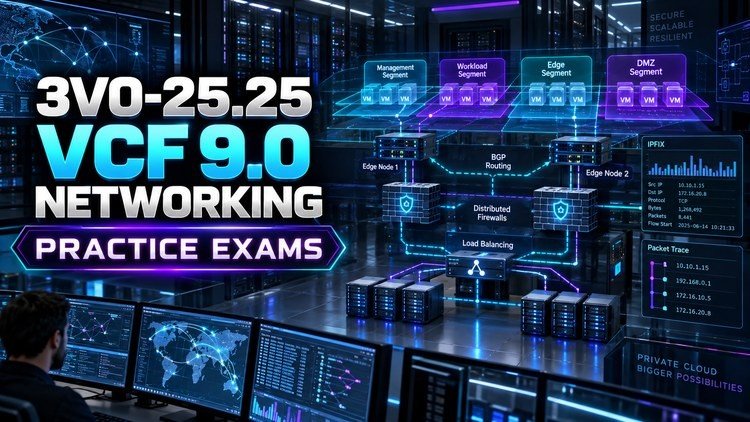
75 original scenario-based questions with detailed explanations for every answer option
What You Will Learn:
- Assess advanced VMware Cloud Foundation networking concepts across the current 3V0-25.25 exam objectives.
- Apply NSX architecture, connectivity, security, resilience, and troubleshooting knowledge to realistic scenarios.
- Identify supported network designs and trade-offs while avoiding common distractors and unsupported shortcuts.
- Use detailed explanations to close knowledge gaps before the 3V0-25.25 exam.
My Take on Mastering the VCF Networking Stack
Let’s be honest: the VMware certification path has changed drastically since the Broadcom acquisition, and the focus is now squarely on VMware Cloud Foundation (VCF). If you’re eyeing the 3V0-25.25 exam, you already know that networking is the most volatile part of the stack. I’ve seen plenty of “brain dumps” in my time, but they rarely prepare you for the actual pressure of a live environment. The 3V0-25.25 VCF Advanced Networking Practice Exams course feels different because it doesn’t just ask you to memorize port numbers; it forces you to think like a Lead Architect. This isn’t just certification prep; it’s a reality check for anyone claiming to be an expert in modern software-defined data centers.
The beauty of this specific set of hands-on labs-inspired questions is how they tackle the “unsupported shortcuts.” In a production environment, taking the easy way out with BGP configurations or MTU settings will eventually lead to a catastrophic failure. These practice exams act as a filter, helping you distinguish between “it works in a lab” and “it works at scale.” If you are tired of generic multiple-choice questions that feel like they were written by a bot, the scenario-based approach here provides a refreshing, albeit challenging, level of depth that mimics the actual industry-standard tools you use daily.
Prerequisites for Success
This is not a beginner to advanced hand-holding session. If you’re jumping into these exams without a solid foundation in NSX or VCF 5.x, you’re going to have a bad time. To get the most out of this course, you should ideally have:
- A current VCP-NV (Network Virtualization) certification or equivalent job-ready skills.
- Experience with hands-on labs focusing on Tier-0 and Tier-1 Gateway configurations.
- A working knowledge of BGP routing protocols and how they interact with physical leaf-spine fabrics.
- Familiarity with the VCF Planning and Preparation Guide—specifically the networking requirements for management and workload domains.
Basically, if you don’t know the difference between an Overlay and an Underlay, go back to the basics before tackling these scenarios.
Developing Your Skills and Mastering the Tools
The core of this course is built around real-world projects and the architectural dilemmas we face in the field. You’ll be digging deep into the NSX Manager, working through edge cluster designs, and ensuring high availability across Multi-AZ (Availability Zone) deployments. The scenarios force you to apply industry-standard tools like VRNI (vRealize Network Insight) logic and NSX Traceflow to troubleshoot connectivity issues within the VCF stack.
You aren’t just learning how to click buttons; you are learning the “why” behind NSX architecture. By the time you finish these 75 questions, your ability to map business requirements to technical constraints—like balancing security through Distributed Firewalls (DFW) versus maintaining peak throughput—will be significantly sharper. It’s about building a mental framework for resilience and troubleshooting that goes far beyond the exam room.
Career Benefits and Job Roles
Earning a VCF Advanced Networking credential is a massive catalyst for career growth. We are currently seeing a huge demand for “Day 2” operations experts who can manage complex hybrid cloud environments. This course prepares you for high-stakes roles such as:
- Cloud Infrastructure Architect: Designing the backbone for massive private clouds.
- Network Security Engineer: Implementing micro-segmentation strategies that actually work without breaking apps.
- VCF Consultant: Guiding enterprises through the transition from legacy vSphere to full-stack VCF.
Having this level of expertise on your resume signals to employers that you aren’t just a generalist; you are a specialist in the most critical component of the modern data center.
What I Liked (The Pros)
- Scenario Authenticity: The questions feel like tickets I’ve actually had to close. They involve complex variables like MTU mismatches and BGP neighbor resets that you don’t find in basic study guides.
- Detailed Explanations: The “why” is more important than the “what.” This course provides exhaustive breakdowns for every single distractor, ensuring you close your knowledge gaps.
- Focus on Trade-offs: It correctly identifies that there is rarely one “perfect” design, teaching you to weigh the pros and cons of different supported network designs.
One Honest Critique (The Cons)
If I have to be picky, the question count (75) is a bit lean if you’re looking for a massive bank to grind for weeks. While the quality is high, I would have liked to see a few more questions specifically dedicated to HCX migration networking, as that is a common pain point in real-world projects when moving workloads into a newly minted VCF environment. However, what is there is pure gold.