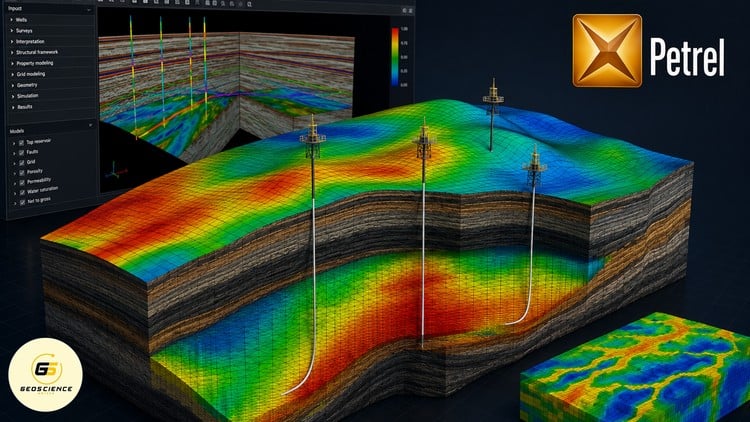
Master Petrel for geological & structural modeling, facies distribution, petrophysics, and volumetric calculations
What You Will Learn:
- Build a strong foundation in reservoir modelling concepts by confidently distinguishing between static and dynamic models
- Navigate and operate Petrel like a professional, mastering its interface, workflows, and domains to efficiently execute geological and reservoir modelling tasks
- Transform raw subsurface data into meaningful geological insights by importing, organizing, and quality-controlling wells, logs, faults, and seismic horizons.
- Interpret subsurface geology in 2D and 3D environments, enhancing your ability to correlate well data and refine geological understanding with precision.
- Construct robust structural and stratigraphic models that accurately represent reservoir architecture, including faults, horizons, and layering frameworks.
- Develop high-quality 3D grid models using pillar gridding and zonation techniques, enabling realistic spatial representation of reservoir properties.
- Show more
Alright, let’s talk about Schlumberger’s Petrel. If you’ve been around the block in subsurface tech, you know this beast is the undisputed king for 3D reservoir modeling. This ‘Complete Subsurface Workflow’ course isn’t just another tutorial; it’s a deep dive into mastering the very heart of how we visualize and understand what’s happening thousands of feet below ground. For anyone serious about a career in upstream energy, CCUS, or even geothermal, getting intimately familiar with Petrel isn’t optional – it’s essential.
Overview
Forget the fluffy intros; this course is about getting your hands dirty with real data and building robust 3D models from the ground up. It brilliantly bridges the gap between raw, often messy, subsurface data – think well logs, seismic surveys, and core analyses – and a coherent, actionable geological model. What truly stands out is the emphasis on the complete subsurface workflow. You’re not just learning a module here or a function there; you’re guided through the entire process: from initial data import and rigorous quality control to sophisticated structural and stratigraphic modeling, and finally, property population and volumetric calculations. It’s less about theoretical concepts and more about practical application, transforming complex geological interpretations into tangible 3D representations that are critical for making informed drilling and production decisions. This hands-on approach is what separates the casual user from someone who can truly drive value using this powerful industry-standard tool.
Prerequisites
Let’s be real, this isn’t for the absolute beginner to geoscience. You’ll need a solid foundational understanding of geology, geophysics, and general oil and gas industry concepts. Basic familiarity with well logs, seismic interpretation, and structural geology principles will serve you well. Most importantly, you’ll need access to Petrel software – whether through a student license, an employer, or a trial version – because the learning here is fundamentally driven by direct interaction with the platform.
Skills & Tools
By the time you’re done, you’ll be navigating Petrel’s intricate interface like a seasoned pro. The course dives deep into data management, teaching you how to import, organize, and perform critical quality control on everything from well paths and deviation surveys to petrophysical logs, fault interpretations, and seismic horizons. You’ll gain expertise in constructing complex structural frameworks, building detailed stratigraphic models, and creating high-quality 3D grid models using pillar gridding and zonation techniques. Beyond the mechanics, you’ll sharpen your 2D and 3D geological interpretation skills, enabling you to confidently correlate well data and perform accurate reservoir characterization. Essentially, you’ll master the art of turning disparate data points into a coherent, spatially accurate 3D reservoir model, ready for advanced volumetric analysis and even dynamic simulation preparation.
Career Benefits & Job Roles
This course isn’t just about learning software; it’s a direct investment in your career growth. Petrel proficiency is a non-negotiable requirement for many roles in the energy sector. Mastering this workflow provides highly sought-after job-ready skills that directly translate into enhanced employability. Professionals with this expertise are crucial in oil and gas exploration and production, carbon capture and storage (CCUS), geothermal energy, and even underground gas storage projects. You’ll be perfectly positioned for roles such as: Reservoir Geologist, Geomodeler, Exploration Geoscientist, Development Geoscientist, and Petrophysicist focusing on geological modeling. The comprehensive nature of the course also serves as excellent preparation for any internal company certification prep or external evaluations requiring advanced Petrel competency, effectively acting as a de-facto certification in the industry.
Pros
- Truly Comprehensive Workflow: This isn’t a piecemeal approach. The course genuinely covers the entire static modeling workflow within Petrel, from raw data ingestion to final volumetric calculations. It’s an ideal way to get from beginner to advanced in a structured, logical progression.
- Hands-on & Practical: The emphasis on hands-on labs and practical application is stellar. You’re constantly working with data, building models, and troubleshooting, which is invaluable for developing genuine proficiency and the confidence needed for real-world projects.
- Mastery of an Industry Standard: Petrel is *the* software. A deep dive into its functionalities and workflows means you’re learning the most relevant and powerful industry-standard tools, making your skills highly marketable.
- Data Integration Focus: The course excels at demonstrating how to integrate diverse subsurface data types (wells, logs, seismic, core) into a single, cohesive model. This holistic view is crucial for effective reservoir characterization.
Cons
- Software Access Dependency: Let’s be honest, Petrel isn’t cheap, and obtaining a personal license can be a significant hurdle. While the course assumes you have access, it might not provide one, which could limit accessibility for independent learners without employer or academic support. This is a common pain point for anyone looking to learn this powerful software outside of a corporate environment.