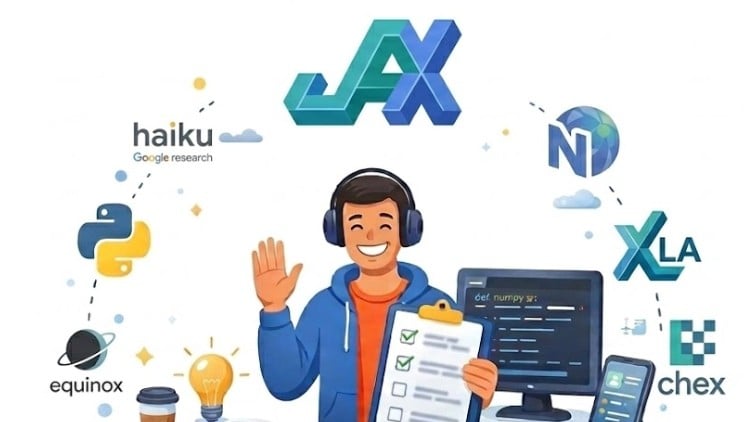
Python JAX Interview Questions Practice Test | Freshers to Experienced | Detailed Explanations for Each Question
What You Will Learn:
- Master Functional JAX: Internalize the “JAX way” by managing immutable arrays, pure functions, and the explicit PRNG state system for reproducible research.
- Expert Transformation Skills: Fluently apply jit, grad, vmap, and pmap to accelerate code, compute high-order derivatives, and vectorize complex operations.
- Scalable Distributed Computing: Deploy models across multiple GPUs and TPUs using the modern jax.Array sharding API and SPMD (Single Program, Multiple Data).
- Neural Network State Management: Navigate the JAX ecosystem (Flax, Equinox, Haiku) to handle model parameters, BatchNorm state, and Optax-based optimization.
Alright, let’s talk about JAX. Specifically, “350+ Python JAX Interview Questions with Answers 2026.” If you’re serious about a career in high-performance machine learning or deep learning research, you’ve probably encountered JAX, or at least heard the buzz. It’s quickly become an indispensable tool for researchers and engineers pushing the boundaries of what’s possible with neural networks and large-scale computations. This course isn’t just another question bank; it’s designed to be a pretty robust ramp-up for anyone looking to solidify their JAX knowledge and ace those tricky technical interviews.
Overview
In the current landscape of AI, libraries like JAX are where innovation truly happens, especially for folks dealing with custom research, novel architectures, or the need for extreme computational efficiency. Unlike some of its more established cousins, JAX demands a slightly different mental model – one rooted deeply in functional programming and explicit state management. This course tackles exactly that paradigm shift head-on. It’s less about memorizing boilerplate and more about internalizing the “JAX way” of thinking about numerical computation, automatic differentiation, and array manipulation. The “2026” in the title suggests a forward-thinking approach, aiming to equip you with knowledge that’s relevant not just for today, but for the evolving demands of the industry. This isn’t just about passing an interview; it’s about building a foundational understanding that contributes significantly to your overall career growth in AI and machine learning engineering.
Prerequisites
Don’t jump into this expecting to learn Python from scratch, or even basic machine learning concepts. This resource assumes a solid foundation. You’ll need to be comfortable with:
- Python Fundamentals: Object-oriented programming, data structures, and general algorithmic thinking in Python.
- Numerical Computing Basics: Familiarity with NumPy is pretty much non-negotiable, as JAX’s API is heavily inspired by it.
- Machine Learning/Deep Learning Concepts: Understanding neural network architectures, backpropagation, and optimization algorithms will help you contextualize many of the JAX applications.
- Some Functional Programming Exposure (Optional but Helpful): If you’ve tinkered with functional concepts before, the immutable arrays and pure functions in JAX will feel more natural. If not, be prepared for a learning curve, but the detailed explanations here should guide you.
This is definitely geared towards individuals who are ready to dive deep into a specialized framework, moving beyond just calling high-level APIs.
Skills & Tools
The course promises to turn you into an expert in a specific set of highly sought-after capabilities, leveraging industry-standard tools within the JAX ecosystem. Here’s what you can expect to master:
- Functional JAX Mastery: You’ll learn to manage immutable arrays, write pure functions, and explicitly handle PRNG states – fundamental concepts for reproducible research and debugging. This is the core “JAX way.”
- Expert Transformation Skills: Getting fluent with
jitfor compilation,gradfor automatic differentiation,vmapfor vectorizing operations, andpmapfor parallelizing computations across devices. These are the superpowers that make JAX incredibly performant for high-performance computing and model optimization. - Scalable Distributed Computing: Deploying models across multiple GPUs and TPUs using the modern
jax.Arraysharding API and SPMD (Single Program, Multiple Data) paradigms. This is crucial for anyone working on large-scale models and distributed training. - Neural Network State Management: Navigating the JAX ecosystem – Flax, Equinox, Haiku – to handle model parameters, BatchNorm state, and Optax-based optimization. This is where JAX meets practical deep learning engineering.
Essentially, you’re looking at acquiring serious job-ready skills that are in high demand for roles ranging from deep learning research to machine learning engineering.
Career Benefits & Job Roles
Mastering JAX, especially through a structured approach like this, can significantly accelerate your career trajectory. The demand for engineers and researchers proficient in JAX is steadily climbing, particularly in companies pushing the envelope in AI. This knowledge isn’t just a “nice-to-have”; it’s a critical differentiator. By going through these questions and explanations, you’re not just doing certification prep; you’re building practical expertise.
Potential job roles that would heavily benefit from this expertise include:
- ML Engineer / Deep Learning Engineer: Developing and deploying high-performance models.
- AI/ML Research Scientist: Designing novel architectures and algorithms, where JAX’s flexibility and AD capabilities are paramount.
- Quantitative Researcher: Especially in fields requiring complex numerical simulations and derivatives.
- Compiler Engineer (with an ML Focus): Understanding how JAX’s transformations work under the hood is invaluable.
The ability to discuss JAX’s core tenets and advanced features confidently in an interview setting will undoubtedly set you apart and open doors to more cutting-edge projects and opportunities.
Pros
- Extensive and Up-to-Date Content: With 350+ questions, covering topics from beginner to advanced, this course offers a truly comprehensive deep dive. The “2026” suggests a commitment to keeping the content current with JAX’s rapid evolution, which is crucial in this fast-paced field.
- Detailed Explanations, Not Just Answers: This is huge. For interview prep, understanding *why* an answer is correct is far more valuable than simply knowing *what* the answer is. These explanations serve as mini-lessons, reinforcing complex JAX concepts.
- Focus on the “JAX Way”: It specifically targets the functional programming paradigm and explicit state management that define JAX. This helps internalize the unique architectural philosophy, making you a more effective and idiomatic JAX developer.
- Directly Addresses Performance & Scalability: By extensively covering
jit,grad,vmap,pmap, and distributed computing, the course prepares you for the real-world challenges of building and deploying high-performance ML systems.
Cons
- Lacks Interactive Hands-on Labs or Real-world Projects: As an “interview questions” resource, it naturally focuses on theoretical understanding and problem-solving through Q&A. While excellent for knowledge reinforcement and certification prep, it doesn’t provide an environment for active coding practice, building real-world projects, or experiencing the debugging process in a live JAX environment. For those who learn best by doing, this would need to be supplemented with other practical resources.