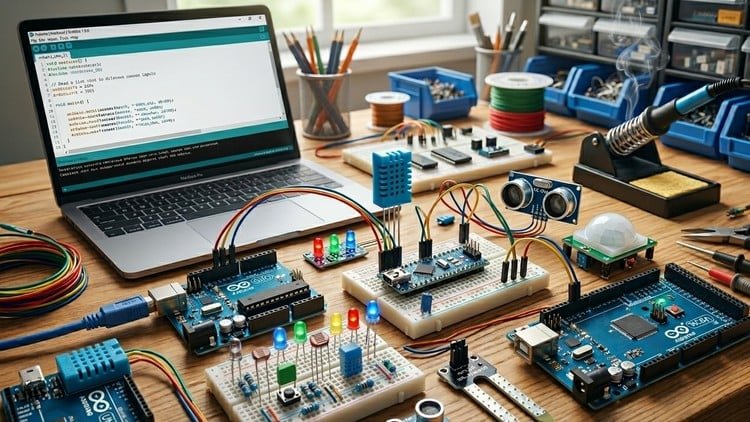
Learn to program Arduino sensors without complex code.
What You Will Learn:
- Understand how different Arduino sensors work and how they interact with microcontrollers in simple step-by-step lessons.
- Learn to connect and configure sensors with Arduino by building circuits and understanding sensor outputs and signal behavior.
- Program sensors using simple block-based coding that helps beginners understand the logic behind embedded programming.
- Read sensor data and control outputs such as LEDs, buzzers, and other components using visual programming methods.
- Understand practical applications of sensors such as distance detection, temperature monitoring, light sensing, and motion detection.
- Understand practical applications of sensors such as distance detection, temperature monitoring, light sensing, and motion detection.
- Show more
Overview
Alright, let's talk about 'Arduino Sensors & Block Coding for Beginners.' If you've ever felt intimidated by the idea of making physical objects interact with code, this course is your golden ticket. I've seen countless programs promise simplicity, but this one genuinely delivers a frictionless entry point into the fascinating world of embedded systems and IoT. What really stands out here isn't just the promise of "no complex code," but how effectively it uses block-based programming as a pedagogical bridge. It's like learning to ride a bike with training wheels – you get the feel for balance and direction without the immediate fear of falling.
Note➛ Make sure your 𝐔𝐝𝐞𝐦𝐲 cart has only this course you're going to enroll it now, Remove all other courses from the 𝐔𝐝𝐞𝐦𝐲 cart before Enrolling!
For me, the value proposition is crystal clear: it demystifies the hardware-software interface. You're not just dragging blocks; you're actively seeing how a physical sensor's input translates into a digital signal that then controls an output. This immediate feedback loop is crucial for beginners, providing instant gratification and reinforcing learning in a way that dry theory simply can't. It's less about memorizing syntax and more about understanding logic, which, frankly, is a far more valuable skill in the long run. This course doesn't just teach you *how* to connect a sensor; it helps you grasp *why* it works that way, fostering a foundational understanding that's essential for any aspiring tech enthusiast looking towards career growth in hardware or software.
Prerequisites
Let's be real: for a course titled 'Beginners,' the prerequisites should be minimal, and this course absolutely nails it. All you truly need is a computer, a willingness to tinker, and perhaps a basic understanding of how to navigate files and install software. No prior coding experience? Great. Never touched a circuit board? Even better. This course is designed to take you from zero to confidently building simple sensor projects. It cleverly bypasses the common hurdle of complex textual syntax, allowing you to focus purely on the concepts of input, processing, and output. Seriously, if you can click a mouse and follow instructions, you're good to go.
Skills & Tools
Upon completion, you won't just have a few functional projects under your belt; you'll possess a genuine toolkit of foundational skills. You'll gain practical experience with various Arduino sensors like ultrasonic distance sensors, temperature sensors, photoresistors for light sensing, and PIR motion detectors. Crucially, you'll master the art of connecting these components to an Arduino microcontroller on a breadboard, understanding basic circuit diagrams and the role of components like resistors. The core programming skill you'll develop is proficiency in a block-based coding environment (like Ardublockly or similar platforms), which is fantastic for visualizing program flow and debugging logic. You'll learn to read sensor data, interpret it, and then control outputs such as LEDs and buzzers. These aren't just theoretical exercises; they are hands-on labs that build tangible competence in embedded programming concepts, setting a strong base for tackling more complex real-world projects down the line.
Career Benefits & Job Roles
While this course is explicitly for beginners, don't underestimate its power as a launchpad. The skills you acquire here are incredibly valuable for anyone considering roles in the burgeoning fields of IoT (Internet of Things), robotics, or even interactive art and design. Understanding how sensors work and how to program microcontrollers is a fundamental building block for becoming a Junior IoT Developer, a Robotics Technician, a Prototyping Engineer, or even a STEM Educator. The logical thinking cultivated through block coding directly translates to higher-level programming languages, making it a stellar precursor for delving into Python or C++ for more advanced embedded systems. This isn't just about learning Arduino; it's about developing critical problem-solving skills and a practical understanding of physical computing that are increasingly becoming job-ready skills. It could even be the preliminary step for future certification prep in areas like smart automation or advanced embedded development, offering a clear pathway for career growth from beginner to advanced.
Pros
- True Beginner Friendliness: The block-based coding approach is brilliant. It completely removes the intimidation factor of syntax, allowing learners to focus purely on logic and problem-solving, which is essential for building a solid foundation.
- Hands-on Project-Based Learning: This course isn't just theoretical. The emphasis on building actual circuits and making physical sensors work provides immediate, tangible results. These hands-on labs are engaging and highly effective for cementing understanding.
- Fundamental Concepts Demystified: It breaks down complex ideas like sensor data acquisition, signal processing, and output control into digestible, step-by-step lessons. You genuinely understand the 'why' behind the 'how.'
- Excellent Introduction to Physical Computing: For anyone interested in IoT, robotics, or just making things blink and beep, this course provides an accessible and exciting entry point, sparking curiosity and providing a pathway for further exploration.
Cons
- Block Coding's Natural Limitation: My one honest caveat is that while block coding is phenomenal for beginners, it is ultimately a stepping stone. To truly leverage Arduino and other microcontrollers for professional-grade real-world projects and utilize industry-standard tools, you will eventually need to transition to text-based coding (like C++ or Python). This course doesn't make that leap, which isn't a flaw in its design, but it's important for learners to manage expectations and understand it's a foundational course, not the final destination for advanced programming proficiency.