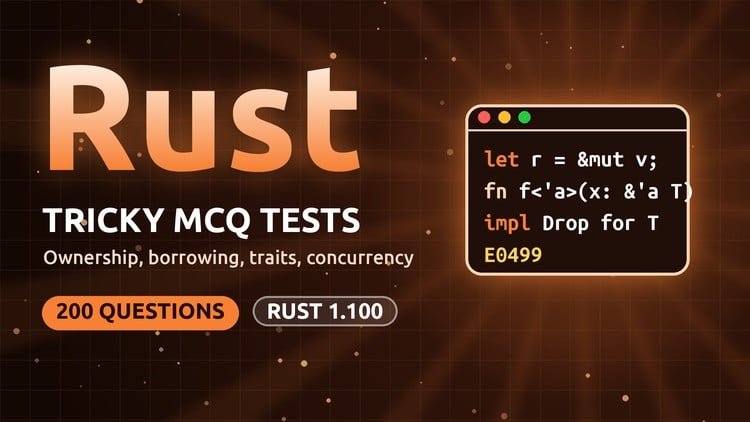
200 tricky Rust questions on ownership, borrowing, traits and concurrency, each verified with Rust 1.100
What You Will Learn:
- Predict when Rust moves, copies, borrows or drops a value, and why the borrow checker accepts or rejects code.
- Read lifetime annotations and elision rules, and fix borrow checker errors idiomatically.
- Use enums and pattern matching precisely, including let-else, let chains and if let guards.
- Choose between generics and trait objects, and reason about coherence and method resolution.
- Handle errors with Option, Result and the question mark operator, and use collections and iterators safely.
- Write correct concurrent code with Arc, Mutex and channels, and know what the 2024 edition changes.
Rust Programming Mastery: Tricky MCQ Practice Tests – An Honest Take
Alright, let’s talk about Rust. If you’re anything like me, you’ve probably wrestled with the borrow checker more times than you care to admit. It’s the gatekeeper to Rust’s memory safety, and while it’s brilliant, it can feel like a cryptic puzzle at times. That’s where a course like Rust Programming Mastery: Tricky MCQ Practice Tests comes in. I recently dived into this offering, and as someone who’s been navigating the world of systems programming for a while, I wanted to give you the lowdown.
Overview
Forget your basic “hello world” Rust tutorials. This course is designed to throw you into the deep end with precisely the kind of thorny scenarios that trip up even experienced developers. The focus isn’t just on memorizing syntax; it’s about building that intuitive understanding of Rust’s core principles. We’re talking about those edge cases where understanding ownership transfers, the nuances of immutable vs. mutable borrows, and the exact moment a value is dropped becomes paramount. It’s about internalizing why the compiler throws an error, not just fixing it blindly. This is crucial for anyone aiming for true mastery and not just surface-level proficiency. The inclusion of questions referencing specific Rust versions (up to 1.100) is a smart move, ensuring the material stays relevant in a rapidly evolving language.
Prerequisites
This is definitely not a beginner’s course. You’ll need a solid foundation in Rust programming already. I’d say having at least a few months of hands-on experience, perhaps having completed a comprehensive introductory course or worked on a small-to-medium sized project, is essential. Familiarity with basic data structures and algorithms is a given. If you’re still figuring out how to declare a mutable variable, save this one for later.
Skills & Tools
The primary skill this course hones is your problem-solving ability within Rust’s strict confines. You’ll become a pro at dissecting compiler errors, understanding lifetimes, and writing idiomatic Rust code. The practice tests themselves are the main tool, pushing you to apply concepts like:
- Ownership, Borrowing, and Dropping: Deep dives into move semantics, copy traits, and the lifecycle of variables.
- Borrow Checker Logic: Predicting acceptance/rejection and fixing errors gracefully.
- Lifetimes: Reading annotations and mastering elision rules.
- Enums and Pattern Matching: Advanced usage including `let-else`, `let chains`, and `if let guards`.
- Generics vs. Trait Objects: Making informed decisions and understanding coherence/method resolution.
- Error Handling: Proficient use of `Option`, `Result`, and the `?` operator.
- Collections and Iterators: Safe and efficient usage.
- Concurrency: Working with `Arc`, `Mutex`, and channels, with an eye on upcoming changes in the 2024 edition.
You’ll also get very comfortable with your IDE and the Rust compiler as your primary feedback mechanisms.
Career Benefits & Job Roles
For anyone looking to level up their Rust game for career advancement, this course is a no-brainer. Employers are increasingly seeking developers who can confidently tackle complex systems programming tasks, and Rust is at the forefront. Mastering these tricky MCQs translates directly into job-ready skills. It’s excellent for certification prep for any advanced Rust certifications that might emerge. This course can pave the way for roles like Senior Software Engineer, Systems Programmer, Embedded Systems Developer, or even roles focused on performance-critical applications in areas like web assembly or blockchain. It’s about building demonstrable expertise that sets you apart in a competitive market.
Pros
- Deepens Core Understanding: This isn’t just rote memorization; it forces you to truly understand *why* Rust works the way it does. The explanations accompanying the answers are gold.
- Realistic Scenarios: The questions feel like they’re pulled directly from real-world codebases where subtle borrow checker issues often hide. This is crucial for practical application.
- Excellent for Skill Validation: It’s a fantastic way to gauge your current Rust proficiency and identify specific areas you need to shore up before tackling real-world projects or more advanced topics.
- Prepares for Tough Interviews: If you’re aiming for competitive Rust roles, the ability to quickly and accurately answer these types of questions will be a significant advantage in technical interviews.
Cons
- Steep Learning Curve for the Unprepared: While a pro for experienced devs, if you’re new to Rust, jumping into this without a solid foundation will be incredibly frustrating. It’s less of a “learning” tool and more of a “mastering” tool.
Overall, for the seasoned Rust developer looking to move beyond the basics and truly solidify their understanding of its intricacies, Rust Programming Mastery: Tricky MCQ Practice Tests is a valuable investment. It’s the kind of practice that builds confidence and makes you a more resilient and capable programmer.