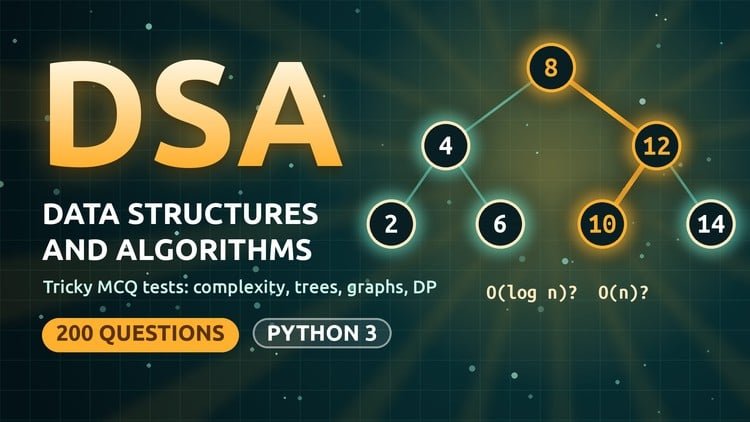
200 tricky Python questions on complexity, searching, heaps, hashing, trees, graphs and DP, every program verified
What You Will Learn:
- Derive the real time and space complexity of Python code, including the hidden cost of built-in operations.
- Write boundary-correct binary searches, two-pointer scans and sliding windows, and know when their preconditions fail.
- Predict exactly how stacks, queues, deques, heaps, hash tables and linked lists behave in Python.
- Trace tree and graph algorithms such as BST operations, tries, BFS, DFS, Dijkstra, topological sort and union-find.
- Design and debug recursive, memoized and dynamic programming solutions, including state, order and memo keys.
- Apply sorting, greedy and bit manipulation techniques together with the conditions that make them correct.
Alright, let’s dive into a course that promised to be a deep dive into the nitty-gritty of data structures and algorithms, specifically with a focus on tricky MCQs in Python. I recently went through ‘Data Structures and Algorithms: Tricky MCQ Practice Tests’, and honestly, it’s the kind of material that separates the folks who just *know* syntax from those who truly *understand* computational thinking. This isn’t your average introductory course; it’s designed to make you sweat a little, in a good way.
Overview
My main takeaway from this course is its unapologetic focus on the nuances. The description mentions “tricky questions,” and they aren’t kidding. This isn’t about rote memorization of algorithms; it’s about dissecting how they actually perform in a Python environment. The “verified programs” are a huge plus – you’re not just guessing what the answer should be, you’re seeing the concrete Python implementation and its output. The emphasis on deriving real-time and space complexity, including the often-overlooked overhead of Python’s built-in functions, is particularly valuable. It forces you to think beyond the Big O notation on paper and consider the practical implications on performance. For anyone preparing for technical interviews at top-tier companies, this level of detail is non-negotiable. It’s structured more like a series of challenging puzzles than a traditional lecture series, which I found incredibly engaging.
Prerequisites
This course assumes a solid foundation in Python programming. You should be comfortable with basic syntax, control flow, functions, and object-oriented concepts. Crucially, some familiarity with fundamental data structures like arrays, lists, and dictionaries is expected. While it doesn’t require you to be a seasoned algorithmic guru beforehand, a basic understanding of concepts like recursion and iteration will definitely smooth the learning curve. If you’re brand new to programming, I’d suggest tackling an introductory Python course first. This is definitely leaning towards the intermediate to advanced spectrum.
Skills & Tools
The skills you’ll hone here are directly applicable to building performant and scalable software. You’ll gain mastery in:
- Complexity Analysis: Becoming adept at determining the time and space complexity of Python code, including built-in operations.
- Algorithmic Problem-Solving: Developing the ability to design and debug solutions for common algorithmic patterns.
- Data Structure Proficiency: Deeply understanding the behavior and application of various data structures in Python.
- Debugging and Optimization: Improving your capacity to identify performance bottlenecks and refine your code.
The primary tool, of course, is Python itself, along with a standard Python IDE or text editor. No exotic third-party libraries are required, keeping the focus squarely on the core concepts.
Career Benefits & Job Roles
For anyone gunning for roles like Software Engineer, Data Scientist, Algorithm Developer, or similar positions that demand strong problem-solving skills, this course is an excellent investment. The skills are highly sought after in the industry and directly contribute to passing rigorous technical interviews. It’s a fantastic component for certification prep if you’re aiming for specific tech credentials that emphasize algorithmic understanding. The confidence gained from mastering these tricky questions can significantly boost your interview performance, paving the way for career growth and opportunities at leading tech firms. It’s about acquiring job-ready skills that go beyond theoretical knowledge.
Pros
- Unparalleled Depth and Nuance: The course excels at digging into the subtle complexities of algorithms and data structures within Python. The focus on practical performance, not just theoretical Big O, is a game-changer.
- Challenging and Engaging Practice: The “tricky MCQs” are genuinely thought-provoking and push you to apply your knowledge rather than just recall it. This active learning style is highly effective.
- Real-World Applicability: The topics covered, from boundary-correct searches to DP, are directly relevant to challenges faced in real-world projects and are foundational for many complex systems.
- Verified Code Examples: Having all programs verified is a critical trust factor, ensuring that the solutions and explanations are accurate and robust.
Cons
My one honest critique is that this course is not for the faint of heart or the absolute beginner. While the description hints at “tricky,” it might be an understatement. The difficulty level is consistently high, and if you’re not prepared to grapple with challenging problems or don’t have a solid Python base, you might find it overwhelming rather than instructive. It’s best approached when you have a foundational understanding already in place and are looking to truly sharpen your edge.