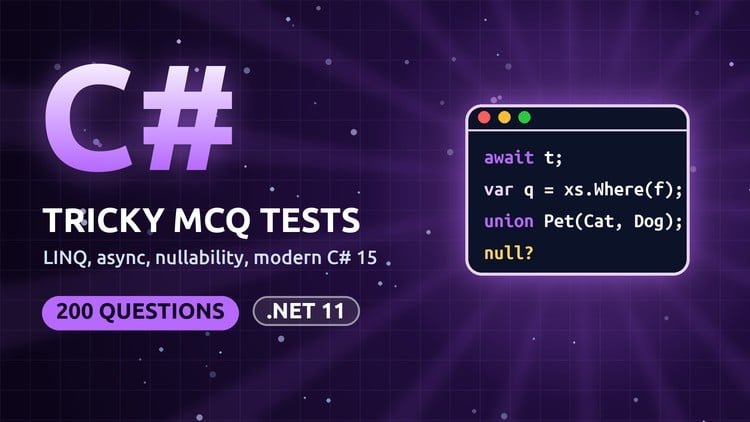
200 tricky C# questions on types, LINQ, async, nullability and C# 15 features, each verified with .NET 11
What You Will Learn:
- Predict the result of tricky expressions involving overflow, conversions, boxing, strings and operator precedence.
- Trace struct copies, record equality, initialization order, method hiding and overload resolution.
- Use interfaces, generics, constraints and variance, and write LINQ queries that run when and how you expect.
- Predict control flow through try, catch, finally, exception filters and using statements.
- Apply delegates, lambdas, pattern matching and nullable annotations without hidden null bugs.
- Reason about async and await, tasks and cancellation, and use the newest C# 13 to 15 features.
Alright, let’s dive into this C# Programming Mastery: Tricky MCQ Practice Tests course. As someone who’s been wrestling with C# and the .NET ecosystem for a good chunk of my career, I’m always on the lookout for resources that go beyond the basic “Hello, World!” tutorials and actually test your deep understanding. This course promises to do just that, with a hefty dose of 200 “tricky” multiple-choice questions. Let’s see if it lives up to the hype.
Overview
My initial impression of this course is that it’s designed for developers who’ve already got a solid grasp of C# fundamentals and are aiming to really solidify their knowledge, especially around those gnarly edge cases. It’s not about learning *how* to write code, but rather about understanding the *why* and *how* of C#’s intricate behavior under specific, often surprising, circumstances. The emphasis on predicting the outcome of code snippets, particularly those involving subtle type conversions, operator precedence, and string interning, is a smart approach. It forces you to engage with the language’s rules at a granular level, which is crucial for debugging those hard-to-track bugs that often pop up in complex applications. The inclusion of newer C# features (up to version 15, which is impressive as of now) also signals a commitment to keeping the content current, a definite plus in our fast-moving tech landscape.
Prerequisites
This course is definitely not for absolute beginners. You’ll need a firm understanding of:
- Core C# syntax and object-oriented programming principles.
- Basic data types, control flow structures, and collections.
- Familiarity with the .NET framework and Visual Studio or a comparable IDE.
- A decent amount of practical C# coding experience is highly recommended.
Think of it as a stepping stone from intermediate to advanced, or as an excellent refresher for seasoned pros.
Skills & Tools
The primary skill this course hones is your diagnostic and predictive ability in C#. You’ll become much better at:
- Anticipating the results of complex code, especially with regard to memory management and value vs. reference types.
- Writing robust asynchronous code that handles exceptions and cancellation gracefully.
- Leveraging advanced language features like LINQ and pattern matching effectively and safely.
- Navigating the nuances of nullable reference types to prevent runtime null reference exceptions.
The main “tool” here is simply a text editor and a C# compiler (hence the mention of .NET 11 verification, which implies a modern .NET runtime). No complex setup or special industry-standard tools are required beyond what you’d typically use for C# development.
Career Benefits & Job Roles
For anyone serious about advancing their C# career, this course offers significant benefits. Mastering these “tricky” aspects of C# can make you a more valuable asset, especially in roles that require deep technical expertise and problem-solving prowess. It’s excellent certification prep for any advanced C# exams out there. The ability to dissect and understand complex code makes you a prime candidate for roles like:
- Senior Software Engineer
- Software Architect
- Performance Engineer
- Technical Lead
It’s about developing the kind of job-ready skills that set you apart from the crowd and can lead to substantial career growth.
Pros
- Deep Dive into Nuances: This course excels at pulling back the curtain on C#’s more obscure behaviors. It’s where you learn about the “gotchas” that can trip up even experienced developers, making you much more confident in your code.
- Excellent for Debugging Mindset: By forcing you to predict outcomes, it cultivates a crucial debugging mindset. You’ll start to think about code execution step-by-step, which is invaluable for identifying and fixing bugs quickly.
- Up-to-Date Content: The inclusion of the latest C# features ensures that you’re not just learning foundational concepts but also staying current with the language’s evolution. This is a huge advantage for anyone working with modern .NET applications.
- Practical Application Focus: While it’s MCQ-based, the questions are designed to reflect real-world coding challenges, preparing you for scenarios you’ll encounter in actual real-world projects.
Cons
- Not for Hands-On Learning: This is purely an MCQ practice test course. While excellent for testing knowledge, it doesn’t provide the hands-on labs or project-based learning that some developers prefer for skill acquisition. You’ll need to supplement this with your own coding practice to truly implement what you’re learning.
Overall, if you’re looking to test and deepen your C# expertise beyond the surface level, this course is a worthwhile investment. It’s a challenging but rewarding experience that will undoubtedly make you a more proficient and confident C# developer.