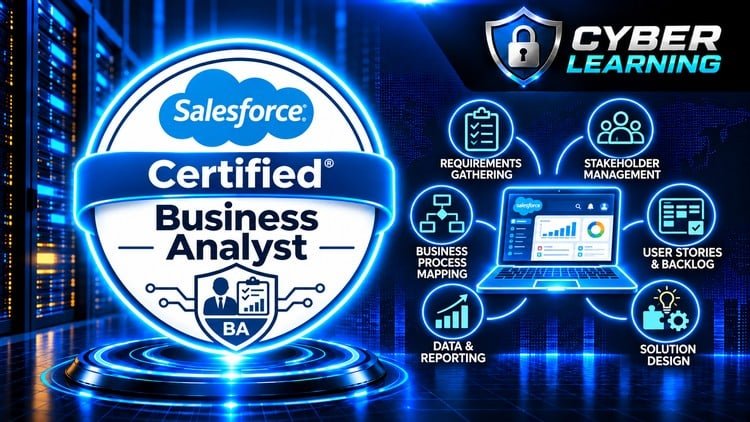
6 Full Practice Exams with 360 Questions and Detailed Explanations to Help You Prepare for the Exam
What You Will Learn:
- Assess your knowledge of the six official Salesforce Certified Business Analyst exam domains.
- Strengthen your understanding of customer discovery, stakeholder collaboration, business process mapping, and requirements management.
- Apply business analysis concepts involving user stories, acceptance criteria, solution validation, and user acceptance testing.
- Prepare for the Salesforce Business Analyst certification exam with 360 practice questions and detailed answer explanations.
Alright, let’s talk about the Salesforce Certified Business Analyst Practice Exams. As someone who’s navigated the Salesforce ecosystem for a good few years, I’m always on the lookout for resources that genuinely help folks level up. This particular set of practice exams caught my eye because, let’s face it, just reading the official exam guide can feel like deciphering ancient hieroglyphs. So, I dove in, put them through their paces, and here’s my no-BS take.
Overview
What sets these practice exams apart, in my opinion, is the sheer volume of targeted questions and, crucially, the detailed explanations. It’s not just about blindly memorizing answers; it’s about understanding the *why* behind each correct response and, more importantly, why the incorrect options are wrong. This is vital for real certification prep, as the exam often throws curveballs designed to test your deeper comprehension, not just rote knowledge. The questions do a solid job of simulating the exam’s difficulty and question style, covering everything from customer discovery nuances to the nitty-gritty of requirements management and solution validation. Think of it as a guided tour through the BA exam domains, highlighting potential pitfalls and reinforcing key concepts.
Prerequisites
Honestly, while these practice exams are designed to prepare you for the Salesforce Certified Business Analyst certification, they’re most effective if you’ve already got some foundational understanding. Ideally, you’d have some familiarity with the Salesforce platform itself. You don’t need to be a seasoned admin, but knowing the basics of how Salesforce operates will make the business analysis concepts much easier to grasp. If you’re coming from a purely non-technical background, you might find the initial learning curve a bit steeper, but the explanations are thorough enough to bridge that gap with dedicated effort. It’s not a magic bullet; it’s a powerful accelerator for those with a baseline.
Skills & Tools
The primary skill these practice exams hone is your ability to apply business analysis concepts within the Salesforce context. You’ll be flexing your muscles on areas like:
- Customer Discovery: Understanding how to elicit and document needs from various stakeholders.
- Stakeholder Collaboration: Practicing effective communication and conflict resolution.
- Business Process Mapping: Visualizing current and future state processes.
- Requirements Management: From elicitation to prioritization and validation.
- User Stories & Acceptance Criteria: Crafting clear and actionable user stories.
- Solution Validation & UAT: Ensuring the implemented solution meets business needs.
While the practice exams are primarily knowledge-based, the understanding they foster translates directly to applying these skills in real-world projects. The “tool” here is your brain, sharpened by repeated exposure to exam-style scenarios and the insights gained from the explanations.
Career Benefits & Job Roles
Earning the Salesforce Certified Business Analyst certification is a significant boost for career growth. It validates your expertise in bridging the gap between business needs and technology solutions on the Salesforce platform. This opens doors to roles like:
- Salesforce Business Analyst
- Salesforce Consultant
- Product Owner
- Business Systems Analyst (Salesforce focus)
- Solution Architect (entry-level)
In essence, it positions you as a key player in successful Salesforce implementations, making you a more attractive candidate for companies investing heavily in their Salesforce strategy. It’s a step towards becoming truly job-ready for specialized roles.
Pros
- Comprehensive Coverage: These exams cover all six official exam domains thoroughly, ensuring you’re not caught off guard by any specific topic.
- In-Depth Explanations: The detailed explanations are the real MVP. They go beyond just stating the right answer, offering context and reasoning that solidifies understanding, which is crucial for moving from beginner to advanced comprehension.
- Realistic Simulation: The 360 questions feel authentic to the actual exam format and difficulty, providing a genuine gauge of your readiness.
- Reinforces Key Concepts: The practice questions are designed to make you think critically about how business analysis principles are applied within the Salesforce ecosystem, reinforcing critical thinking for industry-standard tools.
Cons
The only real drawback I’d point out is that these are practice exams, and as such, they won’t give you direct hands-on labs experience. While they excel at testing your theoretical knowledge and application of concepts, you’ll still need to supplement this with practical experience on the Salesforce platform itself to truly master the role. Think of it as preparing you for the game, but you still need to get on the field.