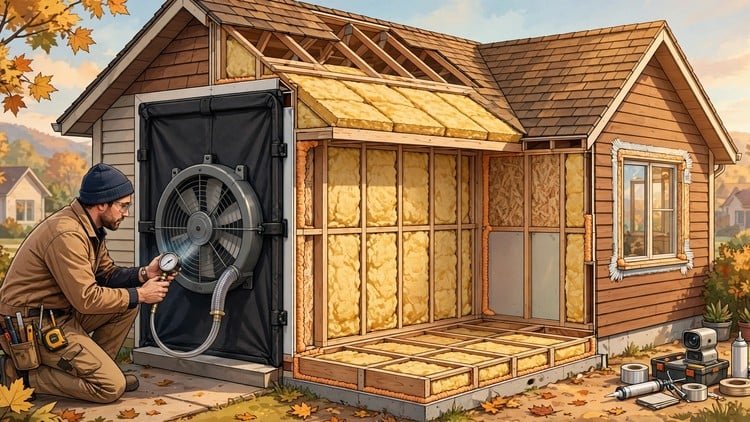
Prepare For Building Analyst Technician (BA-T) Exam 2026 with 560 Practice Questions with Detailed Explanations.
What You Will Learn:
- Apply building science fundamentals, heat transfer, moisture, and airflow for home performance work.
- Identify envelope and construction details, thermal boundaries, and pressure boundaries in a home.
- Apply HVAC, ventilation, and indoor air quality concepts for mechanical system assessment decisions.
- Apply combustion safety, CAZ testing, spillage, and carbon monoxide action levels for field work.
- Interpret blower door, zonal pressure, and pressure pan results for airflow diagnostics correctly.
- Apply data collection, insulation, R-values, and data plate reading for appliance assessment work.
- Distinguish conduction from convection and radiation when explaining heat transfer in a building.
The Real Dirt on the BA-T Practice Tests
Look, if you’ve been hanging around the residential energy efficiency world for more than five minutes, you know the BPI (Building Performance Institute) doesn’t just hand out credentials for showing up. The shift toward the Building Analyst Technician (BA-T) designation is a move to separate the “doers” from the “thinkers,” and frankly, it’s about time. I recently dug into this set of 560 practice questions specifically geared toward the 2026 exam standards, and I’ve got some thoughts. This isn’t your typical “read the manual and pray” type of certification prep. It’s a grind, but the right kind of grind.
Most beginner to advanced techs struggle because they know how to hook up a blower door, but they can’t explain the why behind zonal pressure diagnostics to a homeowner or an inspector. What I appreciated here wasn’t just the volume of questions, but the “Detailed Explanations.” In this industry, knowing you got an answer wrong is useless unless you understand the building science failure that led you there. We’re talking about the interplay between the thermal and pressure boundaries—if you don’t get that right, you’re just moving air around a leaky box. This course treats the house as a system, which is the only way to survive in 2026’s energy landscape.
Prerequisites: What You Actually Need
Don’t just jump into these tests if you’ve never stepped foot in a crawlspace. While the course covers the gamut, you’ll get the most out of it if you have:
- A basic understanding of residential construction—if you don’t know a top plate from a rim joist, start there first.
- Exposure to industry-standard tools like a manometer or a combustion analyzer (even if you’ve only watched a lead tech use them).
- A thick skin for technical math. You don’t need a calculus degree, but you need to be comfortable with R-values, square footage, and basic conversion factors without breaking a sweat.
Skills & Tools You’ll Master
By the time you’ve cycled through these 560 questions, you aren’t just memorizing facts; you’re developing job-ready skills that translate to the truck. You’ll get deep into the weeds on:
- Airflow Diagnostics: Interpreting pressure pan results and understanding why that master bedroom is five degrees colder than the rest of the house.
- Combustion Safety: Mastering CAZ (Combustion Appliance Zone) testing. This is the life-saving stuff—spillage, CO action levels, and draft pressure.
- Heat Transfer Mechanics: Finally being able to explain the difference between a convection loop in a wall cavity and radiation from an uninsulated attic floor.
- Data Collection: Learning how to read a data plate on an old 80% AFUE furnace like a pro so your real-world projects are based on facts, not guesses.
Career Benefits & Job Roles
Let’s talk money and career growth. The residential retrofit market is exploding thanks to new federal rebates and local energy mandates. Having the BA-T under your belt isn’t just a badge; it’s a signal to employers that you can be sent to a site alone and not burn the house down or miss the obvious air-sealing opportunities. This prep path sets you up for roles such as:
- Energy Auditor: The primary “house doctor” who identifies efficiency prescriptions.
- Weatherization Crew Lead: Overseeing the actual implementation of air sealing and insulation.
- Quality Assurance Inspector: Verifying that the work performed meets the BPI-1200 standards.
- HVAC Performance Specialist: Focusing on how the mechanicals interact with the building envelope.
The Pros
- The Depth of Explanations: It’s not just “A is right.” It’s “A is right because B and C describe different heat transfer modes, and D is a pressure boundary issue.” This is where the real learning happens.
- Alignment with 2026 Standards: BPI updates their standards often, and there’s a lot of outdated junk out there. This feels current, especially regarding the newer CO action levels and ventilation requirements.
- The Volume: 560 questions is a lot. It’s enough to ensure you aren’t just memorizing the order of the answers, but actually thinking through the building science.
The Cons
- Lack of Hands-on Labs: This is a digital test prep, not a hands-on lab experience. You won’t get the tactile feel of adjusting a regulator or sealing a bypass. You definitely need to pair this with some field time or a physical boot camp if you want to be truly 100% prepared for the field exam.