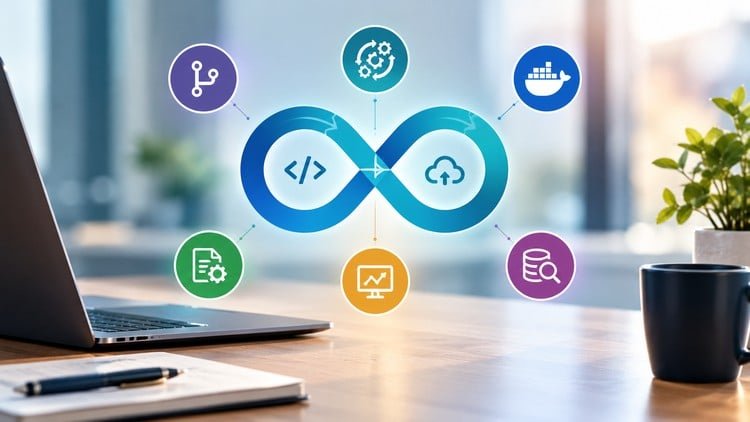
Learn version control with Git, CI/CD fundamentals, containerisation, configuration management and monitoring basics.
What You Will Learn:
- Explain the purpose of DevOps and its role in software development and delivery.
- Describe how Git supports version control and collaboration.
- Explain the fundamentals of continuous integration and continuous delivery (CI/CD).
- Describe containerisation and its role in deploying applications consistently.
- Explain the purpose of configuration management in maintaining consistent environments.
- Identify the roles of monitoring and logging in understanding system behaviour and detecting issues.
- Recognise key DevOps tools and practices used across software delivery workflows.
The Real Deal on Modern Shipping: My Take on DevOps Essentials
Let’s be honest: the term “DevOps” has been thrown around so much in the last decade that it’s started to lose its meaning. Every recruiter wants it, every company claims to do it, and every developer is supposedly “doing” it. But after spending years in the trenches of software delivery workflows, I’ve realized that most people are just cargo-culting tools without understanding the “why.” This course, “DevOps Essentials: Git, CI/CD, Containers & Monitoring,” is a refreshing change of pace because it actually connects the dots between writing code and keeping a system alive in production.
It isn’t just a walkthrough of industry-standard tools; it’s a blueprint for the cultural shift that happens when you stop throwing code over the wall to the operations team. What I appreciated most was the focus on the “feedback loop.” In the old days, we’d wait weeks for a deployment. This course shows you how to shorten that to minutes while actually increasing stability. It’s about building a job-ready skills profile that makes you the most valuable person in the room—the one who knows how to automate the boring stuff so the team can focus on innovation.
Prerequisites: What You Actually Need Before Starting
Don’t believe the hype that you can jump into this with zero technical background. While it’s marketed as beginner to advanced, you’ll struggle if you’ve never touched a command line. You don’t need to be a Senior Dev, but you should have a basic grasp of how a web application works and a healthy curiosity for Linux. If you know how to navigate a directory in the terminal and have written even a simple script, you’re ready. The course does a great job of leveling everyone up, but having that “tinkerer” mindset is the real prerequisite here.
The Toolkit: Skills & Industry-Standard Tools
The curriculum doesn’t shy away from the heavy hitters. You’re going to spend a lot of time in the terminal, and that’s a good thing. The course focuses on:
- Version Control: Deep diving into Git beyond just push and pull—think branching strategies that actually work for teams.
- Automation: Building CI/CD pipelines that act as a safety net for your code.
- Containerisation: Using Docker to ensure the “it works on my machine” excuse finally dies a painful death.
- Infrastructure as Code: A solid introduction to configuration management to keep your environments consistent.
- Observability: Understanding that monitoring and logging aren’t just afterthoughts, but essential for Site Reliability Engineering.
Career Benefits & Job Roles
If you’re looking for career growth, this is where the money is. We are currently seeing a massive talent gap in the market for people who understand the full lifecycle of an application. Completing this course puts you on the fast track for roles like DevOps Engineer, Cloud Architect, or Release Manager.
Even if you want to stay a pure developer, understanding these hands-on labs will make you a 10x better collaborator. You’ll be able to speak the language of the platform team, contribute to real-world projects, and help your company move toward continuous delivery. Plus, if you’re looking at certification prep for AWS, Azure, or GCP, the fundamentals covered here are the literal bedrock of those exams.
What I Liked (The Pros)
- Holistic Approach: It doesn’t treat tools in a vacuum. It explains how monitoring feeds back into Git commits, creating a complete cycle.
- Practical Labs: The hands-on labs are actually challenging. They don’t just give you a script to copy-paste; they force you to troubleshoot, which is where the real learning happens.
- Scalability Focus: The section on containerisation isn’t just about running one container; it’s about the mindset needed for deploying applications consistently at scale.
- Modern Relevance: It covers industry-standard tools that companies are actually using in 2024, not some outdated tech stack from five years ago.
The Reality Check (The Con)
The only real downside is the sheer “breadth” of the content. Because it covers everything from Git to monitoring, it can feel like a firehose of information. You won’t walk away an expert in Kubernetes or a master of Prometheus after one pass. It’s an “Essentials” course, meaning you get the foundation, but you’ll need to put in significant extra hours outside the course to truly master any single one of these job-ready skills. It’s a starting line, not a finish line.