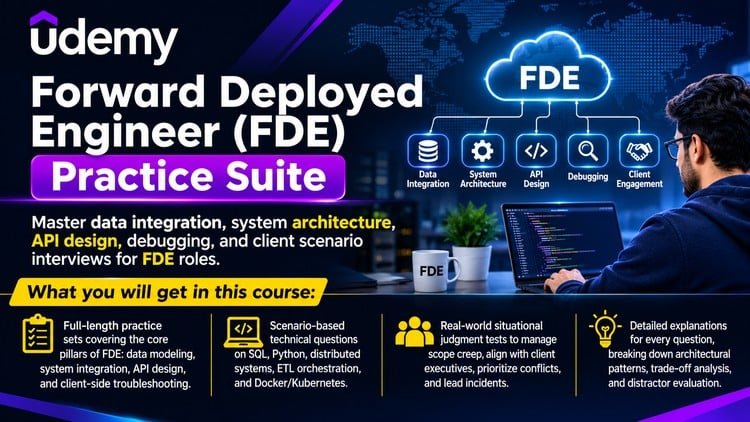
Master data integration, system architecture, API design, debugging, and client scenario interviews for FDE roles.
What You Will Learn:
- Architect enterprise data pipelines, ETL/ELT workflows, and distributed system integrations for client deployment environments.
- Solve client-facing technical challenges, conduct root cause analysis, and debug complex integration edge cases on site
- Build custom APIs, data connectors, and microservices while navigating legacy software systems and air-gapped security networks.
- Balance technical execution with stakeholder management, requirement gathering, scope control, and rapid product adoption
The “Special Ops” of Engineering: An Honest Look at the FDE Practice Suite
I’ve spent a decade in the trenches of backend engineering, and if there’s one thing I’ve learned, it’s that there is a massive gulf between writing code in a clean, isolated sandbox and deploying a massive data platform into a client’s messy, legacy-ridden environment. That’s why I was skeptical when I first saw the Forward Deployed Engineer (FDE) Practice Suite. Most courses treat “client-facing” as a soft-skill footnote, but this suite treats it like the high-stakes tactical operation it actually is.
The FDE role—popularized by firms like Palantir and now adopted by any serious enterprise SaaS company—is essentially the “Special Ops” of the tech world. You aren’t just a dev; you are an architect, a diplomat, and a fire-fighter. This suite doesn’t just teach you job-ready skills; it forces you to think about distributed system integrations while someone is breathing down your neck about a deadline. It’s an intense certification prep for those who want to jump from standard software engineering into the lucrative world of high-impact field deployments.
What sets this apart from your run-of-the-mill hands-on labs is the focus on “the mess.” You aren’t building a Todo app. You’re building custom APIs that have to talk to a mainframe from 1998, all while navigating air-gapped security networks. It’s the only resource I’ve found that accurately captures the anxiety and the rush of a real-world project where the environment is actively trying to break your code.
Who Should Apply: The Prerequisites
Don’t jump into this if you’ve never touched a line of code. While it claims to cover beginner to advanced levels, you’ll struggle if you don’t have a foundational grasp of Python or Java and a decent understanding of SQL. You don’t need to be a Senior Architect, but you should know your way around a terminal and understand what a REST API is supposed to do. The real prerequisite, though, is a “figure it out” mentality. This course is for the engineer who is tired of being stuck in a JIRA ticket vacuum and wants more career growth through direct business impact.
The Tech Stack: Skills & Tools
The suite covers a massive breadth of industry-standard tools. You’ll be working through scenarios involving:
- ETL/ELT Workflows: Moving massive datasets using tools like Apache Spark and Airflow.
- Data Orchestration: Architecting enterprise data pipelines that don’t collapse when a single node goes dark.
- Security & Compliance: Deep dives into encryption at rest, VPN tunneling, and handling data in high-security environments.
- API Design: Building microservices that are resilient and well-documented for client use.
- Root Cause Analysis: Using logging and monitoring (ELK stack/Prometheus style) to find out why a system crashed on-site.
Career Benefits & Job Roles
Completing this suite positions you for some of the highest-paying roles in the industry. We’re talking Forward Deployed Engineer, Solutions Architect, Implementation Lead, or Technical Product Manager. Companies like Snowflake, Databricks, and AWS are desperate for people who can bridge the gap between “it works on my machine” and “it works for the customer.” The career growth potential here is massive because you become “the person” who can be trusted with the most difficult, high-revenue accounts.
The Pros: Why This Works
- Authentic Scenarios: The “client scenarios” are eerily accurate. They include conflicting requirements and scope creep—things you usually only learn by failing in front of a real client.
- Architecture First: It prioritizes system architecture over syntax. It teaches you why a specific data connector is the wrong choice for a specific network topology.
- Debug Intensity: The root cause analysis modules are brutal but fair. They train you to look for the “ghost in the machine” that standard bootcamps ignore.
- Soft-Skill Integration: It forces you to practice stakeholder management. You learn how to say “no” to a feature request while still maintaining the client’s trust.
The One Big Con: It’s Mentally Draining
The honest truth? This isn’t a “passive” course. If you’re looking for something to watch while you eat lunch, this isn’t it. The labs are designed to be frustrating because client work is frustrating. The learning curve is steep, and the suite can be quite opinionated about how you should structure your microservices. If you prefer the “move fast and break things” startup culture, the rigorous focus on security networks and legacy software systems might feel like a drag.