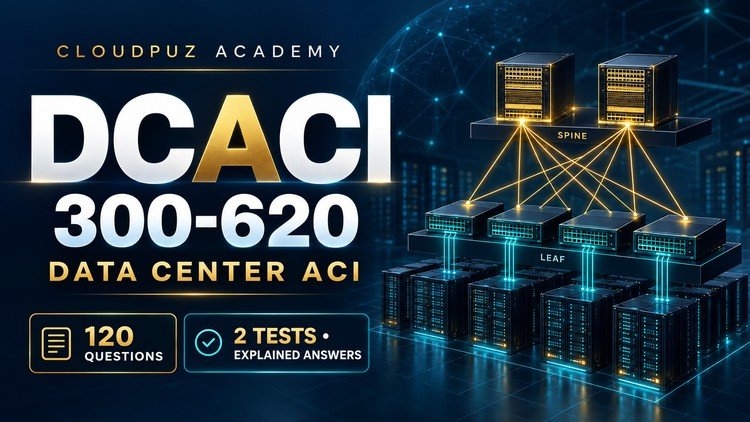
Two DCACI v1.2 tests covering ACI fabric, forwarding, L3Out, VMM, management and multi-location designs
What You Will Learn:
- Interpret ACI fabric, tenant, VRF, EPG and ESG relationships and identify missing access-policy associations.
- Diagnose endpoint-learning, packet-forwarding and L3Out issues using evidence from the stated scenario.
- Evaluate VMware, Nutanix and service-graph integration decisions with the relevant release and policy context.
- Choose suitable management, backup, upgrade and multi-location architecture actions for stated requirements.
The No-Fluff Breakdown: Why This Matters
If you have spent any time in a modern data center, you know that Cisco ACI is the absolute beast of the Software-Defined Networking (SDN) world. It is complex, it is powerful, and frankly, it is incredibly easy to mess up if you do not understand the underlying logic. I recently went through the “DCACI 300-620: 120 Explained Practice Questions” course, and I want to give you the honest, boots-on-the-ground perspective. This isn’t just another boring test bank; it is more like a logic trainer for engineers who are tired of guessing why their L3Out isn’t peering or why their EPG isn’t communicating.
The 300-620 DCACI exam is a notorious hurdle for the CCNP Data Center track. Most study materials just throw dry documentation at you, but this course takes a different approach. It forces you to think like a troubleshooter. Instead of memorizing definitions, you are analyzing scenarios. This is vital because, in the real world, the APIC dashboard doesn’t just tell you “click here to fix.” You have to understand the tenant and VRF relationships deeply. If you are looking to move from beginner to advanced in the ACI space, the way these questions are explained bridges that gap between “I’ve read the book” and “I can actually run this fabric.”
What You Need Before Jumping In
Let’s be real: do not walk into this course thinking it’s a “zero-to-hero” guide for someone who has never touched a Nexus switch. You need a solid foundation. If you don’t know the difference between a Spine and a Leaf, or if terms like “encapsulation” and “anycast gateway” make your head spin, you aren’t ready yet. To get the most out of these explained practice questions, you should have:
- A baseline understanding of industry-standard tools and OSI model fundamentals.
- Prior exposure to the CCNP core concepts or at least some hands-on labs experience with Cisco NX-OS.
- A basic grasp of what SDN is trying to solve—moving away from the CLI-per-device mindset into a policy-driven mindset.
The Toolkit: Skills & Tools You’ll Master
This course isn’t just about passing a test; it’s about building job-ready skills that actually translate to your daily workflow. You are effectively learning how to navigate the Cisco APIC ecosystem without feeling like you’re lost in a maze. Key focus areas include:
- Fabric Discovery & Management: Understanding how to bring up a fabric and keep it healthy using backup and upgrade best practices.
- Troubleshooting Tools: Learning to use the Endpoint Tracker and Visibility & Troubleshooting tools within the APIC to diagnose packet drops.
- Virtualization Integration: Dealing with VMware VDS and Nutanix integrations, which is where most real-world projects get complicated.
- External Connectivity: Mastering the L3Out—the part of ACI that everyone loves to hate—ensuring your fabric actually talks to the outside world.
Career Growth & Where This Leads
Investing time in certification prep for the DCACI is a strategic move for your career growth. We are seeing a massive shift where companies are desperate for engineers who can manage multi-location designs (Multi-Pod and Multi-Site). By mastering these concepts, you’re positioning yourself for high-level Job Roles such as:
- Data Center Architect: Designing the next generation of scalable infrastructure.
- Network Automation Engineer: Using these ACI foundations to integrate with Python or Terraform.
- Cloud Infrastructure Lead: Managing the bridge between on-prem ACI fabrics and public cloud extensions.
The Pros: What I Actually Liked
- The “Why” Behind the Answer: The best part of this course is the detailed explanation for each question. It doesn’t just tell you “B is correct.” It tells you why A, C, and D are wrong, often referencing Cisco best practices. This is the “meat” that builds actual knowledge.
- ESG Logic: Most older courses focus heavily on EPGs, but this one leans into Endpoint Security Groups (ESG), which is the modern way to handle policy. It’s refreshing to see a course stay current with v1.2 updates.
- Scenario-Based Pressure: The questions mimic the industry-standard difficulty. They present you with a broken scenario and ask you to find the missing association. This is exactly how the 300-620 exam feels, so it’s great for building “exam stamina.”
- Focus on L3Outs: Let’s be honest, L3Out is where the money is made. This course spends a significant amount of time on routing protocols and contract applications within L3Outs, which is a common failure point for many engineers.
The Cons: The Honest Truth
If I have one gripe, it’s that this is purely a practice test course. While the explanations are top-tier, it does not include a built-in hands-on lab environment. To truly master ACI, you need to see these policies in action. I highly recommend pairing this course with a Cisco CML (Cisco Modeling Labs) setup or a Cisco DevNet sandbox. Using this course as your *only* resource might leave you with “book smarts” but no “keyboard muscle memory.”