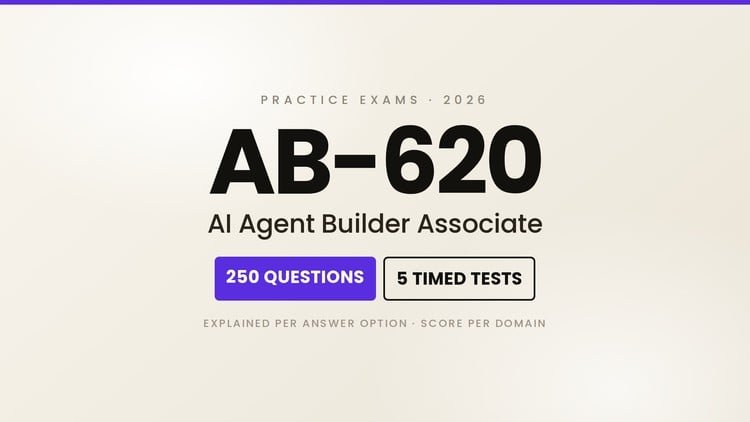
250 exam-style questions on agent flows, tools, multi-agent solutions, Foundry and ALM, with explained answers
What You Will Learn:
- Test yourself against 250 AB-620 style questions that follow the official skills measured and the same domain weighting as the real exam.
- Tell neighbouring Copilot Studio features apart: agent flows and cloud flows, Copilot and Power Platform connectors, MCP tools and REST calls.
- Read why every option is right or wrong, with feedback per answer plus an explanation that links to the Microsoft documentation.
- Work up from single-concept questions to a full-length simulation with exam-length scenarios and a clock that tightens as you go.
- See your score per skills-measured domain after each test, so you know which area to revisit before you book the exam.
- Practise agent evaluation and application lifecycle management, the domain no official Microsoft learning path covers for AB-620.
- Show more
Alright, let’s talk about this AB-620: AI Agent Builder Associate – 250 Practice Questions course. As someone who’s navigated the choppy waters of AI certifications and developer toolchains, I’m always on the lookout for resources that go beyond the theoretical and actually equip you for the trenches. This particular practice question set promises a lot, and for the most part, it delivers. If you’re eyeing the AB-620 certification, or just want to shore up your skills in Microsoft’s Copilot Studio ecosystem, this is definitely worth a look.
Overview
This isn’t your typical “flashcard” style practice test. What sets this AB-620 prep apart is its depth. The 250 questions are meticulously crafted to mirror the official exam’s structure, covering everything from the intricacies of agent flows and the nuances between cloud flows, to differentiating between Copilot Studio and Power Platform connectors. It even dives into the less-covered areas like MCP tools versus REST calls, and importantly, provides explained answers. This isn’t just about identifying the right option; it’s about understanding *why* it’s right and, crucially, why the others are wrong. This detailed feedback is invaluable for solidifying your understanding and spotting those subtle but critical distinctions that Microsoft loves to test. The progression from single-concept questions to full-length simulations with time constraints is a smart move, really simulating the pressure of the actual exam and forcing you to think efficiently. The per-domain scoring is a godsend for targeted study, showing you exactly where your blind spots are before you commit to booking the exam.
Prerequisites
While the course itself is focused on practice questions, it’s not for the absolute beginner. To get the most out of this, you should have a foundational understanding of Microsoft Copilot Studio and its core concepts. Familiarity with general Power Platform principles will also be a significant advantage. You don’t need to be a seasoned developer, but a certain level of comfort with navigating the Copilot Studio interface and understanding basic bot building logic is pretty much a given.
Skills & Tools
The practice questions directly target the skills measured in the AB-620 exam, with a heavy emphasis on:
- Agent Flows and Cloud Flows: Understanding their purpose, creation, and integration.
- Copilot vs. Power Platform Connectors: Knowing when to use each for data integration and process automation.
- MCP Tools and REST Calls: Differentiating their use cases and implementation.
- Multi-Agent Solutions: Grasping the architecture and deployment of complex agent systems.
- Foundry and Application Lifecycle Management (ALM): Practicing aspects that are often underserved in official learning paths.
This course is essentially a deep dive into these critical areas, providing the kind of practical application that online documentation alone can’t always convey. It’s geared towards building job-ready skills.
Career Benefits & Job Roles
Successfully passing the AB-620 certification, bolstered by solid preparation with this practice question set, can significantly enhance your resume. It signals proficiency in building AI-powered conversational agents, a rapidly growing field. This opens doors to roles such as:
- AI Agent Developer
- Copilot Studio Specialist
- Power Platform Developer
- Solutions Architect (with a focus on conversational AI)
- Automation Specialist
The ability to implement and manage AI agents using industry-standard tools is a highly sought-after skill, contributing directly to your career growth and earning potential.
Pros
- Exceptional Explanation Quality: The detailed “why right, why wrong” for each answer is truly outstanding. It goes beyond rote memorization and fosters genuine comprehension.
- Realistic Exam Simulation: The full-length simulations with time constraints are an invaluable tool for building exam stamina and pacing.
- Coverage of Underserved Domains: The inclusion of practice on agent evaluation and ALM is a massive plus, addressing gaps that even Microsoft’s official materials sometimes leave open.
- Granular Skill Assessment: The per-domain scoring allows for highly effective, targeted revision before the exam.
Cons
My one honest critique is that while the questions cover a broad spectrum, some of the more complex, multi-agent scenarios could benefit from even more in-depth case studies or real-world projects integrated within the explanations. While the feedback is good, seeing how these concepts play out in a larger, end-to-end solution would elevate the learning even further. This is a minor point, however, as the core practice questions are incredibly robust.