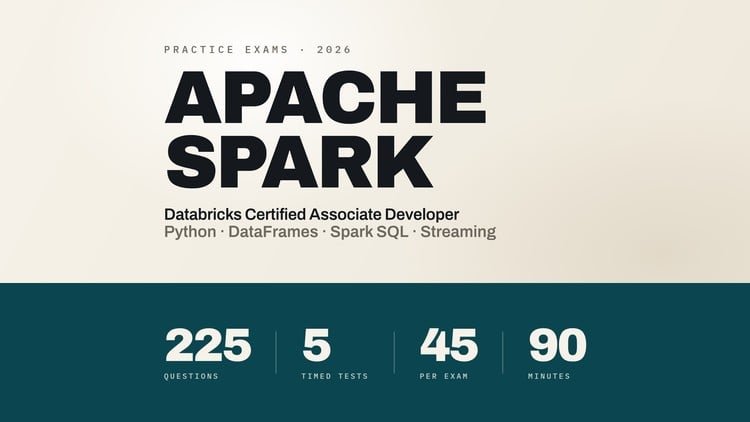
Unofficial practice exams: Spark architecture, Spark SQL, DataFrame API, Structured Streaming. 225 explained questions.
What You Will Learn:
- Test yourself against 225 original questions covering all seven domains of the current exam, weighted exactly as the official exam guide weights them.
- Tell apart the Spark APIs that are easiest to confuse, such as union and unionByName, coalesce and repartition, distinct and dropDuplicates.
- Recall the configuration defaults, accepted parameter strings and method signatures that the exam asks about directly.
- Read every answer option with its own explanation, right or wrong, plus a full rationale linked to the official documentation.
- Work up a deliberate difficulty curve from plain recall to multi-constraint scenarios, ending in a full-length timed simulation.
- Show more
Overview
Alright, let’s talk brass tacks about certification prep. If you’re eyeing that Apache Spark Developer Associate certification, you know the drill: theory is one thing, but acing the exam requires a very specific kind of practice. This set of 5 Practice Exams isn’t just another quiz bank; it’s a meticulously crafted tool designed to get you exam-ready. From my vantage point in the industry, what truly sets this apart is its laser focus on replicating the official exam experience, right down to the difficulty and question distribution. It’s not a substitute for hands-on Spark development, but it’s an indispensable bridge between theoretical knowledge and exam performance. Think of it as your final simulation before the big day, helping you identify blind spots and solidify crucial concepts you might otherwise overlook.
Prerequisites
Before diving headfirst into these practice exams, you’ll want a foundational understanding of Spark. This isn’t for the absolute beginner still figuring out what a DataFrame is. Ideally, you should have some prior experience coding in either Python or Scala with Spark. A basic grasp of Spark architecture – like understanding RDDs (even if you’re mostly working with DataFrames), executors, drivers, and how jobs are executed – is pretty essential. Familiarity with Spark SQL and the DataFrame API, even if you’re not a guru, will save you a lot of head-scratching. While the explanations are thorough, they assume you’re not starting from ground zero, so make sure you’ve got some miles under your belt with Spark fundamentals.
Skills & Tools
This practice set is a deep dive into the core competencies of an Apache Spark Developer. You’ll solidify your understanding across Spark architecture, master various transformations and actions using the DataFrame API, hone your Spark SQL prowess, and get a solid grip on Structured Streaming concepts. The real magic, though, is in how it forces you to confront the subtle nuances that often trip up even experienced developers. For instance, you’ll tackle questions that clearly differentiate between union and unionByName – one concatenates by position, the other by column name, a crucial distinction for data integration. Similarly, the exams emphasize when to use coalesce vs. repartition; remember, coalesce is generally for reducing partitions more efficiently without a full shuffle if possible, while repartition always shuffles the data across the cluster to achieve a specific number of partitions. You’ll also need to know the difference between distinct and dropDuplicates, where the former applies to all columns and the latter allows you to specify a subset. Beyond API calls, the exams are excellent at drilling you on configuration defaults (like spark.sql.shuffle.partitions), accepted parameter strings for various functions (e.g., different join types), and specific method signatures, pushing you towards truly professional, “job-ready” skills.
Career Benefits & Job Roles
Passing the Apache Spark Developer Associate certification significantly boosts your career growth prospects in the competitive big data landscape. It’s a tangible validation of your expertise in an industry-standard tool. For aspiring or current Data Engineers, Spark Developers, or Big Data Engineers, this certification signals to employers that you possess critical job-ready skills needed to build and optimize data pipelines and solutions. It’s not just about a badge; it’s about demonstrating your ability to tackle real-world projects, efficiently process massive datasets, and contribute effectively to modern data platforms. The specific knowledge gained, particularly around performance optimization and API nuances, directly translates into more robust and scalable solutions, making you a more valuable asset to any data-driven organization.
Pros
- Unparalleled Explanation Depth: Every single answer option, whether correct or incorrect, comes with its own detailed explanation. This isn’t just about knowing the right answer; it’s about understanding *why* the others are wrong, often with direct links to the official Spark documentation. This pedagogical approach transforms practice tests into a powerful learning experience.
- Deliberate Difficulty Progression: The exams are structured to gradually increase in complexity. You start with more straightforward recall questions, move into multi-constraint scenarios that demand a deeper understanding of Spark’s behavior, and culminate in a full-length, timed simulation that mirrors the actual exam pressure. This carefully planned curve prevents overwhelm and builds confidence steadily.
- Fidelity to Exam Blueprint: The questions are not only original but also weighted exactly as the official exam guide dictates across all seven domains. This ensures you’re practicing the right topics in the right proportions, maximizing the efficiency of your certification prep and honing in on high-value areas.
- Clarifies Confusing API Nuances: The questions specifically target the trickiest aspects of Spark APIs, configurations, and internal workings. This is where you’ll truly solidify your understanding of commonly confused elements like
unionvs.unionByNameorcoalescevs.repartition, which is invaluable for both the exam and daily development work.
Cons
- While the explanations are superb, these are purely practice exams focused on Q&A. They don’t include integrated hands-on labs or coding environments. To truly internalize some concepts, especially for more complex scenarios, you’ll still need to supplement this with your own coding practice in a live Spark environment.