4 practice tests, 250 questions, and detailed explanations for Type I, II, III, and Universal review.
What You Will Learn:
- Measure readiness for Type I, Type II, Type III, or Universal Section 608 certification testing.
- Practice Core (Group I) environmental, regulatory, and industry-outlook knowledge.
- Apply technical-group knowledge involving leak detection, recovery, safety, shipping, and disposal.
- Recognize the official 50-question Type-test and 100-question Universal-test structures.
- Use detailed answer explanations to identify weak areas and guide further review.
The Reality of Nailing Your EPA Section 608 Certification
Let’s be honest: nobody goes into the HVAC-R industry because they love memorizing federal regulations and atmospheric chemistry. We’re in this because we like fixing things, working with our hands, and building a solid career. But if you want to touch a manifold gauge or buy a jug of refrigerant, you have to get past the EPA Section 608 gatekeeper. I’ve seen incredibly talented “wrench-turners” fail this exam because they underestimated the certification prep required. That’s where this specific course, ‘EPA Section 608 Practice Tests: Type I-III & Universal’, becomes a total lifesaver.
This isn’t just another dry PDF of questions. It’s a focused, high-repetition training ground designed to get you “exam-ready” without the fluff. The leap from beginner to advanced tech often hinges on this one card. In my experience, the biggest hurdle isn’t the technical side—it’s the wording of the law and the specific dates you need to recall. These practice tests mirror the actual pressure of the 100-question Universal exam, making sure you don’t freeze up when the clock is ticking.
Prerequisites: What You Need Before You Click Start
You don’t need a Master’s degree in environmental science, but you shouldn’t go in totally blind either. To get the most out of these practice sets, you should have a baseline understanding of the refrigeration cycle. If you don’t know the difference between a condenser and an evaporator, or if you’ve never seen a vacuum pump in action, you might want to watch some basic theory videos first.
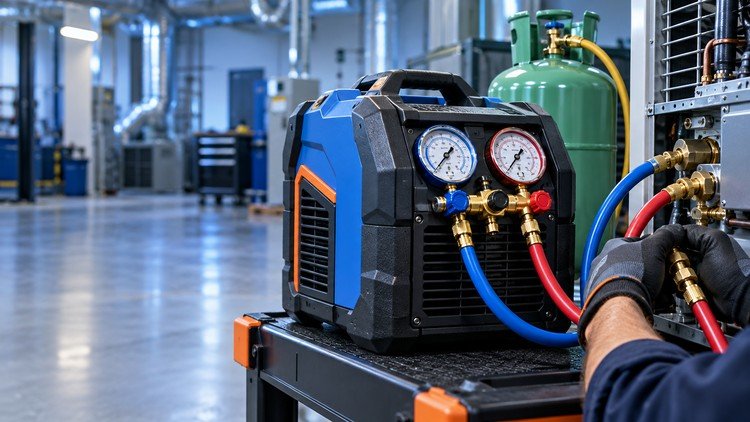
Ideally, you’ve spent a few weeks in hands-on labs or riding shotgun in a service van. Having a mental image of the industry-standard tools—like recovery units and manifold gauges—makes the regulatory questions about “de minimis” releases and “evacuation levels” much easier to visualize. This course is for the person who is ready to turn their field experience into job-ready skills and a legal credential.
Skills & Tools You’ll Master
While this is a testing suite, the “explanations” feature acts like a mini-mentor. You’re not just memorizing A, B, C, or D; you’re learning the “why” behind industry-standard tools and safety protocols. You will sharpen your ability to:
- Navigate the Core (Group I) section, which covers ozone depletion and the Montreal Protocol.
- Identify leak detection requirements for high-pressure and low-pressure systems (Type II and III).
- Understand the logistics of shipping and disposal of cylinders, which is a massive liability if you get it wrong.
- Use a Pressure-Temperature (P-T) chart accurately under exam conditions to determine system states.
- Master the safety protocols for handling flammable refrigerants (A2L), which is becoming a huge part of the modern industry outlook.
Career Benefits & Job Roles
Getting your Universal Section 608 certification is the single most important step for career growth in the mechanical trades. Without it, you are legally restricted in what you can do on a job site. Once you pass, you open doors to:
- Residential HVAC Technician: Working on split systems and heat pumps (Type I & II).
- Commercial Refrigeration Tech: Maintaining walk-in freezers and supermarket racks (Type II).
- Chiller Technician: Handling massive low-pressure systems in hospitals and high-rises (Type III).
- Facilities Maintenance: A “Universal” card makes you an asset for any real-world projects in large-scale property management.
Employers see that EPA card and know you’ve put in the certification prep time. It’s the difference between being a helper and being a lead tech with a higher hourly rate.
The Pros: Why This Course Works
- The “Why” Factor: The detailed answer explanations are the real gold here. Instead of just telling you that you’re wrong, it explains the regulation, which reinforces your job-ready skills for the field.
- Exam Simulation: The 100-question Universal structure is a grind. Practicing in that exact format builds the mental stamina you need so you don’t burn out by question 75.
- Targeted Weakness Identification: With 250 questions, you’ll quickly realize if you’re a pro at Type I (Small Appliances) but a disaster at Type III (Low Pressure). It allows you to stop wasting time on what you already know.
- High-Pressure Preparedness: The questions are phrased similarly to the official exam, which often uses “trick” wording. It trains your brain to look for the “except” or “always” in the sentence.
The Cons: An Honest Take
The only real drawback here is that it is strictly a testing environment. If you are looking for hands-on labs or video demonstrations of a recovery machine in action, you won’t find them here. This is a “final stage” tool. If you try to use this as your *only* source of learning without reading the EPA 608 study guide or having some field experience, you might find the industry-standard tools terminology a bit overwhelming at first. It’s meant to polish your knowledge, not build it from zero.
The Bottom Line: If you want to stop being a “helper” and start being a certified professional, this course is a small investment that pays off in your first paycheck as a lead. It’s the most efficient way to ensure you pass the first time and don’t have to pay those re-testing fees.