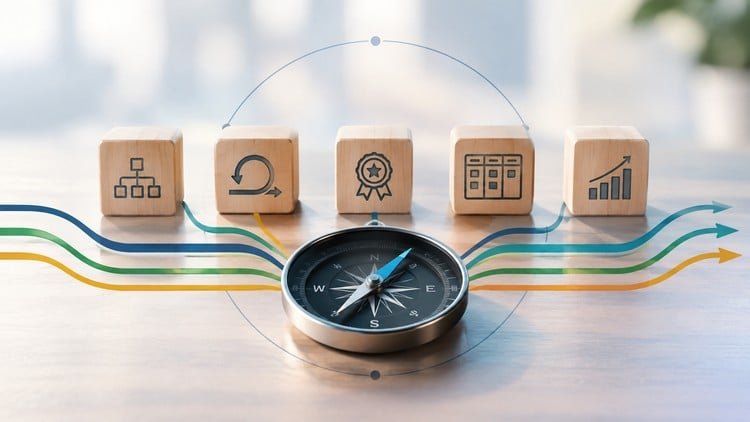
Compare Agile, Scrum & PMP approaches, tools, practices and when to use each
What You Will Learn:
- Understand the fundamentals of project management and how different project management approaches structure and deliver work.
- Learn the core principles, practices, tools, and techniques of Agile project management and Scrum.
- Understand PMP-related project management concepts, including process groups, knowledge areas, tools, and techniques.
- Compare Agile, Scrum, and PMP approaches and understand when different approaches may be appropriate.
Alright, let’s talk shop about ‘Project Management: Agile, Scrum & PMP’. In a world where every other job description asks for “Agile experience” or “PMP certification,” figuring out where to start can feel like trying to nail jelly to a wall. This course? It’s your glue stick, folks. It doesn’t just teach you one way to run a project; it teaches you how to think like a project leader who knows their way around a toolbox with more than just a hammer.
Overview
If you’re anything like me, you’ve probably seen the terms “Agile,” “Scrum,” and “PMP” thrown around like confetti at a tech conference. The real genius of this course isn’t just introducing you to these methodologies; it’s in laying them side-by-side, dissecting their DNA, and showing you not just *what* they are, but *when* and *why* you’d pick one over the other. It’s less about memorizing definitions and more about developing that critical intuition for project strategy. This course cuts through the noise, offering a holistic perspective on modern project management – a crucial skillset for anyone looking to navigate the often-complex delivery landscape, from a beginner to advanced understanding.
Prerequisites
Honestly, you don’t need to be a seasoned project veteran to get value here. If you’ve ever been part of a team trying to deliver *anything*—a product, a service, even just organizing a potluck—you’ve got a baseline. A general curiosity about how things get done, a willingness to engage with different frameworks, and perhaps some familiarity with business environments will certainly help you contextualize the material quicker. But truly, the fundamentals are covered, making it accessible even if your project experience is mostly informal.
Skills & Tools
This course equips you with a formidable arsenal of conceptual and practical skills. You’ll develop a keen sense for methodology selection, understanding when a rigid, predictive approach (like PMP principles) makes sense versus an iterative, adaptive one (Agile/Scrum). Key skills include: strategic planning, risk identification and mitigation, stakeholder management, effective communication, and team facilitation. While it’s not a software tutorial, you’ll gain a foundational understanding of how industry-standard tools like Jira or Trello are utilized in Agile/Scrum environments, and how traditional planning software (like MS Project, conceptually) fits into a PMP-driven world. The focus is on the *thinking* behind the tools, ensuring you can adapt to any specific platform.
Career Benefits & Job Roles
Let’s be blunt: knowing this stuff makes you incredibly valuable. Companies aren’t just looking for people who can *do* project management; they’re looking for people who can *think* critically about it. This course gives you the job-ready skills to pursue roles such as Project Manager, Scrum Master, Product Owner, Business Analyst, or even to excel as a team lead. For those eyeing professional credentials, it provides a solid foundation for certification prep for major industry certifications like the PMP (Project Management Professional) or various Agile/Scrum certifications (CSM, PSM). Ultimately, it’s a significant accelerator for your career growth, making you a more versatile and attractive candidate across a wide range of industries.
Pros
- Comprehensive Comparative Analysis: This isn’t a siloed exploration. The course’s greatest strength is its ability to break down Agile, Scrum, and PMP, then thoughtfully compare and contrast them. You’ll genuinely understand their strengths, weaknesses, and, most importantly, the scenarios where each shines.
- Strategic Decision-Making Focus: It goes beyond mere definitions, pushing you to develop the strategic acumen to choose the right project management approach for a given context. This real-world applicability is priceless.
- Foundation for Certification & Growth: While not a dedicated “exam prep” course, it provides an excellent theoretical and practical bedrock for anyone considering PMP, CSM, or other related certifications, significantly reducing the learning curve for further dedicated study.
- Real-World Relevance: The course emphasizes practical application, connecting theoretical frameworks to real-world projects. This helps solidify understanding and demonstrates how these principles translate into tangible outcomes.
Cons
- While it excels at providing a broad comparative understanding, the depth of coverage for any single methodology might feel somewhat introductory to those already specialized. If you’re looking to become an expert exclusively in, say, advanced Scrum scaling techniques, you’ll likely need additional, more focused training after this.