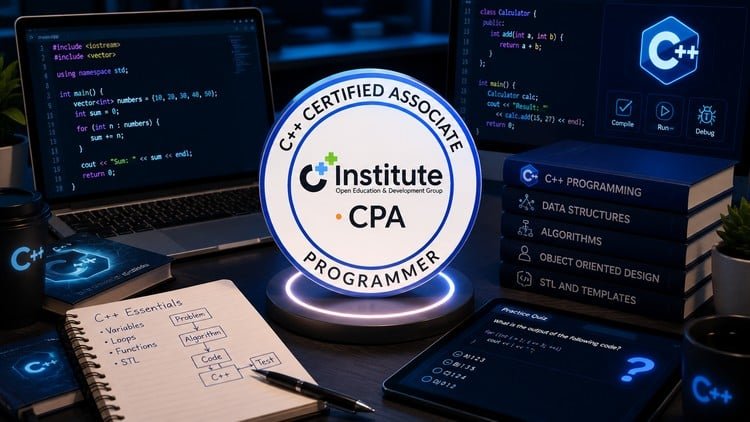
Exam-style questions with full explanations for CPA-21-02: pointers, arrays, classes, inheritance & code tracing
What You Will Learn:
- Pass the C++ Certified Associate Programmer (CPA) exam with confidence, using original questions written to the current published syllabus
- Read C++ code and predict its output, compilation behaviour and failure points without running it — the core exam skill
- Handle data types, operators, precedence and implicit conversions correctly, including the cases that quietly change results
- Work confidently with pointers, references, pointer arithmetic, dynamic memory and arrays
- Write and reason about functions: parameters by value and reference, overloading, default arguments and recursion
- Build classes and objects properly — fields, methods, access control, constructors, destructors and their execution order
- Show more
Alright, let’s talk about the ‘C++ Certified Associate Programmer CPA Practice Exams.’ If you’re eyeing that CPA-21-02 certification, you know it’s not just about knowing C++; it’s about *proving* you know C++ under pressure. This course isn’t some generic C++ tutorial. It’s a targeted, no-nonsense resource for serious certification prep, designed to get you over the finish line.
Overview
Forget passive learning or hoping you’ll stumble into the right answers. This isn’t a “learn C++ from scratch” course, nor does it bombard you with theoretical fluff. Instead, it gets straight to the point: drilling you with original, exam-style questions that force you to think like the test makers. The real gem here is its relentless focus on reading C++ code and predicting its behavior without the crutch of a compiler. This isn’t just an exam trick; it’s a foundational skill for any professional C++ developer, allowing you to debug mentally and understand the deepest nuances of the language. It pushes you to master areas like tricky pointer arithmetic, the subtle implications of implicit type conversions, and the exact execution order within complex class hierarchies. This course is for those ready to transform their theoretical C++ knowledge into tangible, job-ready skills under exam conditions, ensuring you’re ready for an industry-standard certification.
Prerequisites
Let me be blunt: if you’re a complete beginner to C++, turn back now. This course assumes you have a solid, working understanding of core C++ concepts. You should be comfortable with basic syntax, data types, control structures, and the fundamentals of functions. Having prior exposure to object-oriented programming (OOP) principles and some experience working with a C++ compiler (like GCC, Clang, or MSVC) and an IDE (Visual Studio Code, Visual Studio, or CLion) is highly recommended. This isn’t where you learn what a pointer is; it’s where you learn how to reason about five pointers on a single line of code and predict their outcome. It’s for developers who’ve moved past the initial learning curve and are now looking to solidify their understanding and catch those subtle edge cases that often trip up even experienced programmers.
Skills & Tools
The primary skill you’ll hone here is critical thinking applied directly to C++ code. You’ll develop the ability to meticulously trace code execution, anticipate compilation errors, and pinpoint runtime failures—all without hitting ‘run.’ This includes a deep dive into mastering pointer and reference semantics, understanding dynamic memory allocation, and confidently navigating complex class structures, including inheritance and polymorphism. You’ll sharpen your understanding of operator precedence and implicit conversions, which are often silent killers in C++ programs. While the course emphasizes mental simulation, having access to an industry-standard tool like a C++ compiler (e.g., g++) and an editor like VS Code or CLion for *optional* self-verification of tricky examples can be beneficial. But remember, the core “tool” this course trains is your brain, transforming it into a precise C++ execution engine, a truly valuable job-ready skill.
Career Benefits & Job Roles
Earning the CPA certification, reinforced by rigorous practice from this course, offers clear advantages for your career growth. It validates your foundational C++ knowledge, making you a more attractive candidate for entry-to-mid level C++ development roles. We’re talking positions like Junior C++ Developer, Software Engineer focusing on C++, Embedded Systems Programmer, or even roles within game development. This certification demonstrates to potential employers that you possess a structured understanding of C++ fundamentals and can reason effectively about code—a quality that often sets candidates apart. It’s a formal acknowledgment of your dedication to professional development and provides a robust stepping stone towards more advanced C++ roles and deeper specialization in areas requiring strong C++ expertise.
Pros
- Authenticity and Relevance: The questions are not just C++ trivia; they are meticulously crafted to mirror the style, difficulty, and specific focus areas of the CPA-21-02 exam. This isn’t just practice; it’s a dress rehearsal for the actual test, making your certification prep incredibly effective.
- Deep Explanations, Not Just Answers: Each question comes with a comprehensive, step-by-step explanation. This isn’t a cheat sheet; it’s a learning opportunity. You don’t just find out *what* the answer is, but *why*—covering the nuances of C++ behavior, potential pitfalls, and the reasoning process needed to arrive at the correct conclusion.
- Mastering the “No-Run” Skill: This course specifically trains you to read C++ code and predict its output or behavior without running it. This is arguably the most crucial skill for the CPA exam and a highly valuable diagnostic ability for any C++ developer, directly translating into quicker debugging and a deeper understanding of the language’s mechanics.
- Comprehensive Syllabus Coverage: It methodically covers all critical areas outlined in the CPA-21-02 syllabus, from pointers and arrays to complex inheritance, operator precedence, and memory management. No key stone is left unturned, ensuring you have a well-rounded and confident grasp of all exam topics, supporting your journey from beginner to advanced understanding.
Cons
- Strictly Practice-Oriented, Lacks Foundational Instruction: The most significant “con”—if you can even call it that for a practice exam course—is that it offers zero foundational C++ lessons. It won’t teach you C++ from scratch. If you encounter a knowledge gap, you’ll need to seek out external resources, textbooks, or dedicated C++ learning platforms. It doesn’t include hands-on labs for building real-world projects, as its sole purpose is exam readiness, which means you need to bring your existing C++ knowledge to the table.