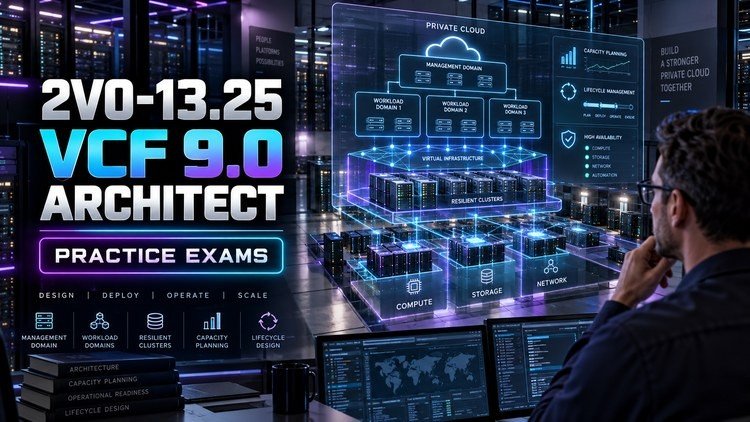
75 original scenario-based questions with detailed explanations for every answer option
What You Will Learn:
- Assess VMware Cloud Foundation architecture choices across management, workload, networking, storage, and lifecycle domains.
- Apply availability, scalability, security, and governance requirements to realistic VCF architecture scenarios.
- Identify supported design patterns and trade-offs for private cloud platform services and operations.
- Use detailed answer explanations to close knowledge gaps before the 2V0-13.25 exam.
Why This Practice Exam is the Missing Piece of Your VCF Certification Strategy
Let’s be real for a second: the leap from being a solid VMware Administrator to a VMware Cloud Foundation (VCF) Architect is less of a step and more of a canyon jump. I’ve seen plenty of brilliant engineers crumble during the 2V0-13.25 exam because they knew the buttons to click, but didn’t understand the “why” behind the design. That’s where this practice exam set comes in. It doesn’t just drill you on facts; it forces you to think like a designer who has a CTO breathing down their neck about uptime and scalability.
What I appreciated most about these 75 questions is that they aren’t your typical “true or false” filler. They are scenario-based questions that feel like actual tickets or project briefs you’d see in a high-stakes environment. You aren’t just memorizing port numbers; you’re deciding whether a consolidated or stretched cluster architecture makes sense for a specific disaster recovery requirement. If you’re looking for a shortcut, this isn’t it. But if you’re looking for certification prep that actually builds job-ready skills, you’re in the right place.
Prerequisites for Success
Before you dive into these practice exams, don’t expect to pass them by just “winging it.” This is an advanced level resource. To get the most out of these questions, you should ideally have:
- A solid foundation in vSphere, vSAN, and NSX. If you don’t know your way around a distributed switch, go back to the basics first.
- Previous experience with SDDC Manager or at least a passing grade in the VCP-level exams.
- Exposure to real-world projects involving private or hybrid cloud deployments.
- Familiarity with the VMware Validated Solutions (VVS) and standard architecture frameworks.
Skills Developed and Industry-Standard Tools
This course is a deep dive into the VCF stack. While the questions are theoretical, the knowledge required to answer them is deeply rooted in hands-on labs and practical application. You’ll find yourself wrestling with:
- Architectural Design: Choosing between different management and workload domain configurations based on industry-standard tools.
- Storage Policy Management: Understanding how vSAN and external storage integration impacts long-term scalability.
- Network Virtualization: Designing NSX-T topologies that satisfy strict security and compliance audits.
- Lifecycle Management (LCM): Navigating the complexities of patching and upgrading a full-stack private cloud without causing a massive outage.
- Governance: Implementing Aria Automation (formerly vRealize) to maintain control over self-service environments.
Career Benefits and Job Roles
Passing the 2V0-13.25 exam isn’t just about adding a digital badge to your LinkedIn profile; it’s about massive career growth. In the current market, “Cloud Architect” is one of the highest-paying titles you can hold. By mastering the concepts in these exams, you’re positioning yourself for roles such as:
- Cloud Infrastructure Architect: Leading the migration from legacy hardware to a modern SDDC.
- Systems Designer: Creating the blueprint for real-world projects that involve multi-site availability.
- Senior Technical Consultant: Advising enterprises on how to balance private cloud platform services with cost-effective operations.
The demand for VCF-certified professionals is skyrocketing as companies realize that the public cloud isn’t the “magic bullet” they thought it was and are moving back toward sophisticated on-premise solutions.
The Pros: Why It’s Worth the Investment
- Deep-Dive Explanations: The “why” is more important than the “what.” Every answer option—including the wrong ones—comes with a detailed explanation that helps close knowledge gaps immediately.
- Nuanced Scenarios: The questions reflect the messy reality of IT. You have to balance availability, scalability, and security against conflicting governance requirements.
- Logical Progression: It covers the beginner to advanced spectrum within the VCF domain, ensuring you don’t feel overwhelmed on question one but are sufficiently challenged by question seventy-five.
The Cons: An Honest Assessment
If I have one gripe, it’s that 75 questions can feel a bit light if you’re a “volume learner.” While the quality of the scenario-based questions is top-tier, I would have loved to see a second set of 75 to really hammer home the lifecycle management nuances. However, considering the depth of the explanations provided, it’s definitely a case of quality over quantity. This isn’t a dump; it’s a study tool.