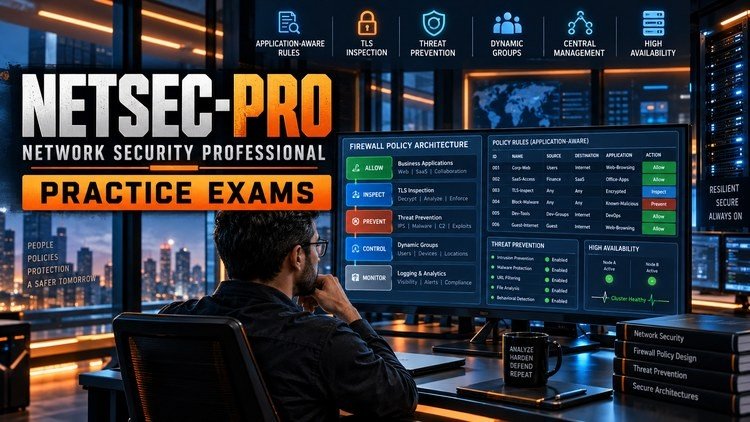
75 original scenario-based questions with detailed explanations for every answer option
What You Will Learn:
- Apply current NETSEC-PRO objectives to realistic Palo Alto Networks scenarios.
- Distinguish plausible alternatives by technical purpose, scope, and operational effect.
- Use detailed option-level explanations to identify and correct knowledge gaps.
- Build a focused revision plan using official Palo Alto Networks documentation.
Overview: A Deep Dive into Real-World Engineering Logic
If you have spent any time in the trenches of cybersecurity, you know that the gap between passing a multiple-choice test and managing a production firewall is a literal canyon. Most certification prep materials on the market today are essentially glorified memory games. They ask you which menu a button is in, rather than why you would press it in the first place. This is where the NETSEC-PRO Network Security Professional Practice Exams caught my attention. This isn’t just a brain dump; it is a tactical simulation designed for those of us who have to explain to a CISO why the VPN dropped during a critical update.
What I appreciated most about this set of 75 questions is the shift in perspective. Instead of rote memorization, the content forces you to engage with real-world projects and architectural dilemmas. It feels less like a classroom quiz and more like a series of tickets pulled from a high-pressure Jira board. The focus is squarely on the nuance of Palo Alto Networks logic—specifically how traffic flows through the “Single-Pass Parallel Processing” architecture. If you are looking to move from beginner to advanced in your understanding of Next-Generation Firewalls (NGFW), this is the kind of mental friction you actually need.
Prerequisites: Who Should Take This On?
While the course covers a wide range of difficulty levels, this isn’t for someone who doesn’t know what an IP address is. To get the most out of these exams, you should have a baseline understanding of the OSI model and standard networking protocols. Ideally, you have spent some time in hands-on labs or have had “read-only” access to a Panorama instance. If you understand the difference between a traditional stateful firewall and an application-aware gateway, you are ready. It is a perfect fit for those currently studying for their PCNSE or PCNSA who feel like they’ve hit a plateau with official study guides.
Skills & Tools: Mastering the Ecosystem
The core of this practice set revolves around industry-standard tools that define the modern security stack. You aren’t just learning “security”; you are learning the specific mechanics of the Palo Alto ecosystem. The scenarios drill deep into:
- PAN-OS Policy Management: Understanding the hierarchy of Security, NAT, and PBF rules.
- Decryption Mirrors & SSH Proxy: Navigating the complexities of inspecting encrypted traffic without breaking internal applications.
- GlobalProtect Implementation: Solving the common “split-tunnel” and “pre-logon” headaches that plague remote work environments.
- WildFire & Threat Prevention: Distinguishing between signatures, sandboxing, and heuristic analysis in a live threat environment.
- Panorama: Managing device groups and templates at scale—crucial for career growth in enterprise environments.
Career Benefits & Job Roles: Beyond the Badge
Let’s be honest: high-paying roles in network security don’t go to the people who can just pass a test; they go to the people who can troubleshoot. Completing these exams prepares you for roles such as Network Security Engineer, Security Architect, or Senior SOC Analyst. By mastering the “why” behind the configuration, you develop job-ready skills that make you an asset during a migration or a breach response. In an industry where “experience” is the primary currency, having a firm grasp on these Palo Alto Networks scenarios allows you to speak the language of senior engineers during technical interviews.
Pros: Why This Stands Out
- The “Why” Factor: Every single answer choice—even the wrong ones—comes with a technical autopsy. This helps you identify “distractor” answers that look plausible but fail due to specific operational constraints.
- Documentation Integration: It bridges the gap between the exam and official Palo Alto Networks documentation. You aren’t just told you’re wrong; you’re shown where the source of truth lives.
- Operational Depth: The scenarios focus on the “operational effect” of a change. For example, it won’t just ask about a Zone Protection Profile; it will ask how that profile impacts legitimate traffic during a SYN flood.
Cons: The Honest Take
If I have one gripe, it’s the volume. At 75 questions, it is a lean, high-protein meal. While the quality is significantly higher than the 500-question “mega-dumps” you find on sketchy forums, I would have loved to see another 25 questions specifically focused on SD-WAN or Sase (Prisma Access). It’s a focused revision tool, but you will likely finish it faster than you’d like because the content is actually engaging. You’ll leave wanting more scenarios to chew on.