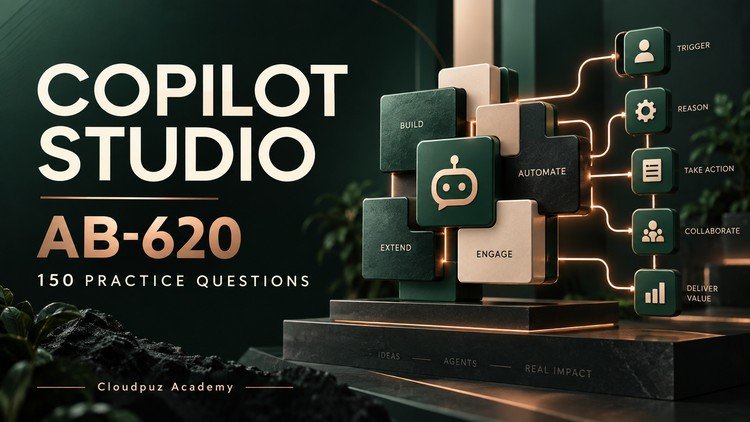
Review agent planning, integrations, MCP, APIs, evaluation and ALM with explanations for every answer option
What You Will Learn:
- Plan agent identity, channels, reusable components, typed inputs, approval gates and recovery behavior.
- Select and evaluate connectors, APIs, MCP tools, agent collaboration and enterprise knowledge integrations.
- Diagnose retrieval, authorization, schema, latency and tool-result interpretation failures.
- Design representative evaluations and manage solutions, environment configuration and controlled releases.
Overview: Cutting Through the Copilot Hype
Let’s be real for a second—everyone and their mother is claiming to be an “AI Expert” lately. But there is a massive difference between knowing how to prompt a chatbot and knowing how to build a production-grade autonomous agent that doesn’t hallucinate all over your corporate data. That is where the Copilot Studio AB-620: 150 Practice Questions course enters the frame.
I’ve spent the last decade navigating the Microsoft ecosystem, and I’ve seen plenty of certification prep materials that are nothing more than lazy brain dumps. This course isn’t that. It addresses the AB-620 exam which, for those who haven’t been tracking the beta cycles, is essentially the gold standard for anyone serious about the Power Platform’s evolution into the AI agent space. Instead of just memorizing button clicks, this course forces you to think like an architect. It focuses heavily on the “why” behind agent planning and the messy, often overlooked reality of ALM (Application Lifecycle Management). If you want to move beyond the “hello world” phase of AI and actually deploy something that survives a security audit, this is where you start.
What You Need Before Diving In
Don’t expect to walk into this if you’ve never touched the Power Platform. While the course is accessible from beginner to advanced levels in terms of its progression, you’ll struggle if you don’t have a foundational grasp of cloud environments. I’d recommend having a basic understanding of Microsoft 365 and at least a passing familiarity with low-code environments. You don’t need to be a Python wizard, but you should understand how data flows between systems. If you’ve never heard of an API or don’t know what an environment variable is, you might want to spend a weekend on some hands-on labs before tackling these practice questions.
The Toolkit: Industry-Standard Skills
This course packs a punch when it comes to industry-standard tools. You aren’t just learning a proprietary interface; you’re learning the logic that governs modern AI integration. Here is the breakdown of the high-value skills you’ll sharpen:
- Agent Orchestration: Mastering agent identity and complex recovery behavior so your bot doesn’t just crash when it hits an edge case.
- Connectivity: Deep dives into connectors, APIs, and the increasingly important MCP (Model Context Protocol) for context-aware interactions.
- Troubleshooting: Learning to diagnose latency issues and schema mismatches—the silent killers of most real-world projects.
- Enterprise Governance: Managing approval gates and controlled releases, ensuring your AI agents don’t go rogue in a production environment.
Career Trajectory: Is This the Golden Ticket?
In the current market, “AI Engineer” is a flashy title, but “Copilot Architect” is where the actual career growth is happening within the enterprise sector. Companies are desperate for people who can bridge the gap between raw LLM capabilities and job-ready skills that solve business problems.
By mastering the AB-620 content, you’re positioning yourself for job roles like AI Solutions Architect, Power Platform Developer, or Digital Transformation Consultant. These roles are seeing a massive spike in demand because they involve more than just “chatting”; they involve enterprise knowledge integrations. If you can prove you know how to handle authorization and tool-result interpretation, you become an indispensable asset to any organization trying to automate their internal workflows.
What Hits the Mark (Pros)
- The “Why” Factor: My favorite part of this course is that every single answer option—even the wrong ones—comes with a detailed explanation. This is crucial for certification prep because it helps you spot the “distractor” answers that Microsoft loves to throw at you.
- ALM Focus: Most AI courses ignore Application Lifecycle Management. This course leans into it. Learning how to move agents from dev to test to production without breaking the schema is a skill that will save you 100 hours of headaches in a real job.
- MCP and Modern Tech: It stays current. Including MCP tools and typed inputs shows that the curriculum is being updated for the latest shifts in how agents interact with external data sources.
The Reality Check (Cons)
The only real downside here is the intensity. Because it’s focused on 150 high-level practice questions, it can feel like a firehose of information. If you’re looking for a slow, hand-holding walkthrough of how to build your first bot, this might feel a bit intimidating. It’s designed to test and refine your knowledge, so if you haven’t done the hands-on labs yourself, you might find the diagnostic questions particularly punishing. It’s an honest assessment tool, not a “participation trophy” kind of course.