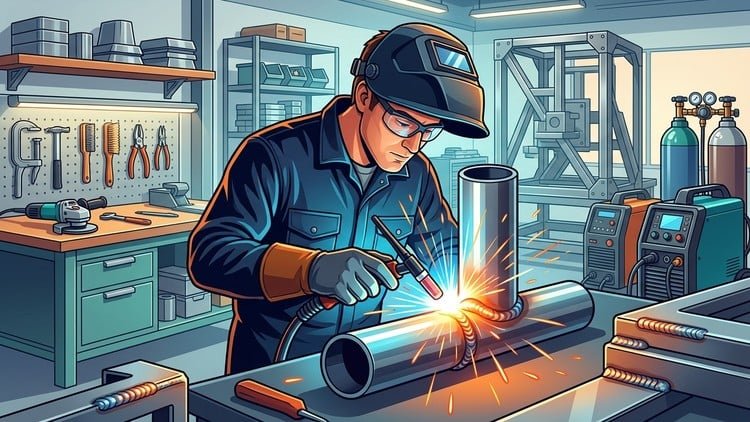
Prepare for the AWS Certified Welder Exam with Mock Tests, Multiple-Choice Questions and Detailed Explanations
What You Will Learn:
- Understand AWS Certified Welder exam topics, welding codes, standards, and basic certification requirements.
- Practice questions on WPS and PQR, including welding procedures, qualification records, and key welding variables.
- Review welding processes, equipment, operating settings, welding positions, joint types, and test assembly requirements.
- Identify weld defects and review inspection, testing, welding safety, symbols, and basic blueprint reading.
- Use detailed question explanations to find knowledge gaps and improve AWS Certified Welder exam preparation.
Overview: Beyond the Bead
Let’s be honest—anyone can strike an arc, but not everyone can pass a AWS Certified Welder (CW) exam on the first try. I’ve seen incredibly talented shop welders fail the CW not because they couldn’t weld, but because they didn’t speak the “language” of the American Welding Society. This course, the ‘Practice Test For AWS Certified Welder (CW) Exam 2026’, isn’t just a collection of questions; it’s a mental simulator for the high-pressure environment of certification prep.
What I appreciate here is the focus on the “why” behind the weld. In the real world, you aren’t just following a gut feeling; you’re following a WPS (Welding Procedure Specification). This course forces you to get comfortable with the technical bureaucracy of welding—the PQR (Procedure Qualification Record), the essential variables, and the specific tolerances that separate a “good looking weld” from an “industry-standard code weld.” It bridges the gap between being a hobbyist and developing job-ready skills that major contractors actually trust. It’s an opinionated take on prep, focusing heavily on the trap-doors that usually catch people off guard, like obscure symbols or specific safety regulations that we often ignore in the daily grind.
Prerequisites: What You Need in Your Kit
Before you dive into these practice tests, don’t expect to be taught how to weld from scratch. This is a beginner to advanced resource, but it assumes you’ve spent some quality time under the hood. To get the most out of this course, you should have:
- Basic Shop Experience: You should know your way around a shop and understand the difference between SMAW, GMAW, and GTAW.
- Foundational Metallurgy: A basic grasp of how heat affects different metals will help you understand the logic behind the test questions.
- Safety Literacy: You should already be familiar with OSHA standards and basic PPE requirements; the course will sharpen this, but shouldn’t be your first exposure.
- Patience for Paperwork: The AWS CW involves a lot of documentation. You need a mindset that values precision and record-keeping as much as the physical weld.
Skills & Tools: Mastering the Industry Standard
This course acts as a digital hands-on lab for your brain. You’ll be working through scenarios that involve industry-standard tools and documentation styles that you’ll encounter on any Tier-1 job site. By the time you finish the mock exams, you’ll have a firm handle on:
- Reading Blueprints and Symbols: You’ll move past guessing and start interpreting complex welding symbols and blueprint reading like a pro.
- WPS/PQR Mastery: Understanding the relationship between the procedure and the qualification record is the backbone of career growth in inspection and quality control.
- Defect Identification: You’ll learn to spot undercut, porosity, and slag inclusions in theory so you can prevent them in practice.
- Operating Settings: Reviewing the fine-tuning of voltage, wire feed speed, and amperage for various welding positions (1G through 6G).
- Testing Protocols: You’ll get deep into the weeds of destructive and non-destructive testing (NDT) requirements.
Career Benefits & Job Roles
Passing the AWS CW isn’t just about a pay bump—it’s about opening doors to real-world projects that are off-limits to uncertified labor. Once you’ve used this course to nail your certification, your resume takes on a whole new level of authority. Potential job roles include:
- Structural Welder: Working on skyscrapers, bridges, and heavy infrastructure where AWS D1.1 compliance is non-negotiable.
- Pipe Welder: Entering the lucrative oil and gas sector or high-pressure steam systems.
- Welding Inspector (CWI Path): The CW is a massive stepping stone for those looking to eventually move into inspection and quality assurance.
- Manufacturing Technician: Working with industry-standard tools in aerospace or automotive plants that require documented proof of skill.
Pros: Why This Course Hits the Mark
- Detailed Explanations: This is the biggest win. It doesn’t just tell you that you’re wrong; it explains why based on the code. This turns a simple practice test into a genuine learning tool.
- Current Content: Being geared toward the 2026 standards ensures you aren’t studying outdated welding codes that have since been revised.
- Efficiency: It highlights your knowledge gaps immediately. If you’re a pro at GMAW but fail every question on blueprint reading, you know exactly where to spend your weekend.
- Accessibility: The format allows you to squeeze in certification prep during lunch breaks or between shifts, making it easier to balance career growth with a full-time job.
Cons: The Reality Check
The only real “con” here is that practice tests can sometimes give a false sense of security regarding the physical side of the exam. You can ace the written portion of these tests, but if your hand isn’t steady and you can’t manage your heat in a 6G position, the certification will still elude you. This course is a masterclass in the theory and code of welding, but it must be paired with actual time in the booth to be truly effective. It’s a tool for the head, not a replacement for the hands.