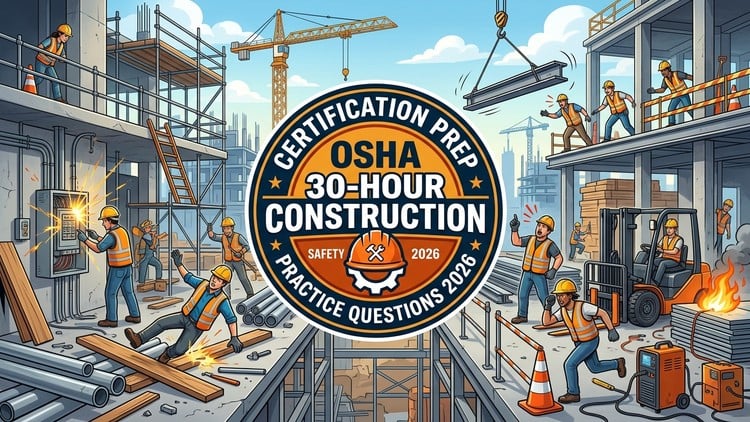
Pass the OSHA 30-Hour Construction Exam on Your First Try – Realistic Practice Questions with Clear Explanations
What You Will Learn:
- Understand key OSHA standards for construction sites and learn how to apply safety rules correctly on the job.
- Identify the Focus Four hazards — falls, electrocution, struck-by, caught-in — and know how to prevent each one on site.
- Learn about PPE, health hazards like silica and asbestos, confined spaces, fire safety, and how to protect workers.
- Answer practice questions with full explanations and learn from every mistake so you feel ready on your official exam day.
- Prepare for every major topic on the OSHA 30-Hour Construction exam using a simple, quiz-style practice test format.
A Straight-Talk Review of the 2026 OSHA 30-Hour Construction Practice Tests
Let’s be honest: sitting through thirty hours of safety training is a rite of passage in this industry, but it’s also a total grind. If you’ve spent any time on a job site, you know that OSHA 30 isn’t just a “nice-to-have” certificate; it’s the gold standard for anyone looking to transition from a laborer to a supervisor or safety manager. I recently went through the “Practice Tests for OSHA 30-Hour Construction 2026,” and I wanted to share my take on whether this specific certification prep is worth your time and money. Spoiler alert: if you’re looking for job-ready skills that go beyond just memorizing regulations, this is a solid shortcut.
What I liked about this set of practice tests is that it doesn’t treat the user like a robot. In the tech and construction-tech world, we often deal with industry-standard tools that are overly complex, but these tests simplify the chaos. They focus heavily on the “Focus Four”—falls, electrocution, struck-by, and caught-in-between. These are the hazards that actually kill people on real-world projects, and the practice questions reflect that reality. Instead of just asking you to recite a code number, the 2026 edition forces you to think about how to mitigate risks in the field. It’s less about academic theory and more about surviving a site walk-through with a skeptical inspector.
What You Need Before You Start
While this course is marketed as going from beginner to advanced, you’ll get a lot more out of it if you’ve actually stepped foot on a construction site. There are no hard technical requirements—you don’t need to be a master of CAD or BIM software—but you do need a baseline understanding of how a project flows. If you don’t know the difference between a scaffold and a ladder, you might find some of the hands-on labs-style logic questions a bit tricky. That said, as far as certification prep goes, it’s accessible enough for someone brand new to the industry who is looking to jumpstart their career growth.
Developing Your Safety Toolkit
The “Skills & Tools” covered here are surprisingly comprehensive for a quiz-style format. You’re not just learning about hard hats and safety glasses; you’re diving into the heavy stuff. Here’s what you’re actually building in your mental toolbox:
- Hazard Recognition: Learning to spot the “Focus Four” before they become an incident report.
- Health Standards: Navigating the complexities of silica dust, lead, and asbestos—huge for anyone working in renovation or remediation.
- Regulatory Literacy: Understanding how to read industry-standard tools like the OSHA 1926 standards without your eyes glazing over.
- Emergency Response: Developing the job-ready skills to manage fire safety and confined space entry protocols.
Career Growth and Real-World Job Roles
Let’s talk about the money. Getting your 30-hour card is one of the fastest ways to increase your hourly rate or land a salaried position. This course prepares you for roles like Site Superintendent, Safety Coordinator, or Project Manager. In these positions, you aren’t just swinging a hammer; you’re managing real-world projects and ensuring hundreds of workers go home safe. Companies are desperate for people who can bridge the gap between “knowing the rules” and “enforcing the rules.” This certification prep gives you the confidence to talk the talk during an interview, proving you have the job-ready skills to handle a high-stakes site.
The Pros: Why This Works
- Realistic Question Bank: The questions don’t feel “canned.” They mimic the tricky wording you’ll see on the actual exam, which is half the battle.
- Detailed Explanations: This is the best part. When you get a question wrong, it doesn’t just give you the right answer; it explains the why behind the OSHA standard.
- Efficiency: It’s designed for busy professionals. You can knock out a few certification prep quizzes during a lunch break or while commuting.
- Up-to-Date Content: Since this is the 2026 version, it includes the latest updates on crystalline silica and heat illness prevention, which are becoming massive focus areas for inspectors.
The Cons: An Honest Critique
If I have one gripe, it’s that the format is strictly quiz-based. If you’re a visual learner who needs hands-on labs or high-production video walk-throughs to stay engaged, you might find the text-heavy explanations a bit dry. It’s an effective tool for passing the test, but it shouldn’t be your only source of learning if you’ve never actually seen a trench box or a fall arrest system in person. It’s a supplement to experience, not a total replacement for it.
Overall, if you’re serious about your career growth in the construction or safety tech space, this is a no-brainer. It cuts through the fluff and gets you ready for the official exam day without wasting your time.