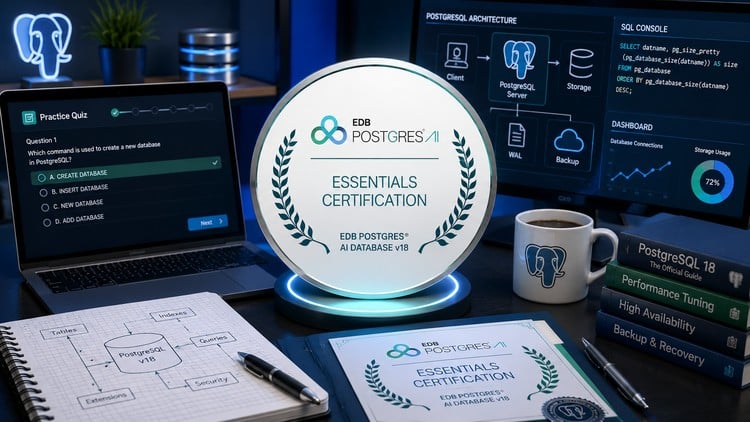
Exam-style questions with full explanations covering architecture, installation, security, backup, tuning and SQL
What You Will Learn:
- Prepare for the EDB PostgreSQL Associate certification using original exam-style questions written to the published curriculum
- Explain PostgreSQL system and physical architecture: processes, memory, WAL, checkpoints, MVCC and how they interact
- Install, configure and manage a PostgreSQL server, including the configuration parameters that matter in production
- Secure a database properly with roles, privileges, host-based authentication and encryption in transit
- Design and manage database objects — schemas, tables, data types, indexes, constraints, partitions and tablespaces
- Plan and execute backup and recovery, including logical dumps, physical backups, WAL archiving and point-in-time recovery
- Show more
Overview
Alright, let’s talk about the ‘PostgreSQL Associate Certification Practice Exams (EDB)’. If you’re eyeing that shiny EDB PostgreSQL Associate certification, this course isn’t just a nice-to-have; it’s a critical component of your **certification prep**. Frankly, it nails the format and difficulty you’ll encounter on the real exam. This isn’t your average quiz; these are genuinely challenging, mirroring the depth and sometimes trickiness of actual certification questions. What truly sets it apart are the comprehensive explanations accompanying each answer – whether you get it right or wrong, you walk away with a deeper understanding of the “why” behind the correct choice, covering everything from `WAL` mechanics and `MVCC` to intricate `pg_hba.conf` directives. It’s an invaluable tool for identifying those stubborn knowledge gaps before they cost you on exam day, effectively transforming an assessment into a powerful learning experience. Think of it as your final, rigorous sanity check before you sit for the big one.
Prerequisites
Let’s be real, this isn’t a course for someone just dipping their toes into the PostgreSQL waters. To get the most out of these practice exams, you absolutely need a foundational understanding of PostgreSQL concepts. You should ideally have spent some time with PostgreSQL, perhaps through a structured course, official documentation, or even some dedicated **hands-on labs**. Familiarity with basic SQL, database administration tasks, and an understanding of core relational database principles are non-negotiable. While the explanations are excellent, they reinforce rather than introduce concepts. If terms like `WAL`, `checkpoint`, `VACUUM`, `roles`, or `point-in-time recovery` sound like gibberish, you’ll want to hit the books (or a beginner course) first. This material is designed to test and refine existing knowledge, not build it from scratch – it’s a capstone to your learning, not the cornerstone.
Skills & Tools
Engaging with these practice exams will significantly sharpen your command over a range of **industry-standard tools** and essential PostgreSQL skills. You’ll solidify your understanding of:
- PostgreSQL Architecture: Deep dives into processes, memory structures, `WAL` (Write-Ahead Log), `checkpoints`, and `MVCC` (Multi-Version Concurrency Control).
- Server Installation & Configuration: Mastering key parameters in `postgresql.conf` that impact performance and stability in a production environment.
- Security Best Practices: Implementing `roles`, `privileges`, `host-based authentication` (`pg_hba.conf`), and `encryption in transit`.
- Database Object Management: Designing and manipulating `schemas`, `tables`, various `data types`, `indexes`, `constraints`, `partitions`, and `tablespaces`.
- Backup & Recovery Strategies: Proficient use of `pg_dump`, `pg_basebackup`, `WAL archiving`, and executing `point-in-time recovery` for robust disaster preparedness.
- Performance Tuning Basics: Understanding how configuration parameters and indexing strategies contribute to optimal database performance.
You’ll implicitly be working with concepts applicable to tools like `psql`, `pg_dump`, `pg_restore`, and various operating system commands for managing service configurations.
Career Benefits & Job Roles
Earning the EDB PostgreSQL Associate certification, validated by these rigorous practice exams, is a significant boost for your **career growth**. It’s a clear signal to employers that you’ve got your ducks in a row when it comes to PostgreSQL, one of the most powerful and widely adopted open-source databases. This isn’t just a piece of paper; it demonstrates concrete **job-ready skills** and a commitment to mastering an **industry-standard tool**.
This certification is particularly beneficial for roles such as:
- Junior/Mid-level Database Administrator (DBA): Provides a solid foundation for managing PostgreSQL environments.
- Data Engineer: Enhances understanding of data storage, retrieval, and performance implications.
- Backend Developer: Improves ability to design efficient database schemas and write optimized queries.
- DevOps Engineer: Supports deployment, monitoring, and scaling of PostgreSQL instances.
- Solutions Architect: Offers credibility in designing robust, scalable database solutions.
It enhances your marketability, validates your expertise, and can open doors to more challenging and rewarding **real-world projects** involving critical data infrastructure. It’s a stepping stone from being merely familiar with PostgreSQL to being recognized as a competent professional.
Pros
- Authentic Exam Experience: The questions are expertly crafted to mirror the style, difficulty, and scope of the actual EDB PostgreSQL Associate certification exam, making it a truly effective **certification prep** tool.
- Comprehensive Explanations: Each question comes with a detailed, clear explanation for both correct and incorrect answers. This transforms wrong answers into valuable learning opportunities, covering the “why” and not just the “what.”
- Curriculum Alignment: The content is meticulously aligned with the published EDB PostgreSQL Associate certification curriculum, ensuring you’re studying exactly what you need to know.
- Effective Knowledge Gap Identification: By rigorously testing across all domains from **beginner to advanced** concepts, the practice exams quickly highlight areas where your understanding is weak, allowing targeted study.
Cons
- Not a Standalone Learning Resource: While the explanations are excellent, these are practice exams, not a full instructional course. This isn’t a replacement for a structured course, official documentation, or actual **hands-on labs** to build foundational knowledge. If you come in completely green, you’ll be swimming against the current.