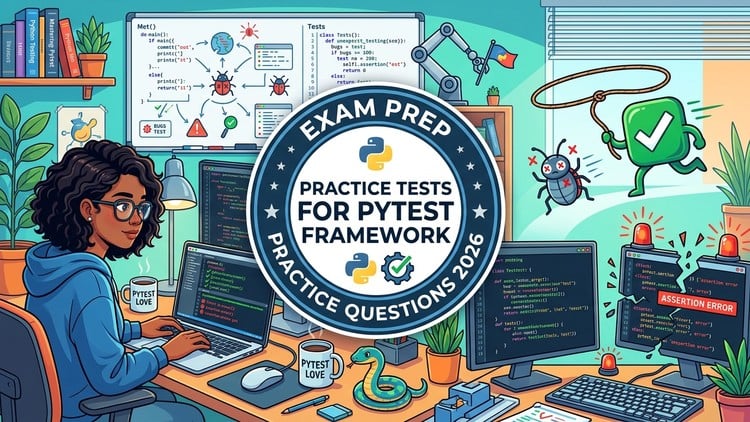
Master Pytest with Realistic Exam Questions, Mock Exams, and Detailed Explanations
What You Will Learn:
- Master Pytest fixtures, scopes, and dependency injection through realistic practice questions built for certification exam success.
- Write strong assertions, use parametrization, and apply skip/xfail marks with confidence through hands-on exam-style practice.
- Understand Pytest’s plugin system, hooks, and conftest . py architecture to extend and organize large test suites effectively.
- Practice mocking and monkeypatching techniques used to isolate dependencies and simulate real-world testing scenarios.
- Run tests in parallel, measure code coverage, and integrate Pytest into CI/CD pipelines like a testing professional.
- Show more
The Reality of Testing in 2026: A Deep Dive into Pytest Mastery
If you’ve spent any time in the Python ecosystem lately, you know that unit testing isn’t just a “nice-to-have” checkbox on a Jira ticket anymore—it’s the literal backbone of enterprise-grade software development. I’ve seen far too many developers coast by with basic unittest scripts, only to hit a brick wall when they have to scale a suite to thousands of tests. That’s where the “Pytest Framework Prep: Practice Tests for 2026” comes into play. Let’s be real: most tutorials show you how to write a simple assert, but they leave you hanging when it comes to the complex architecture required for job-ready skills.
This course isn’t a passive “watch and forget” experience. It’s a gauntlet of certification prep designed to mimic the high-pressure environment of technical interviews and professional certification exams. What I appreciated most was the forward-looking approach. By targeting 2026 standards, the material moves past deprecated methods and focuses heavily on industry-standard tools like dependency injection through fixtures and the advanced use of conftest.py. It’s about building a robust testing mindset rather than just memorizing syntax.
Prerequisites for Success
Don’t jump into this if you’ve never written a line of Python. To get the most out of these hands-on labs and practice exams, you should have:
- A solid grasp of Python 3.x fundamentals (loops, dictionaries, and especially decorators).
- Basic familiarity with the command line or terminal.
- A general understanding of why we test code (even if you haven’t mastered the “how” yet).
- An IDE like PyCharm or VS Code ready to go, as you’ll want to replicate these questions in a local environment.
Skills & Tools You’ll Command
This course goes wide and deep. It’s not just about passing a test; it’s about mastering the Pytest ecosystem. You’ll be working with:
- Advanced Fixture Scopes: Moving beyond “function” scope to “session” and “package” levels to optimize execution speed.
- Parametrization: Learning how to run a single test logic against dozens of data sets without repeating yourself (DRY principle).
- Mocking & Monkeypatching: This is huge. You’ll learn to isolate your code by simulating external APIs and databases—essential for real-world projects.
- Plugin Architecture: Understanding how to extend Pytest with hooks to create custom reporting or setup logic.
- CI/CD Integration: How to hook your suite into pipelines, use pytest-xdist for parallel execution, and generate code coverage reports that actually mean something to stakeholders.
Career Benefits & Job Roles
If you’re looking for career growth, specialized testing knowledge is a major shortcut. Companies are desperate for people who can do more than just write code; they need people who can ensure that code doesn’t break in production. Mastering Pytest opens doors to specific, high-paying roles:
- SDET (Software Development Engineer in Test): A role that often pays as much as (or more than) standard dev roles.
- QA Automation Engineer: Moving away from manual clicks to scalable, automated industry-standard frameworks.
- DevOps Engineer: Where understanding test exit codes and parallel execution is vital for stable deployment pipelines.
- Senior Python Developer: Because at the senior level, you aren’t just writing features; you’re maintaining the testable architecture of the entire application.
Pros: Why This Course Hits the Mark
- High-Fidelity Questions: These aren’t “what is a variable” questions. They are scenario-based. You’re given a broken conftest.py or a failing fixture injection and told to fix it. This is exactly how hands-on labs should feel.
- Deep-Dive Explanations: The “why” is more important than the “what.” Each question comes with a breakdown of why the other options were wrong, which is where the real learning happens.
- Modern Tooling: It covers pytest-cov, mock, and parallel testing. These are the tools used in high-traffic tech companies right now.
The One Honest Con
If I have to be critical: the course is intense. Because it’s focused on practice tests, it can feel a bit dry if you aren’t actively coding alongside the questions. If you’re a complete beginner who prefers a long, conversational lecture before doing any work, the rapid-fire nature of these mock exams might feel overwhelming at first. It’s a “lean-forward” course, not a “lean-back” one.