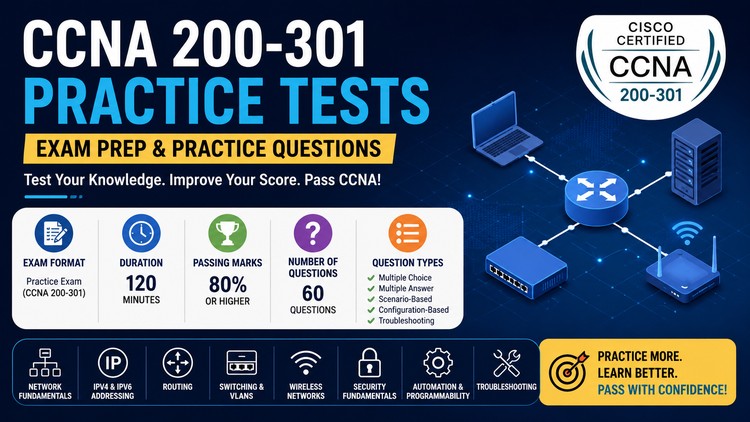
Master CCNA 200-301 with realistic practice questions on networking, subnetting, routing, switching, and troubleshooting
What You Will Learn:
- Test your knowledge of core CCNA networking concepts through realistic practice exam questions and scenarios.
- Strengthen your understanding of IPv4 addressing, subnetting, routing, switching, VLANs, and network fundamentals.
- Practice configuring and troubleshooting Cisco networks using commands, diagrams, and scenario-based CCNA questions.
- Identify knowledge gaps and improve your confidence and exam readiness for the Cisco CCNA certification exam.
Alright, let’s talk about certification prep, specifically for the Cisco CCNA 200-301. If you’re serious about forging a path in networking, this certification is your foundational cornerstone. I recently took a deep dive into ‘CCNA 200-301 Practice Tests: Exam Prep 2026 {Unofficial}’, and here’s my honest take as someone who’s been around the block a few times in tech.
Overview
Let’s be real: simply reading the official study guide cover-to-cover isn’t enough to pass the CCNA, let alone truly understand networking concepts. You can consume all the theoretical knowledge in the world, but until you’re forced to apply it under pressure, identify your blind spots, and get comfortable with the exam’s rhythm, you’re not fully prepared. That’s precisely where a good set of practice tests comes in. This particular ‘unofficial’ offering isn’t a substitute for a comprehensive course, nor does it replace the critical need for hands-on labs. Instead, it serves as a robust diagnostic tool and a crucial confidence builder. It pushes you to think critically, challenging your understanding beyond mere memorization. For anyone aiming for serious career growth in the networking domain, leveraging high-quality practice questions like these is a non-negotiable step in your certification prep journey. It’s about building muscle memory for the exam format and truly cementing those core principles.
Prerequisites
Here’s the deal: you absolutely should not jump into these practice tests cold. While they’re phenomenal for drilling concepts and identifying weaknesses, they are not a learning platform for beginners. These tests assume a solid foundational understanding of networking. Before you even think about hitting ‘start’ on the first practice exam, you should ideally have completed a substantial portion of an official CCNA study guide, gone through a reputable online course, or even have some basic real-world exposure to network devices. You should already be familiar with concepts like the OSI model, TCP/IP, basic router and switch functions, and the fundamentals of IPv4 addressing and subnetting. If you’re a true beginner, start with the core curriculum first. Think of these as the ultimate sparring partner *after* you’ve learned to throw a punch, not a boxing coach teaching you how to stand.
Skills & Tools
By diligently working through these practice tests, you’ll significantly sharpen several key job-ready skills. You’ll become much more adept at intricate IPv4 addressing and subnetting, which is a daily requirement for any network professional. Your understanding of various routing protocols (like OSPF and EIGRP) will move from theoretical to practical application within simulated scenarios. You’ll reinforce critical switching concepts, including VLANs, trunking, and STP, and solidify your grasp of network fundamentals and security basics. While these are *practice tests* and not hands-on labs, many questions present scenario-based challenges, complete with diagrams and troubleshooting outputs, compelling you to think like you’re directly interacting with industry-standard tools – the Cisco IOS command-line interface. This process inherently improves your analytical and problem-solving capabilities, pushing you from a conceptual understanding to being able to apply knowledge to realistic network configurations and troubleshooting tasks. It’s a bridge between theory and practical execution.
Career Benefits & Job Roles
Let’s not mince words: obtaining your CCNA is often the golden ticket into entry-level networking roles. Successfully mastering the content within these practice tests translates directly into being a far more competitive and capable candidate for positions such as Network Support Specialist, Junior Network Administrator, Help Desk Engineer (with a clear networking focus), or even a NOC Technician. It’s a tangible demonstration to employers that you possess the fundamental job-ready skills required to understand, configure, and troubleshoot networks effectively. Beyond merely landing that first role, the deep conceptual and practical understanding you gain from rigorous certification prep like this provides a robust launchpad for sustained career growth. It sets you up for future specialization and advancement, potentially leading to more senior roles like Network Engineer, Solutions Architect, or even specializing in cybersecurity or cloud networking. It’s an investment that pays dividends, signaling your commitment and capability to potential employers and opening doors to a dynamic career path.
Pros
- Realistic & Scenario-Based Questions: The questions are designed to mimic the actual exam’s complexity and format, featuring scenario-based questions, diagrams, and command output interpretation, which is vital for building real-world problem-solving skills.
- Effective Diagnostic Tool: These tests are excellent for identifying your specific knowledge gaps. By reviewing detailed explanations for both correct and incorrect answers, you can pinpoint areas needing further study, making your subsequent learning incredibly efficient.
- Comprehensive Topic Coverage: They hit all the critical domains of the CCNA 200-301 blueprint, including routing, switching, IP services, security fundamentals, and automation, ensuring you’re well-rounded for the exam.
- Boosts Exam Confidence: Regularly simulating the exam environment reduces test anxiety. The more familiar you become with the question types and time constraints, the more confident and prepared you’ll feel on exam day, significantly improving your overall exam readiness.
Cons
- Lacks True Hands-on Application: As practice *tests*, by their very nature, they don’t provide actual hands-on configuration or troubleshooting experience on live equipment or within a simulated lab environment. While the questions are scenario-based, they don’t replace the invaluable learning that comes from configuring devices yourself using industry-standard tools. This crucial practical component must be sought through complementary resources like Cisco Packet Tracer, GNS3, or physical lab equipment to truly develop robust job-ready skills.