Master electronics assembly standards with targeted MCQ practice for exam readiness and skill confidence
What You Will Learn:
- Congratulations on completing this IPC‑A‑610 CIS exam prep course. You have practiced essential assembly concepts, refined your problem-solving skills, and rein
- Evaluate component placement
- Apply assembly standards
- Interpret inspection criteria
Overview: Beyond the “Bible” of Electronics
Let’s be honest: if you’ve spent any time on a production floor or in a rework station, you know that the IPC‑A‑610 is essentially the “bible” of electronics assembly. But here’s the cold, hard truth—just owning the manual doesn’t mean you’re going to pass the certification prep exam. I’ve seen veteran techs with twenty years of experience get tripped up by the subtle phrasing of a multiple-choice question. That’s where this MCQ Exam Preparation Course steps in, and frankly, it’s a bit of a lifesaver for anyone aiming for that Certified IPC Specialist (CIS) badge.
This isn’t your typical dry, “read-the-slide” experience. It’s designed as a high-intensity drill sergeant for your brain. The course focuses on the mental gymnastics required to differentiate between a Class 2 “Process Indicator” and a Class 3 “Defect” under pressure. What I appreciated most was the transition from theoretical knowledge to job-ready skills. Instead of just memorizing definitions, you’re forced to look at high-resolution imagery and make a call—just like you would at an inspection station, but with the added layer of exam-style trickery that the IPC is famous for.
Prerequisites: What You Need Before You Click Start
While the course covers beginner to advanced levels of inspection criteria, you shouldn’t walk in totally green. You don’t need to be a master of the soldering iron, but a basic familiarity with electronic components (SMT vs. through-hole) is a must. Ideally, you should have access to a copy of the industry-standard tools—specifically the IPC-A-610 standard document itself—because this course is built to help you navigate that book like a pro. If you don’t know the difference between a resistor and a capacitor, spend an afternoon on YouTube first; otherwise, you’re ready to dive in.
Skills & Tools: Mastering the Standards
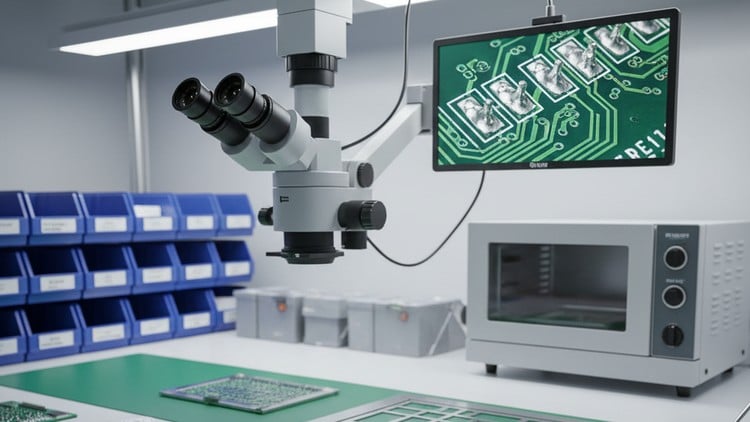
The primary “tool” here is the 610 manual, but the skill being honed is “standards navigation.” It’s one thing to know what a good solder joint looks like; it’s another to find the specific table that justifies your decision during an audit. This course pushes you to use industry-standard tools for visual inspection by simulating the visual cues you’ll see through a microscope.
- Criteria Interpretation: Mastering the “Target,” “Acceptable,” “Process Indicator,” and “Defect” hierarchy across all three classes of products.
- Pattern Recognition: Identifying obscure defects like “tombstoning,” “cold joints,” and “non-wetting” through real-world projects and visual case studies.
- Time Management: Learning how to quickly index the manual so you aren’t wasting precious minutes during the actual certification prep.
Career Benefits & Job Roles
Let’s talk money and career growth. In the world of high-reliability electronics—think aerospace, medical, and automotive—an IPC-A-610 certification is often a non-negotiable requirement. Completing this prep course puts you on the fast track for roles such as Quality Assurance Inspector, Production Lead, or Manufacturing Engineer.
By shifting from a “line worker” mindset to a “certified specialist” mindset, you’re signaling to employers that you have job-ready skills that reduce waste and prevent costly recalls. It’s a massive resume booster that turns a “worker” into a “subject matter expert.” If you’re looking to move out of entry-level assembly and into a role with more departmental influence (and a better paycheck), this is the path.
Pros: Why This Course Works
- Realistic Question Bank: The MCQs aren’t fluff. They mimic the actual wording and “distractor” answers you’ll face in the real exam, which is the best kind of certification prep.
- Visual Clarity: The use of high-quality macro photography for component placement and solder fillets makes the hands-on labs (virtual as they are) feel legitimate.
- Efficiency: It respects your time. It cuts out the noise and focuses on the high-fail areas like heel fillets, toe overlaps, and PTH (Plated Through-Hole) fill requirements.
- Bridge to Professionalism: It moves you from “I think this looks okay” to “I know this meets the standard,” which builds massive skill confidence.
Cons: The Honest Take
The only real downside is that this is strictly a certification prep tool for the MCQ portion of the exam. If you’re looking for hands-on labs where you’re actually melting solder or handling physical boards, you won’t find that here. This is a cognitive training tool, not a physical one. You’ll still need to put in the time at a real bench to get the “feel” for the components, but for the sake of passing the CIS exam, this is a minor trade-off.