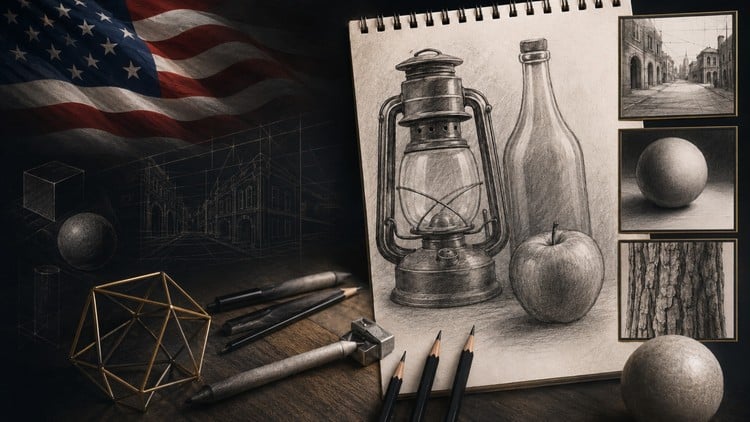
Improve pencil control, light and shadow, blending, textures, object proportions, perspective, depth, and everyday.
What You Will Learn:
- Use advanced pencil control to create cleaner lines, stronger strokes, and more confident sketches.
- Apply light, shadow, value, blending, and cast shadows to make drawings look more realistic.
- Draw smooth, rough, wood, fabric, metal, and glass textures using practical pencil techniques.
- Improve object proportions, structure, symmetry, negative space, and everyday object drawing accuracy.
Alright, let’s talk about ‘The Complete Drawing & Sketching Masterclass.’ As someone who spends their days knee-deep in code and data, the idea of picking up a pencil felt like a delightful, albeit daunting, departure. I’m all for structured learning and acquiring new skills, whether it’s mastering a new programming language or, in this case, trying to draw something that doesn’t look like it was created by a very enthusiastic toddler. So, I dove into this course with a critical eye, hoping for something more than just a vague ‘how-to.’ And honestly, it delivered quite a bit more.
Overview
From a tech professional’s perspective, this masterclass is less about becoming the next Picasso and more about building a robust, foundational skillset in visual communication. Think of it as learning the assembly language for art. It strips away the mystique of drawing and breaks it down into logical, repeatable processes. For anyone accustomed to project milestones and incremental development, this approach resonates. It’s not just about replicating what you see; it’s about understanding the underlying structure, the interplay of light, and the physical properties of objects. This isn’t just a casual doodle session; it’s a systematic build-up of techniques that empower you to tackle virtually any subject matter with confidence. I found it particularly useful for ideation and quickly sketching out concepts, which surprisingly translates well into initial UI/UX wireframing or even just clearer explanations during team whiteboarding sessions.
Prerequisites
The beauty of this course is its accessibility. You genuinely don’t need any prior experience. If you can hold a pencil and have a willingness to learn, you’re good to go. The instructors do an excellent job of starting from the absolute basics, assuming zero artistic background. This makes it an ideal entry point for complete novices who are serious about developing their drawing abilities. That said, if you’ve dabbled a bit and have some rudimentary skills, this masterclass also serves as an invaluable accelerator, helping you refine existing techniques and fill in foundational gaps. It truly provides a clear path from beginner to advanced without leaving anyone behind.
Skills & Tools
By the end of this masterclass, you’ll accumulate a solid arsenal of practical drawing skills. You’ll develop advanced pencil control, leading to cleaner lines, stronger strokes, and much more confident sketches. The course meticulously covers applying light, shadow, value, blending, and cast shadows – essential elements to make your drawings pop with realism and depth. One of the highlights is learning to render various textures, from the intricate grain of wood to the reflective sheen of metal or the soft folds of fabric, using surprisingly simple yet effective pencil techniques. Furthermore, you’ll significantly improve your understanding of object proportions, structure, symmetry, negative space, and gain remarkable accuracy in drawing everyday objects. As for tools, it’s wonderfully low-tech: a range of graphite pencils (like 2H, HB, 2B, 4B, 6B), erasers (kneaded and vinyl), a good sketchbook or drawing paper, and maybe some blending stumps or tortillons. No expensive industry-standard tools required, which is a breath of fresh air.
Career Benefits & Job Roles
While this isn’t a direct path to a software engineering role, the skills acquired here have surprising transversal utility. For tech professionals, improved visual communication is a significant plus. Think better diagramming, clearer visual explanations for complex systems, or even just enhanced presentation graphics. It fosters a keen eye for detail and spatial reasoning, which are invaluable in many technical disciplines. For those looking for a pivot or expanding their creative repertoire, this masterclass lays critical groundwork. It builds job-ready skills foundational for roles like a junior concept artist, illustrator (especially freelance), graphic designer (when combined with digital tools), or even a UI/UX designer who needs to quickly sketch ideas. The emphasis on observation and detailed rendering directly translates into the ability to create impactful real-world projects. While not a certification prep course in itself, mastering these fundamentals makes future learning in digital art much more efficient, opening doors to careers where artistic prowess meets technical execution, contributing significantly to one’s overall career growth.
Pros
- Structured & Progressive Learning: The course is incredibly well-organized, moving logically from fundamental concepts to more complex techniques. It ensures a solid understanding at each step, building a robust skill foundation.
- Hands-On Practice Focus: This isn’t just theoretical. The course is packed with practical exercises and hands-on labs that genuinely reinforce learning. You’re constantly drawing, which is the only real way to improve.
- Clear & Engaging Instruction: The instructors break down complex artistic concepts into digestible, easy-to-understand explanations. Their approach is encouraging and demystifies many aspects of drawing.
- Affordable & Accessible Tools: You don’t need a hefty investment in supplies. Standard pencils, paper, and erasers are all it takes to get started, making it incredibly accessible for anyone.
Cons
- Limited Direct Feedback: As with many self-paced online courses, the primary drawback is the lack of personalized, direct feedback on your work. While there are often community forums, it’s not the same as having an instructor pinpoint specific areas for improvement in your unique drawings. This means you need to be highly self-motivated to critically evaluate your own progress and seek out constructive criticism independently.