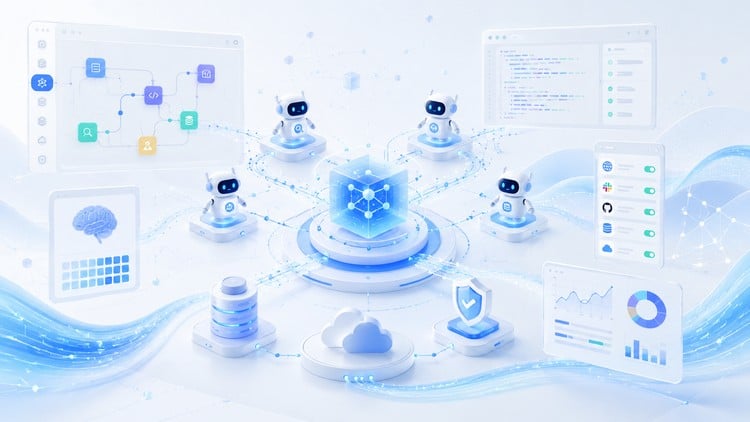
From Your First AI Agent to Production-Ready Multi-Agent Systems
What You Will Learn:
- Understand the architecture and lifecycle of modern AI agents and Agentic AI systems.
- Build AI agents that can reason, plan, use tools, call APIs, and complete multi-step tasks.
- Create agents with short-term memory, long-term memory, embeddings, and vector databases.
- Build Retrieval-Augmented Generation (RAG) applications that answer questions from documents and PDFs.
- Design autonomous research agents that search, analyze information, and generate structured reports.
- Develop multi-agent systems using Planner, Executor, Researcher, Writer, and Reviewer roles.
- Connect AI agents to APIs, databases, webhooks, files, and external business systems.
- Build interactive AI interfaces using Streamlit, FastAPI, streaming responses, and optional voice capabilities.
- Show more
Alright, let’s talk about a course that’s been making some waves in the AI space: ‘Build Autonomous AI Systems in 4 Weeks’. I’ve spent some time digging into it, and as someone who’s been around the block a few times with AI development, I wanted to give you the lowdown. This isn’t your typical marketing fluff; this is a real look at what you’ll get out of it, warts and all.
Overview
The promise here is ambitious: take you from a rudimentary AI agent to a fully-fledged, production-ready multi-agent system in just four weeks. And honestly, they come pretty close to delivering on that. What really sets this course apart is its laser focus on the practicalities of building agentic AI. We’re talking about creating systems that don’t just spit out answers, but can actively reason, plan their actions, leverage external tools (think API calls and webhooks), and manage information intelligently through various forms of memory. The inclusion of Retrieval-Augmented Generation (RAG) and the development of autonomous research agents are particularly strong points, as these are directly applicable to solving complex business problems. Building multi-agent systems with distinct roles like Planner, Executor, and Researcher feels like a direct pathway to understanding how sophisticated AI orchestrations work. The emphasis on connecting these agents to real-world systems – databases, APIs, even legacy business systems – is a massive plus for anyone looking to bridge the gap between theoretical AI and practical application.
Prerequisites
This is where you need to be honest with yourself. While the course aims to be comprehensive, it’s definitely not a ‘learn to code’ experience. You’ll need a solid foundation in Python. I’m talking comfortable with data structures, object-oriented programming, and ideally some experience with libraries like requests for API interactions. A basic understanding of AI concepts, like what a neural network is and the general idea of machine learning, will also be extremely helpful. If you’re completely new to programming, you might find yourself struggling to keep up. It’s geared more towards individuals who can hit the ground running with coding and want to specialize in AI systems.
Skills & Tools
By the end of this course, you’ll be well-versed in a suite of cutting-edge tools and techniques. The core of the technical skillset revolves around building AI agents using popular frameworks, likely leveraging libraries like LangChain or similar abstractions. You’ll get hands-on experience with vector databases (think Pinecone, ChromaDB, or FAISS), which are crucial for efficient information retrieval. Implementing RAG pipelines will become second nature. For building interactive interfaces, you’ll be working with Streamlit and FastAPI, enabling you to create dynamic and responsive applications. The course also touches on streaming responses and, optionally, voice integration, which are becoming increasingly important for user experience. These are all highly sought-after industry-standard tools that will significantly boost your resume.
Career Benefits & Job Roles
This is where the rubber meets the road. The skills you acquire here are directly transferable to a number of high-demand roles. Think AI Engineer, Machine Learning Engineer specializing in AI agents, Prompt Engineer (with a much deeper technical understanding), and even roles in AI Product Management where you can speak the language of building intelligent systems. The practical, job-ready skills you’ll gain from building real-world projects will make you a very attractive candidate. It’s definitely a course that can contribute to your career growth, especially if you’re looking to pivot into the rapidly expanding field of autonomous AI. It can also serve as excellent certification prep for more advanced specializations.
Pros
- Practical, Project-Based Learning: The course excels at translating complex concepts into actionable steps, allowing you to build functional AI systems from the ground up.
- Comprehensive Coverage of Agentic AI: It covers the full spectrum, from individual agent capabilities (reasoning, planning, memory) to sophisticated multi-agent architectures.
- Focus on Real-World Integration: The emphasis on connecting agents to external systems and building interactive interfaces makes the learning highly relevant to industry needs.
- Up-to-Date Technologies: You’ll be working with modern tools and frameworks that are actively used in the AI industry.
Cons
My main critique, and it’s an honest one, is that the 4-week timeline is extremely aggressive. While they do a commendable job of pacing, you will be working at a sprint. To truly absorb and master the material, especially if you’re not already deeply entrenched in Python and AI, you’ll likely need to dedicate significant extra time outside of the official course hours for practice and deeper exploration. It’s intense, and while achievable for some, it might feel like a mad dash for others. Some of the more nuanced aspects of deployment and scaling might also feel a bit glossed over due to the time constraints.