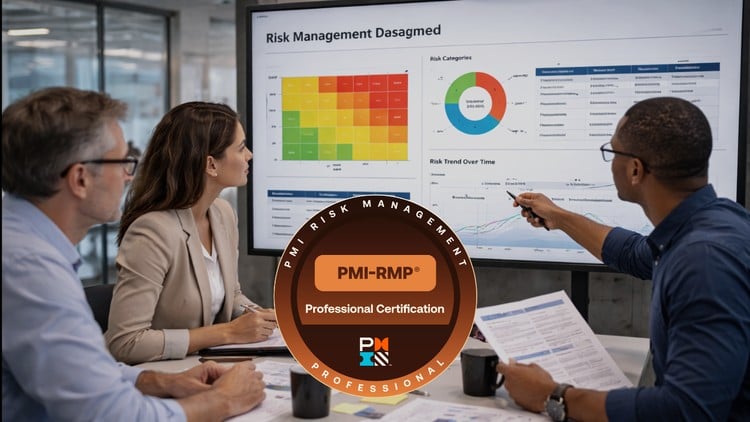
Pass the PMI-RMP exam on your first attempt with real-world frameworks, risk diagrams, and exam-focused strategies
What You Will Learn:
- Apply the full risk management lifecycle across projects
- Identify risks using professional techniques and frameworks
- Perform qualitative risk analysis using probability and impact
- Perform quantitative analysis using EMV and simulations
- Develop effective risk response strategies for threats and opportunities
- Monitor and control risks using practical tools and dashboards
- Understand risk appetite, threshold, and organizational context
- Answer PMI-RMP situational exam questions with confidence
RMP® Exam Prep : Professional Risk Manager (Videos + Exams) – An Experienced Pro’s Take
Alright, let’s talk about the PMI-RMP® (Risk Management Professional) certification. It’s one of those that signals you’re not just dabbling in risk management; you understand the *process*, the *why*, and the *how* at a strategic level. I recently dived into the ‘RMP® Exam Prep : Professional Risk Manager (Videos + Exams)’ course, and as someone who’s been around the tech block a few times, I wanted to give you the lowdown – the good, the bad, and the truly useful.
Overview
Forget the dry, academic approach. This course gets straight to the point: passing the RMP exam and, more importantly, equipping you with the practical chops to actually *do* risk management in the trenches. What stood out immediately was the emphasis on real-world frameworks and risk diagrams. They don’t just tell you what to do; they show you how it looks on paper (or screen). The video lectures are engaging, breaking down complex concepts like EMV and simulations into digestible chunks. It’s a solid blend of theoretical understanding and actionable application, designed to make you exam-ready and, hopefully, job-ready. The inclusion of practice exams is crucial; it’s the closest you’ll get to the real deal before sitting for the actual certification.
Prerequisites
The course assumes you have a foundational understanding of project management principles. While not explicitly stated as a prerequisite, having some familiarity with the PMBOK® Guide (or equivalent project management knowledge base) will definitely smooth the learning curve. For those new to risk management concepts, it might be a bit of a steep climb, but the course does a decent job of introducing them. Ideally, you’ve worked on some real-world projects where risk was a factor, even if it wasn’t formally managed.
Skills & Tools
This prep course is designed to impart several key skills and familiarity with industry-standard approaches:
- Risk Identification Techniques: Going beyond brainstorming to structured methods like checklists, assumptions analysis, and SWOT.
- Qualitative & Quantitative Analysis: Mastering probability/impact matrices, EMV calculations, and understanding the basics of Monte Carlo simulations.
- Risk Response Planning: Developing strategies for threats (avoid, mitigate, transfer, accept) and opportunities (exploit, enhance, share, accept).
- Risk Monitoring & Control: Using tools and dashboards for tracking risks and implementing contingency plans.
- Organizational Context: Grasping concepts like risk appetite, threshold, and tolerance, and how they influence decision-making.
While the course focuses on the *concepts* and *frameworks*, it implicitly prepares you for using industry-standard tools that support these processes, even if it doesn’t offer hands-on labs with specific software.
Career Benefits & Job Roles
Earning the PMI-RMP certification is a significant step for career growth. It positions you as an expert in risk management, a skill highly valued across all industries. This can lead to roles like:
- Risk Manager
- Project Risk Analyst
- Senior Project Manager (with risk specialization)
- Program Manager
- Consultant
It’s a certification that can differentiate you in a competitive job market, especially for complex or high-stakes real-world projects.
Pros
- Exam-Focused & Practical: The course nails the balance between theoretical knowledge required for the exam and practical application. The emphasis on real-world frameworks and situational questions is invaluable.
- Clear & Concise Videos: The video lectures are well-structured and easy to follow, breaking down complex topics without unnecessary jargon.
- Comprehensive Practice Exams: The simulated exams are excellent for assessing your readiness and identifying weak areas. They closely mirror the style and difficulty of the actual PMI-RMP exam.
Cons
The biggest drawback for me is the lack of deeper dives into specific risk management software tools. While the course teaches the *principles* brilliantly, it doesn’t offer the equivalent of hands-on labs with tools like specialized risk registers, advanced simulation software, or enterprise risk management platforms. This means you’ll likely need to supplement your learning with practical experience or further self-study if you want to be proficient with specific industry-standard tools right out of the gate.
Overall, if your goal is to conquer the PMI-RMP exam and build a strong foundation in risk management, this course is a highly effective choice. Just be prepared to roll up your sleeves and get some practical software experience elsewhere.